Japanese Massacre On
pp. 83-86 · Read in the full issue

Only One Man Survived
Ocean Island In 1945
At a War Crimes Court in Rabaul on April 27, 1946 two Japanese officers were sentenced to death for the massacre of 200 Gilbertese labourers on Ocean Island several days after Japan had surrendered in World War 11.
THE two officers, Lieutenant- Commander Nahcomi Suzuki and his quartermaster, Lieutenant Yoshio Nara, admitted that they knew that Japan had surrendered, and said they had deliberately massacred the Islanders because they wanted to “inflict damage on the Allies”.
The chief witness against the Japanese was the sole survivor of
the massacre, Kabunare, a native of Nikunau Island in the Gilberts.
Almost miraculously, Kabunare escaped the bullets and bayonets of a Japanese firing squad, and after falling over a cliff, he hid in a hole tor more than three months—until meeting two Gilbertese on December 2, 1945.
Kabunare was then interrogated by Australian troops who had landed on the island on September 30, and the amazing story he had to tell was largely responsible for Lieutenant-Commander Suzuki and Lieutenant Nara being sent to the gallows.
Fisherman
An account of the Japanese officers trial was published in PIM for May, 1946, and was recalled in the Yesterday” column in May this year (p. 89).
By a coincidence, the official transcript of Kabunare’s interrogation was also published recently in the Nauru roneoed newspaper, Pinnacle Post. It is now republished here almost verbatim because of its extraordinary interest as a human document.
Kabunare said that he was a native of Nikunau Island and was 28 years old. He had signed on with the British Phosphate Com mission about 18 months before the Japanese occupied Ocean Island.
“During the occupation,” he said, I was employed as a fisherman. We fished from early in the morning until about 3 p.m., usually two men Pf r canoe. The Japanese collected all the fish, but only occasionally gave us a little for our own use. If we did not catch any fish, we were slapped on the face.
“The names of the other fisher men were Eric, Mitire, Tuweri, Teboitabut, Baitau, Uriam, Buariki, Angkam, Aba, Banei and Maori.
We all lived in one European house at Uma.
“One evening Osakiso, the
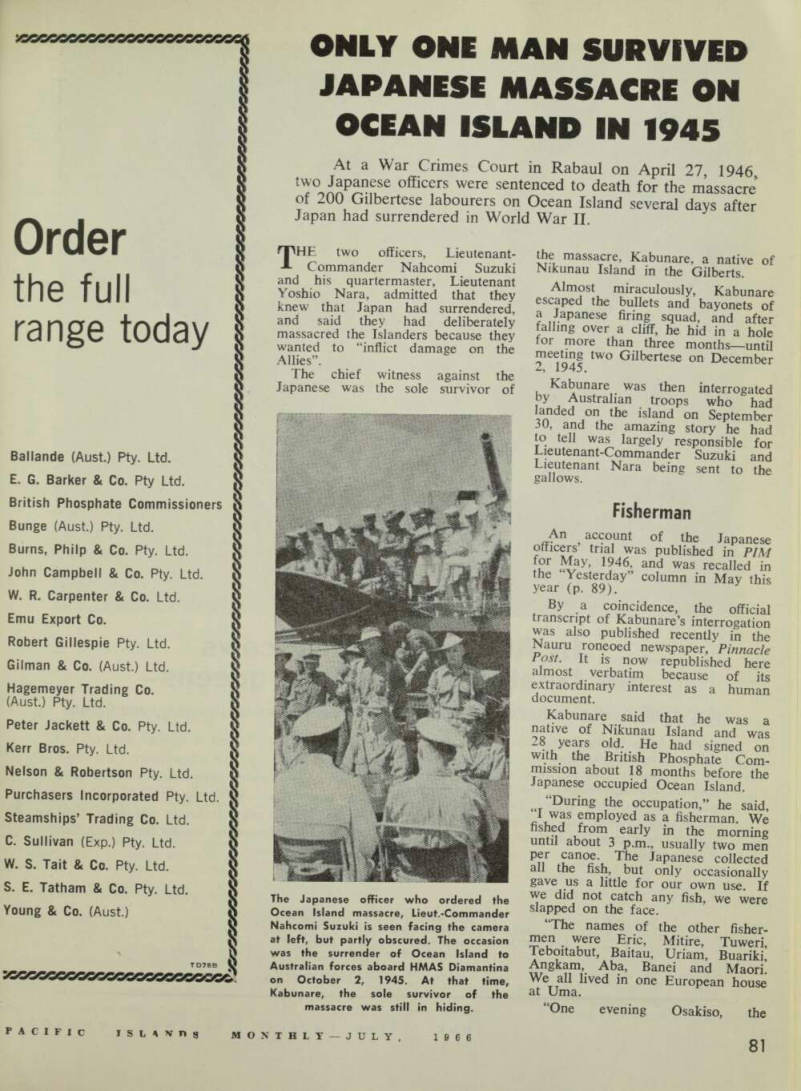
The Japanese officer who ordered the Ocean Island massacre, Lieut.-Commander Nahcomi Suzuki is seen facing the camera at left, but partly obscured. The occasion was the surrender of Ocean Island to Australian forces aboard HMAS Diamantina on October 2, 1945. At that time, Kabunare, the sole survivor of the massacre was still in hiding.
Japanese who was in charge of the fishermen, came into our house and told us that next morning we were to come back early from fishing.
“Some time after 9 a.m. next day, Osakiso shouted to us to come down and gather beside the road to the billiard room. When we got there we found all the other boys on the island there. There would have been over 100. We all paraded in five lines along the road. Sukaiso, the No. 3 commander, spoke to us through Osakiso, the interpreter. He stood upon the verandah with five other Japanese. He told us that the war was over, but that we must still work for a while, and then the Japanese would be going away and leaving us here.
Too Scared
“We were too scared to show our happiness, so just bowed our heads and went to our houses. Then we laughed and talked of the good news in our house.
“Next morning Maori and I came back very early from our fishing, about 8 a.m., because we had a lot of fish. When we arrived back all the natives and a lot of Japanese soldiers were gathered in the same place as we were gathered the previous day. Osakiso called us down to join the parade.
“We were divided into new sections. I was in the fifth group of eight men. We were marched away with one soldier in charge.
“When we arrived at the police lines on our way to our destination, we were told to sit down in a line and face the east while the soldier in charge of us asked each one of us in turn how old we were and
wrote it in his book. When he had nearly finished, an officer came up with another soldier from behind us.
The officer drew his sword and revolver, and the soldier drew a revolver, too, and both pointed them at us.
“They did not speak to us but called out some more soldiers.
Eight soldiers came out with guns and fixed bayonets. Each soldier stood in front of one man with the bayonet pointing at his stomach.
“The soldier who had led us up then tied each man’s hands with string from his pocket. My hands were tied very tight.
“A long end was left loose after each man’s hands were tied which the soldiers gathered up so we could not run away. Then we walked down the track across the road and on down to the cliffs below Tabiang village.
“We were told to line up on the edge of the cliff and squat down close together. Then our eyes were tied up with cloth.
“I was the second man to have my eyes tied up. Then I could hear movements behind and felt as though the soldiers were behind us.
"Ready to Die"
“Falailiva was on my left. He said to me, ‘Are you ready?’ and I replied, ‘Yes, I am ready to die’.
Then Falailiva asked, ‘You remember God?’ and I replied, ‘Yes, I remember.’
“Then everything was quiet for a moment. Then I fell over the cliff.
I did not try to, but just fell.
Almost at the same time I heard a scream and someone fell on top of me. I think it was Falailiva.
“I heard others fall but no more screams. Then I heard a lot of shots fired. Falailiva was still on top of me and some of the bullets I could hear were close to me.
“The water kept breaking over us but I could breathe each time it receded.
“After a while I bit Falailiva on the shoulder to see if he was still alive. He did not cry out so I knew he was dead.
“I stayed about an hour in the water. I could see a little out of my left eye past the blindfold so I went over to a piece of sharp rock in the cliff where I could cut the binding from my wrists. Then I removed the blindfold.
“Then I went around all the other bodies to see if any were alive.
They were all dead and I looked at each man’s face. There was a lot of blood about.
“After I found they were all dead.
I looked for a place to hide. T found a cave and I stayed there all night.
“The next morning I saw some of the bodies floating outside the cave.
About mid-day I heard a plane fly ing low for about half an hour. I did not see it, but stayed in the cave.
“Then I saw some Japanese soldiers walking along the reef.
Some came by my cave. Two of them dragged a body out to the reef then came back and dragged another body out to where there was deep water.
“I could not see them all the time and think they made other trips for the other bodies. I saw two canoes come to pick up the bodies from the soldiers and tow them out to a launch which was further out.
Then the launch went out to sea.
“I stayed in the cave that night
and the next day. That evening abouu 8 o’clock I left the cave to searcH: for young coconuts and to find a new hiding place inland.
“While I was up the tree, Japanese came along. But I stayeoi hidden until they had gone. Then I went to look for a hiding place* and found a hole above the police lines and hid there.
“I stayed in hiding in this hold until the day I met two Gilbertese on December 2, 1945 (100 day* later).
“I used to go out at night an»r gather young coconuts, old coco nuts and water.”
Kabunare gave a simple explanas tion for not coming forward until more than two months after the Ausi tralian troops occupied Ocean Island* He said that one day he climber a tree and saw many ships at thd anchorage, but thought they wen Japanese ships. He also saw a Unio:c Jack flying from the staff in thri police lines but thought it was another Japanese trick.
"Lot of Bugles"
“I heard the bugle every day too r c he said, “but the Japanese had a loi of bugles.”
Describing his meeting with thJ Gilbertese on December 2, 19411 Kabunare said: “One day I heard the tinkle o bottles and saw two men. The om carrying the bottles was wearing lava-lava and I thought he was Gilbertese, but the other I though’ was a Japanese because he wearing Japanese clothing.
“After they passed I followed then" silently. When I got close up behim them I was sure they were Gilbertese so I greeted them: ‘Kam na maurh “They seemed frightened of m«n [They thought he was a Japanese because his skin was very pals from hiding away from the sun, ami he had shaved his head with splinteis of broken glass to occupy himselfil “They asked where I had coim from. I told them I had here all the time and I showo\ them.
“Then I changed from my napkini into my lava-lava which I has: hidden in the hole. I thanked tMf hole for saving my life and then came down to the police lines ami Teauoki took me to the Distrih Commissioner.”
Footnote: According to Pinnace Post, Kabunare is now living o Nikunau. He is the father of Tirionc who, until last year, was employey on Nauru as a houseboy and ; assistant in the trade store arts messroom.