Fiji's Waidina
pp. 71-73 · Read in the full issue
Spotlight Is On Fiji's Waidina Banana Growers
From Beryl Cates, in Suva Interest in Fiji agriculture has focused on banana growers along the Waidina River, who are showing indications of becoming one of the colony’s major suppliers of bananas for export.
WAIDINA growers made their first organised export contri bution only a few months ago, begin ning with an initial shipment of a few hundred cases of what was un mistakably plantation grade fruit.
Increases have been marked with each subsequent shipment. The most recent shipment was 1,500 cases, again of high grade fruit, and by the end of July it is hoped no less than 4,000 cases will have been sent. (Lomaivuna, Fiji’s largest land re settlement scheme, sent 1,415 cases on March 23, 1,061 on April 4).
The production is the work of 400 Fijians, who labour and market together as a co-operative association bearing the descriptive, if somewhat cumbersome, title of The Waidina Co-operative Banana Marketing and Transport Association Ltd.
Banana growing along the Waidina is almost as old as the river itself.
Growers for years made sporadic at tempts as individuals to export, and as far back as 1956 they began their series of efforts to form themselves into a workable co-operative, or at least to have some satisfactory out side group undertake their market ing for them.
The Background
In 1956 growers in the Naqali area along the Waidina formed their own organisation and obtained a licence to export, but proceeded little further as a group and soon reverted to individual effort.
In 1958 three more producer organisations, Ovalau, Nabukaluka and Namosi, commenced operations under the aegis of the Fijian Banana Ventures. However, most producers continued selling their fruit to the Dominion Fruit Co. and the Fijian Co-operative Marketing Assn. Co.
Ltd. until 1960, when the Banana Marketing Board was established.
The board’s establishment marked the decline of the Dominion Fruit Co. and, at the same time, the Fijian Co-operative Marketing Assn. Co.
Ltd. while the Fijian Banana Ventures demonstrated its failure to provide satisfactory services to pro ducers in the area.
Individual village groups began applying for licences to export and in 1962 10 producer marketing organisations in the central and lower Waidina held licences.
Initially the Department of Agri culture kept a watchful eye on the groups’ progress, assisting in the organisation of packing and trans porting of fruit grown by members and also that grown communally in the villages.
More Troubles
Because of staff shortages, the department was unable to continue its supervision, and the same reason prevented the Fiji Government’s Department of Co-operatives ex tending its activities to include the groups of banana growers.
Malpractices in the handling of
the groups’ finances, and insufficient utilisation of resources, resulted in the net return to members per case of packed bananas dropping as low as 8/-.
In 1963 Lomai, Nabukaluka and Nailavuni became registered co operatives and came under the im mediate surveillance of the Govern ment Co-operatives Department, a kind of harassed type of fairy god mother to all Fiji’s organisations, societies and co-operatives.
Unsatisfactory Practices
The Co-operatives Departmennt rationalised the supply of cases, wire, nails, etc; generally put the associa tion’s finances in order, and after the 1965 hurricane obtained a loan for its member groups from the Agricultural and Industrial Loans Board.
Several unsatisfactory practices were revealed in the process of re organisation. One was an arrange ment with a company which pro vided growers with wire-tying machines for £3O deposit, plus £4 per annum rental on the proviso that
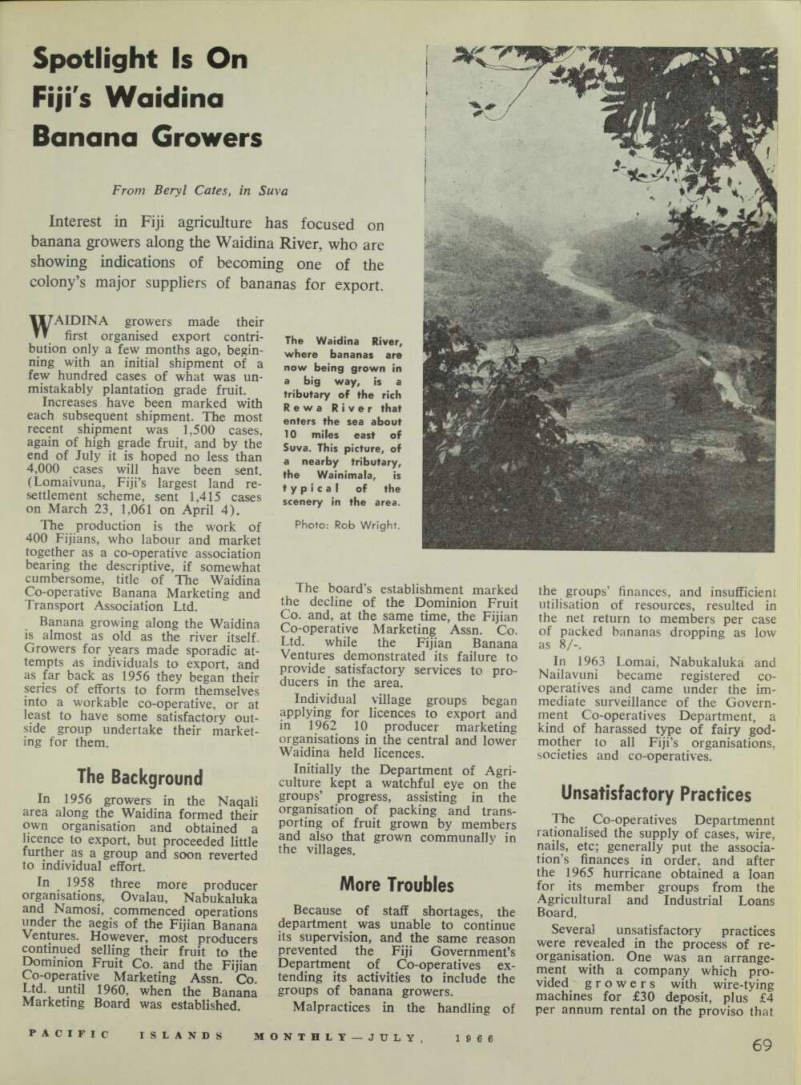
The Waidina River, where bananas are now being grown in a big way, is a tributary of the rich Rewa River that enters the sea about 10 miles east of Suva. This picture, of a nearby tributary, the Wainimala, is typical of the scenery in the area.
Photo: Rob Wright.
all wire used be purchased from the same firm at £5 per 32 lb coil.
The Suva Co-operative Association quickly brought in wire-tying machines for the growers, selling them outright for £32 and allowing the purchase to procure any type of wire desired at £3/10/- per 32 lb coil.
Returns to growers increased, rising first to 14/6 then to 17/- per case, while the contract price re mained between 23/- and 25/-.
Inevitably other growers along the Waidina became registered societies, and in 1964 the Waidina Banana Marketing and Transport Association Ltd. was formed to handle bulk sup plies of cases and other requisites and to organise co-ordinated trans port.
Until 1965 farmers operated within the co-operative, working their own individual holdings close to villages, but when the entire area was flattened in the 1965 hurricane, the Co-operatives Department with the Agriculture Department re organised the area, setting the crops out in plantations above flood level.
Soil surveys determined best areas for cultivation under the supervision of the Department of Agriculture, and the new co-operative, under the Co-operatives Department’s guidance, brought in bulk fertilisers, misting oils and so on.
All spraying is done by organised teams under Department of Agricul ture guidance, while each grower is made responsible for one acre of plantings.
The one-person-one-acre system is experimental, and area per person will be increased according to growers’ improvement in the know ledge and skill.
To date a trial amount of 8/9d per case is deducted from the growers’ odtput—representing loan repayment and insurance against hurricane loss.