Life Has Its Problems—
pp. 47-49 · Read in the full issue

Even In The G.E.I.C.
From a Tarawa correspondent Two years ago this month, Heron aircraft of Fiji Airways began an air service between Fiji and the islands of Funafuti and Tarawa in the far-flung and little-known Gilbert and Ellice Islands Colony.
THIS air service has brought an end to the Colony’s traditional isolation from the rest of the world, and it is probably no coincidence that there has been a slight stirring of nationalism in the Colony since then, and one or two tentative steps towards self-government.
However, the Colony’s progress towards self-government is not likely to gain much momentum until the Administration is able to get and retain senior overseas civil servants to help intensify development.
The Resident Commissioner, Mr.
V. J Andersen, told the Colony’s Advisory Council last year that the difficulty in getting and retaining such officers was both depressing and frightening.
But my view is that the right type of men would not be at all difficult to attract if the Government made an effort to promote the Colony’s image.
Wholesale Society
How many people, after all, have ever heard of the Gilbert and Ellice Islands Colony? And of those who have, how many could even guess where it is?
That it is possible to recruit the right sort of staff, and in quantity, has just been amply proven by the Wholesale Society, which buys copra from and sells wholesale goods to the various native-run co-operative societies in the group.
In late 1965, the Wholesale Society, which has its headquarters on Betio Islet, Tarawa, recruited a new manager, who, on arrival, quickly realised that what he needed most were half a dozen expatriates to departmentalise the fairly complex operations of the society.
In the space of only four weeks, a suitable recruitment programme was initiated, and applicants were interviewed and selected. In the fol lowing six weeks, the six new staff men arrived—evenly spaced out so that their reception could be worthy of them, and of the society.
The new recruits are all between
25 and 35 years old, well-qualified and enthusiastic.
I am reliably informed that they were chosen from more than 80 ap plicants, which makes it clear that there is no shortage of people who would like to come here, even allow ing for the “romantics”.
Meanwhile, the Government has taken months to recruit two or three men in the 50 to 60 age group—good men very likely, but probably not the most suitable for the conditions.
If the Colony Government sought staff in Australia, it, too, could no doubt get the men it needs. But the Government is heavily laced with New Zealand personnel and continues to look steadfastly to the United Kingdom for staff, while apparently turning its back on the tremendous potential lying close to hand in Aus tralia.
On the other hand, the Govern ment has been fortunate in acquiring a number of officers from former British colonies in Africa who are a decided asset to the Colony.
They seem to bring a much greater sense of purpose to their tasks and are intolerant of the delays and equivocations which seem to beset the entrenched staff.
Perhaps their experiences with the emergent nations of Africa has shown them that it is possible to develop native peoples to the point where they can and do take over the run ning of their own government— something which I am convinced no one in this Colony at present believes possible of attainment.
No Racial Prejudice
Although it is sometimes said that British officers who serve in Africa are inclined to be racially intolerant, I am pleased to say that I have never
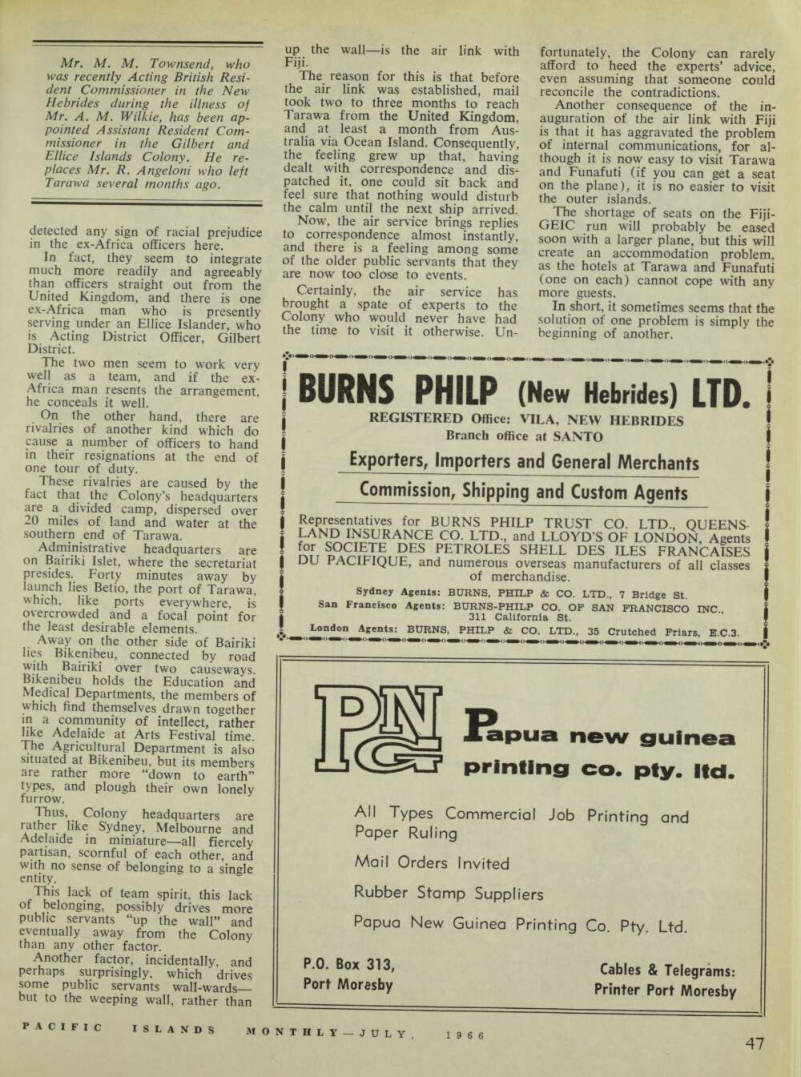
Betio, the port of Tarawa, is overcrowded and a focal point for the least desirable elements on the atoll, according to the author of this article. The flag-bedecked ship is the Wholesale Society's ship "Moana Raoi".
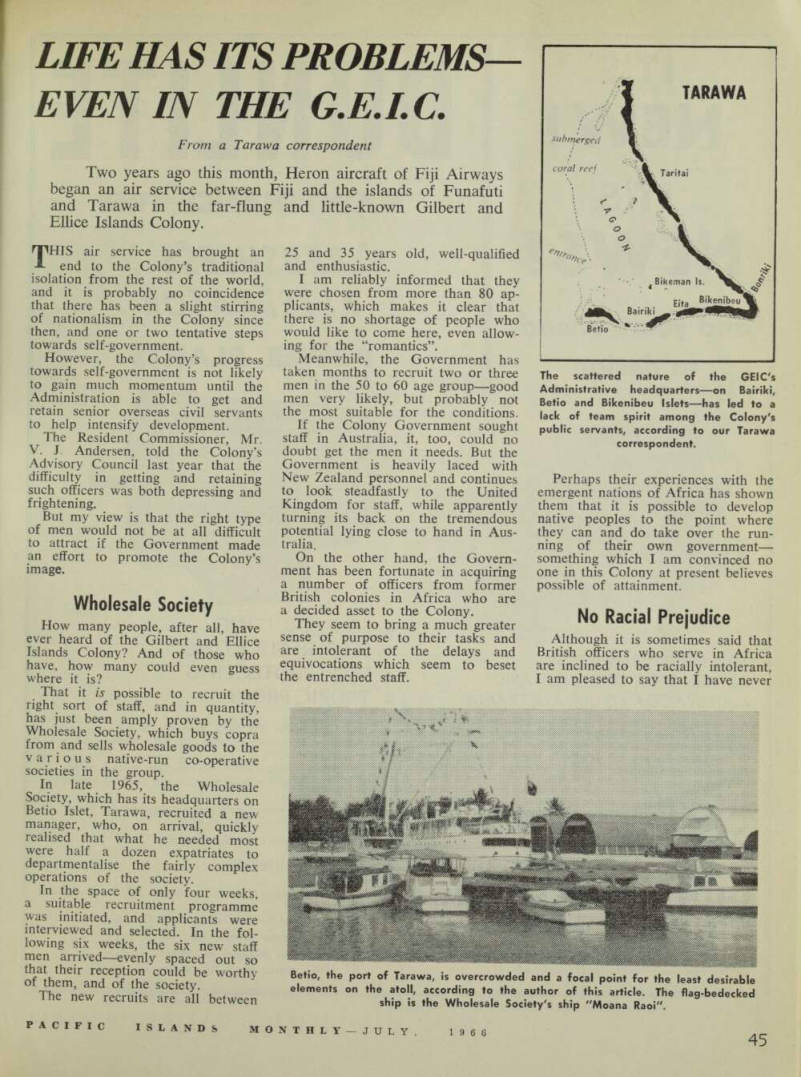
The scattered nature of the GEIC's Administrative headquarters—on Bairiki, Betio and Bikenibeu Islets—has led to a lack of team spirit among the Colony's public servants, according to our Tarawa correspondent.
Mr. M. M. Townsend, who was recently Acting British Resi dent Commissioner in the New Hebrides during the illness of Mr. A. M. Wilkie, has been ap pointed Assistant Resident Com missioner in the Gilbert and Ellice Islands Colony. He re places Mr. R. Angeloni who left Tarawa several months ago.
detected any sign of racial prejudice in the ex-Africa officers here.
In fact, they seem to integrate much more readily and agreeably than officers straight out from the United Kingdom, and there is one ex-Africa man who is presently serving under an Ellice Islander, who is Acting District Officer, Gilbert District.
The two men seem to work very well as a team, and if the ex- Africa man resents the arrangement, he conceals it well.
On the other hand, there are rivalries of another kind which do cause a number of officers to hand in their resignations at the end of one tour of duty.
These rivalries are caused by the fact that the Colony’s headquarters are a divided camp, dispersed over 20 miles of land and water at the southern end of Tarawa.
Administrative headquarters are on Bairiki Islet, where the secretariat presides. Forty minutes away by launch lies Betio, the port of Tarawa, which, like ports everywhere, is overcrowded and a focal point for the least desirable elements.
Away on the other side of Bairiki lies Bikenibeu, connected by road with Bairiki over two causeways.
Bikenibeu holds the Education and Medical Departments, the members of which find themselves drawn together in a community of intellect, rather like Adelaide at Arts Festival time.
The Agricultural Department is also situated at Bikenibeu, but its members are rather more “down to earth” types, and plough their own lonely furrow.
Thus, Colony headquarters are rather like S'ydney, Melbourne and Adelaide in miniature—all fiercely partisan, scornful of each other, and with no sense of belonging to a single entity.
This lack of team spirit, this lack of belonging, possibly drives more public servants “up the wall” and eventually away from the Colony than any other factor.
Another factor, incidentally, and perhaps surprisingly, which drives some public servants wall-wards but to the weeping wall, rather than
U P, the wall—is the air link with
Fiji; . .
The reason for this is that before the air link was established, mail took two to three months to reach Tarawa from the United Kingdom, and at least a month from Australia via Ocean Island. Consequently, the feeling grew up that, having dealt with correspondence and dispatched it, one could sit back and feel sure that nothing would disturb the calm until the next ship arrived.
Now, the air service brings replies to correspondence almost instantly, and there is a feeling among some l lh '* r pu , bhc f rvants . that *ey are now too close to events.
Certainly, the air service has brought a spate of experts to the Colony who would never have had the time to visit it otherwise. Un-
fortunately, the Colony can rarely afford to heed the experts’ advice. even assuming that someone could reconcile the contradictions, Another consequence of the in auguration of the air link with Fiji is that it has aggravated the problem of internal communications, for al though it is now easy to visit Tarawa and Funafuti (if you can get a seat on the plane), it is no easier to visit the outer islands, The shortage of seats on the Fiji- GEIC run will probably be eased soon with a larger plane, but this will create an accommodation problem, as the hotels at Tarawa and Funafuti (one on each) cannot cope wi(h more guests, In short, it sometimes seems that the solution of one problem is simply the beginning of another.