New Guinea Mining Laws
pp. 33-35 · Read in the full issue

Get A New Look
From Judy Tudor in Port Moresby The most important legislation dealt with at the June meet ing of the Papua-New Guinea House of Assembly was that affecting the mining laws of the country. Two bills amending the mining laws finally made the grade in the early hours of June 14—but only just, and with a couple of amendments.
THE present mining ordinance for Papua was based on Australian conditions at the end of last century and that for New Guinea was intro duced in the early 1920’5. Both are out of date for modern large-scale operations and the long-term reason for the new legislation is to interest big overseas mining companies and at the same time benefit the territory.
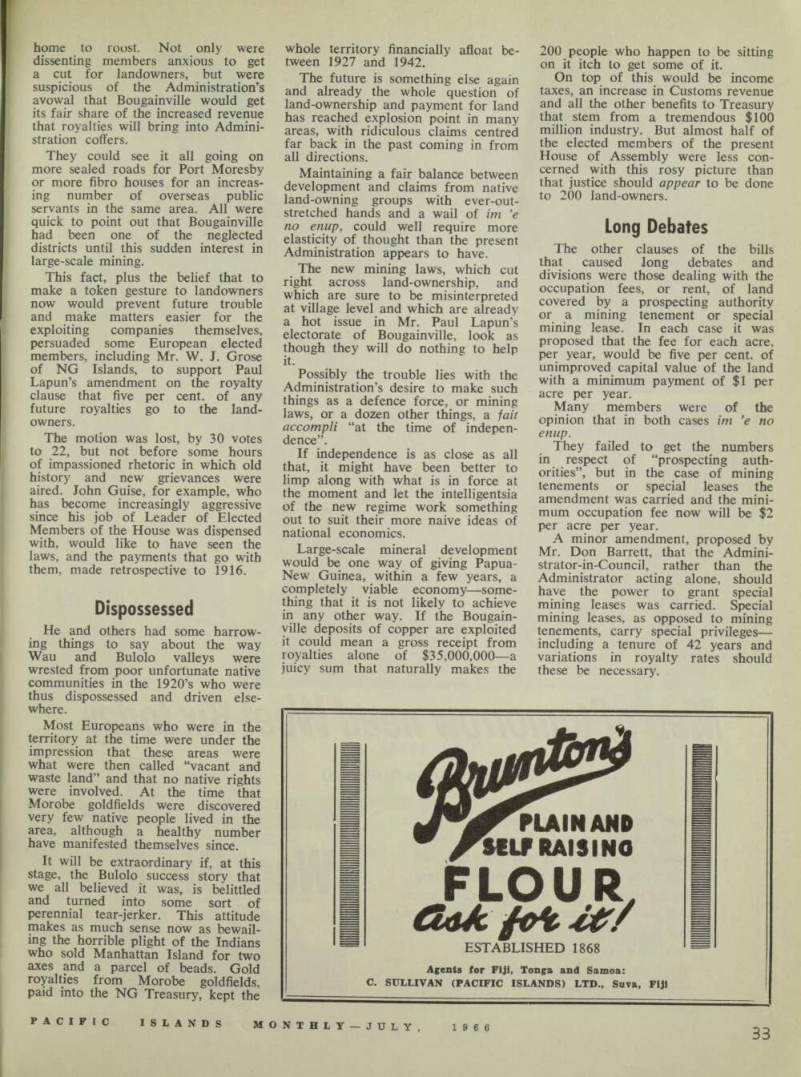
A more immediate need for the new legislation, however, is the interest of Conzinc-Riotinto in prov ing large deposits of copper near Kieta on Bougainville and the wish of the local Bougainville people to get a cut of it through royalties (see PIM, Mar., p. 19).
Under present legislation, owner ship of all minerals rests with the Administration and not with the owners of the surface land. It is held that royalties paid on minerals mined should go into revenue for the good of all the people of the territory and not for the individual enrich ment of a comparative few.
The new legislation reaffirms and restates this view but it makes pro vision for the payment of compensa-
tion to owners of the land and for an annual occupation fee, or rent, to be paid to them also, at a rate of five per cent, of the unimproved capital value, with a minimum rate of $1 per acre per year.
In the case of prospecting areas over which titles are proposed for up to 10,000 square miles and where occupation is usually temporary, the degree of occupation for payment of “occupation fee” will be assessed by the mining warden.
The new legislation seems designed more for the huge operator who is not usually looking for gold but for other types of minerals, including copper, tin, nickel, etc.
The essential difference between the new and the old legislation is the role of the owner of the surface ground. Most old legislation was based on the idea that the holder of a miner’s right could prospect anywhere.
Compensation
The miner’s right will, under the new set-up, give right of entry only to Crown land—which is a very small proportion of the whole of the territory. A permit must first be obtained from a mining warden be fore entering other land.
Under the old ordinance com pensation was payable to owners of native land only when it was owned and occupied. The proposed legisla tion makes compensation payable on all land which has an owner, whether it is occupied or not.
Presumably anyone or any group that can prove ownership, even if it is only after delving back into ancient history, will be entitled to the annual occupation fee as well.
Although the Director of Lands, Surveys and Mines, Mr. Grove, in introducing the bills stressed that the amending legislation was (a) to improve the status of native-owned land in relation to the mining legislation; (b) provide prospecting titles more suited to the technology and needs of a modern mining industry; (c) provide additional
classes of mining leases designed to facilitate large-scale mining opera tions; and (d) to restate in more suitable and more definite terms the principle of State-ownership of minerals, it was (d) that held the key to the six-hours long tussle in the House of Assembly.
Although the bills concerned minerals and mining in general, now and in the future, most of the heat was generated by the fact of Conzinc Riotinto’s interest in Bougainville copper development, and the interest in a cut of any future profits that might accrue to (a) the 200-odd people who happen to own the surface land and (b) the people of Bougainville as a whole.
The official members nailed their colours to the mast over the principle that the minerals in the ground do not belong to whoever can stake a claim to the land immediately over the top of it—which in P-NG can sometimes be a very tenuous claim— but to all the people of the terri tory.
Fair Deal
The principle that mineral wealth belongs to the Government, is the law in Australia and in most other countries, but not including the United States. But this fact cut little ice with most of the native members of the House, and a large section of them were just as determined as the Administration to fight for a principle—this time the principle that Bougainville and/or the landowners must get a fair deal.
This fight was, in a way, one of the Administration chickens coming
Paul Lapun, representative for Bougain ville in the Aseembly.
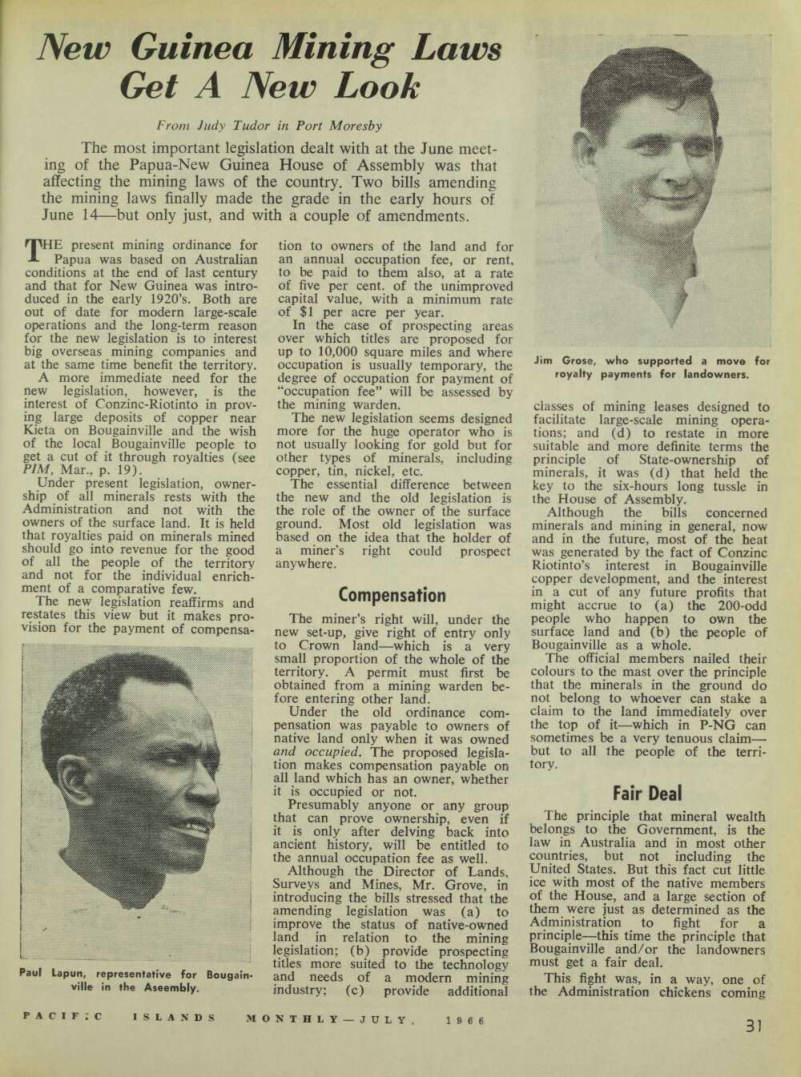
Jim Grose, who supported a move for royalty payments for landowners.
home to roost. Not only were dissenting members anxious to get a cut for landowners, but were suspicious of the Administration’s avowal that Bougainville would get its fair share of the increased revenue that royalties will bring into Admini stration coffers.
They could see it all going on more sealed roads for Port Moresby or more fibro houses for an increas ing number of overseas public servants in the same area. All were quick to point out that Bougainville had been one of the neglected districts until this sudden interest in large-scale mining.
This fact, plus the belief that to make a token gesture to landowners now would prevent future trouble and make matters easier for the exploiting companies themselves, persuaded some European elected members, including Mr. W. J. Grose of NG Islands, to support Paul Lapun’s amendment on the royalty clause that five per cent, of any future royalties go to the land owners.
The motion was lost, by 30 votes to 22, but not before some hours of impassioned rhetoric in which old history and new grievances were aired. John Guise, for example, who has become increasingly aggressive since his job of Leader of Elected Members of the House was dispensed with, would like to have seen the laws, and the payments that go with them, made retrospective to 1916.
Dispossessed
He and others had some harrow ing things to say about the way Wau and Bulolo valleys were wrested from poor unfortunate native communities in the 1920’s who were thus dispossessed and driven else where.
Most Europeans who were in the territory at the time were under the impression that these areas were what were then called “vacant and waste land” and that no native rights were involved. At the time that Morobe goldfields were discovered very few native people lived in the area, although a healthy number have manifested themselves since.
It will be extraordinary if, at this stage, the Bulolo success story that we all believed it was, is belittled and turned into some sort of perennial tear-jerker. This attitude makes as much sense now as bewail ing the horrible plight of the Indians who sold Manhattan Island for two axes and a parcel of beads. Gold royalties from Morobe goldfields, paid into the NG Treasury, kept the
whole territory financially afloat between 1927 and 1942.
The future is something else again and already the whole question of land-ownership and payment for land has reached explosion point in many areas, with ridiculous claims centred far back in the past coming in from all directions.
Maintaining a fair balance between development and claims from native land-owning groups with ever-outstretched hands and a wail of im ’e no enup, could well require more elasticity of thought than the present Administration appears to have. ■m- • • i , . . right' across mi "a m niow W ner S hip and*
rt h^ageVvd e and which'areXady
though they will do nothing to help 1 f ♦ li Administration’s desire to make such things as a defence force or mining , ° er thl f ngS ’,, a /o " accompli at the time of indepen- ‘, , . . tiw is as close as all hat, it might have been better to the moment and let the intelligentsia of the new regime work something out to suit their more naive ideas of national economics.
Large-scale mineral development would be one way of giving Papua- New Guinea, within a few years, a completely viable economy—something that it is not likely to achieve in any other way. If the Bougainyille deposits of copper are exploited it could mean a gross receipt from royalties alone of $35,000,000—a juicy sum that naturally makes the
200 people who happen to be sitting on it itch to get some of it.
On top of this would be income taxes, an increase in Customs revenue and all the other benefits to Treasury that stem from a tremendous $lOO million industry. But almost half of the elected members of the present House of Assembly were less con cPrne.d with this rosy picture than , s^ou^d appear to be done to land-owners,
Long Debates
. o^er clauses of the bills that caused long debates and
SSSStTfaS”o/ren? 8 ofland
fays
r p year> would be five per cent of unimproved capital value of the land "” um payment of $1 per Many members were of the opinion that in both eases ’e e „ up They failed to get the numbers j n re spect of “prospecting auth orities”, but th £ ca P se of 8 mining tenements or special leases the amendment was carried and the mini mum occupation fee now will be $2 per acre * A minor amendment, proposed by Mr. Don Barrett, that the Admini strator-in-Council, rather than the Administrator acting alone, should have the power to grant special mining leases was carried. Special mining leases, as opposed to mining tenements, carry special privileges— including a tenure of 42 years and variations in royalty rates should these be necessary.