topicalities
pp. 27-31 · Read in the full issue
A fascinating guessing competition in some circles in recent months has been: Did Sir Donald Cleland talk out of turn when he said in Port Moresby in May that the idea of P-NG becoming a seventh state of Australia was “completely impracticable” both for the Australian people and for New Guinea?
ONLY a week before he made his comment, Papua-New Guinea’s House of Assembly’s select committee on constitutional development had been in Canberra attempting to find out from various Ministers whether or not a seventh state was a pos sibility.
The members got no answer, and the Australian Minister for Territories, Mr. Charles Barnes, soon found himself under fire, accused of avoid ing the issue and of having failed to give specific direction when it was asked for.
People have therefore been wondering whether Sir Donald Cleland made his statement to get Cabinet off the hook, without at the same time committing them. Those who know Sir Donald have found it impossible to believe that he would have made a statement on a matter of such con troversy without having been “in spired” to do so from the top.
Well, after having done a lot of homework on this interesting matter, we now go on record as saying Sir Donald stuck his neck out probably for the first time in his political career.
He had no authority from Canberra to say that the seventh state was im practicable.
What does Cabinet believe?
We’re convinced that Cabinet be lieves (a) that there is no agitation in New Guinea for the territory to be made into a seventh state (b) that be cause of all the difficulties of such a course, seventh istatedsm 'should not be encouraged, (c) that self-determination is the first hurdle and (d) if seventh state agitation should later develop so that the majority wants it, then the question will have to be looked at seri ously, and if necessary, be accepted.
Cabinet hopes that the Australian “Government of the day”, which will have to resolve this sticky problem, won’t be them. The members are meanwhile not prepared to commit any future Cabinet on this specific issue. Nor are they prepared to say the seventh state is out as a practic-
When Sir Donald
Stuck His Official
Neck Out
able solution. Thus Sir Donald rocked the boat—though, of course, not seriously.
The implications of Cabinet’s at titude to seventh state-ism are rather significant.
Cabinet’s attitude underlines its present policy on New Guinea. The policy is “gradualism”— a policy which many people thought was dead.
Mr. Hasluck followed it once, and it was generally assumed he threw it overboard after the Foot report.
He did for a time, but a change of Cabinet Ministers, and a change of Prime Minister, has resulted in this gradualist policy being stronger than ever.
If you could take a poll of in dividual Cabinet Ministers we think you would find that virtually every one of them, including Mr. Barnes, would consider that New Guinea has been moving too fast politicially and that the territory might have a good 20 years ahead of it before it is ready for self-determination.
We can’t see anything wrong with the theory either. New Guinea surely needs 20 years to develop, not to mention sort out its problems. Whether or not it gets the time, with its Gaudi Miraus and the UN, is another matter.
Realism At
All Costs
HUGH CLARKE, who is now acting boss of the Press and Information division of the Aus tralian Department of Territories, spent three and a half years as a POW of the Japs in World War 11. and he told some of his experiences in a successful book called The Tub.
The Tub gave a grim picture of life in Changi and on the Burma- Thai railway under the Japanese yoke, so Hugh was rather surprised when he was approached recently by a Japanese publishing firm which wanted the rights to translate The Tub for a special edition for Japanese schools. He got his first copy in Canberra the other day. It’s a paperback, illustrated with black and white drawings—all of them showing Japanese guards ill-treating the prisoners.
Comments Hughie: “‘They must have a broad-minded school curriculum!”
Norfolk Island For
The Islanders!
AS everyone who has ever been to Norfolk Island knows, there are two kinds of people who live on that island—lslanders and Mainlanders.
The Islanders are descendants of the Pitcairners who moved to the island in 1856 or are otherwise of long-term Norfolk origin; the Main landers are the Johnny-Come-Latelys, usually from either Australia or New Zealand.
In recent years, with the develop ment of tourism on Norfolk, so many outsiders have moved to the island that Mainlanders now outnumber Islanders.
However, the Islanders still have the bigger say in the island’s affairs, and it looks as if things will continue that way for the time being.
Of the 21 candidates contesting the Norfolk Island Council elections in July, 14 are Islanders or of Norfolk
(Continued on p. 27)
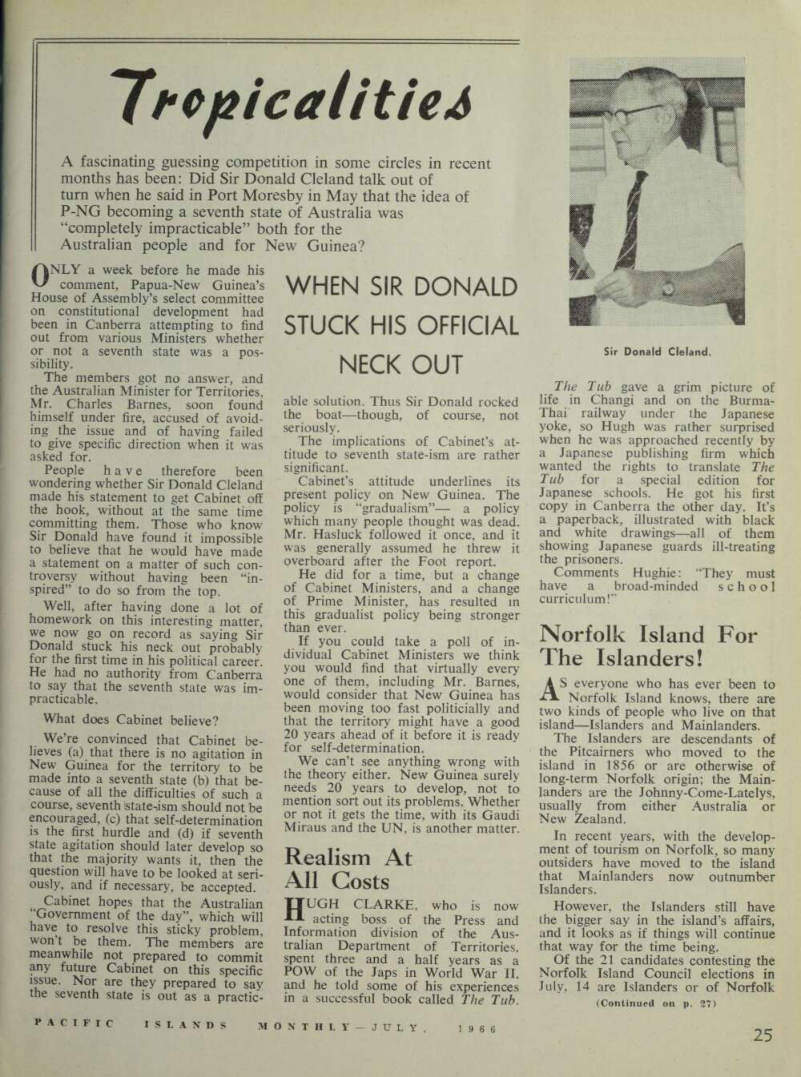
Sir Donald Cleland.
descent and they are expected to receive strong backing.
The Mainlanders have the only woman candidate, Mrs. Gwen Stan ton, who unsuccessfully contested the last election in 1964.
Five of the retiring councillors— Charles Evans, Albert Bathie, Dayell Christian, Richard Bataille and Gregory Quintal —are seeking re election.
Beaten, Battered,
But Good PRO’S
THE Papua-New Guinea Rugby League team which played games against top club teams in Sydney and Brisbane in June returned to the territory well battered, defeated in both games, but much richer in ex perience and with many new friend ships made while they were away.
In Sydney on June 12, the visitors suffered a crushing defeat, 35-6, by the South Sydney first grade team (a grand finalist last year), but they followed this up with a much worthier performance against the leading Brisbane side, Brothers. The scores in that match were 17-13.
The trip to Australia for the terri tory players followed an end-of season playing holiday in P-NG late last year for the South Sydney club.
The various League bodies in the territory were such good hosts that South Sydney offered to sponsor a trip by a combined territory team for a game with Souths on their home ground, Redfern.
Seventeen players and several officials were invited. Meanwhile, the
second game, in Brisbane, was or ganised.
Followers of the game in the terri tory feared at first that the players chosen for the tour would prove to be mainly the professionals and semi professionals of the Papua Rugby League and the fly-by-nights who spend a few months in the area dur ing the football season.
But officials of the PRL and the New Guinea Rugby League quickly ruled that tour aspirants would be limited to those who had played football in the territory both this season and before. This immediately eliminated several top-line players.
The experts say that if the best team had been sent it certainly would have been stronger than the one which did make the trip. But it would have done little towards the further promotion of the code in the territory.
As it turned out there were three Papuans, two New Guineans, one Chinese, one mixed race and 10 Euro peans in the line-up. Most of the Europeans have made their homes in the territory.
The team captain, Barry Orchard, has lived in Lae for 10 years and has given much time to the encourage ment and teaching of Rugby League in the territory without collecting a cent for his services, when he prob ably could have been earning big money playing the game profession ally in Sydney.
There are others like him—school teachers, public servants, policemen, farmers and so on.
While in Australia, the whole group
did a good public relations job, mak ing many new personal friends and many friends, generally, for the terri tory.
It was the first visit to Sydney of a combined Papua-New Guinea team, but it probably won’t be the last.
In Sydney, territory officials were approached by representatives of several big Sydney clubs about the prospects of making trips to the terri tory at the end of last season.
Manly-Warringah, in particular, is interested in going north at the end of this season, and if this comes off a combined P-NG side could easily be playing a return game on Manly’s home ground, Brookvale Oval, next year.
How The Games
Got Started
WHEN the First South Pacific Games were held in Suva, Fiji, in 1963, Dr. A, H. Sahu Kahn, a Fiji-born Indian resident of Fiji, was acclaimed in the Press as the man mainly responsible for getting the Games started.
Dr. Kahn was said to have sug gested, at the 4th South Pacific Con ference in Rabaul in 1959, that an inter-territory sports tournament should be held every few years to overcome insularity in the Pacific.
As far as we know, no one at the
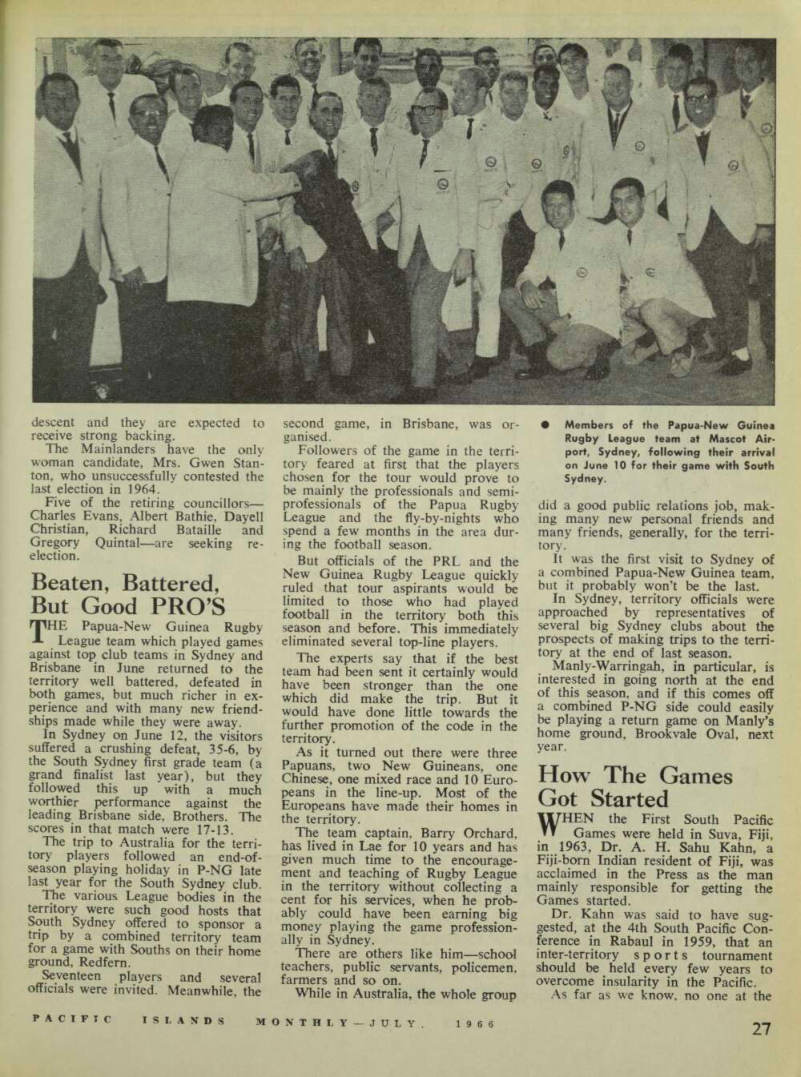
Members of the Papua-New Guinea Rugby League team at Mascot Air port, Sydney, following their arrival on June 10 for their game with South
Sydney.
First Games disputed Dr. Kahn’s right to a little bit of credit as the father of the Games.
However, with the Second Games coming up in Noumea in December, we learned the other day from a newsletter put out by the organising committee in Noumea that the idea of creating the Games was first put forward by a New Caledonian, Mr.
Pierre Issamatro—at the 1959 Rabaul conference.
At first sight, this looked to us like another case of Anglo-French rivalry. But a check through the records of the Rabaul conference showed that Mr, Issamatro was ap parently the man who suggested the Games idea.
This idea stemmed in turn from a paper delivered to the Welfare Committee of the conference by Semesa Sikivou, of Fiji, on “The Place of Recreation, including Sport and Youth Activities, in the Com munity”.
In the discussions which followed, Mr. Issamatro suggested that the committee recommend to the con ference that the various South Pacific territories develop all bodies con nected with sport and recreation in the region with a view to holding a Pacific sports tournament.
The idea of a Pacific regional sports meeting to which the territories would send teams was then widely discussed, and the general feeling was that although the people themselves should organise sports and recreation from their own efforts, the South Pacific Commission should take steps to bring to the notice of territorial administrations the need for further encouragement of sport and youth activities.
Dr. Sa.hu Kahn then suggested that the Commission should be asked to encourage and organise inter territorial tournaments every three years, although he said that such tournaments would create problems of finance.
Resolutions incorporating the ideas of Mr. Issamatro, Dr. Kahn and other conference delegates were sub sequently passed ... and the First Games were held four years later.
Census Time In
The Territories
fITHREE Pacific territories are to have a census soon—New Guinea, Fiji and the New Hebrides.
The New Guinea census will begin on June 30. Fiji’s will be in September and the New Hebrides census will be taken in May next year.
The New Guinea census, like most
other things in that territory, will be larger than life.
The census will not be a full one but achieved by “sampling”. Most population figures in the past have been educated guesses and this one will not be 100 per cent, correct either, but it is expected to get closer.
A great deal of other information will also be gathered at the same time.
The sampling is done by taking full details in sample villages and calculating the rest.
Some of the 23 questions on the foolscap-sized printed sheet concern degrees of literacy (“Can the person speak simple English?” or “Can the person speak simple Pidgin”); occu pation or employment status; hours worked per week; etc.
One of the most interesting ques tions is the rather extraordinary one of whether the person is “usually an inmate of an institution”—meaning a gaol.
The questions, naturally enough, are not filled in by villagers but by enumerators. They are done in code, the papers will be sent to Australia, where the information will be punched on tape and fed into a com puter.
To have all the enumerators in the correct villages at the correct time, P-NG school children have been given three weeks “census holiday” so that school teachers can join Census Bureau staff and officers of the Department of District Adminis tration to gather in the information.
A complete census will be run around urban areas such as Lae, Port Moresby, Madang, Rabaul, etc. Al though it is said that in Port Moresby some of the sophisticates fear that there is a connection between the June 30 census and the bill that was introduced in the June meeting of the
House of Assembly designed to clip a bit of income tax off low income earners (it does not come up for debate until next session), it affects other areas differently.
Where some villages in an area are selected as samples and others are not, those who are not feel that they have lost something in prestige.
The New Hebrides census, which is the first for the Condominium, will also be processed by computer in Sydney. Details will be studied by experts at the Australian National University, Canberra, and first results should be available by the end of 1967.
A Cadet Takes A
Stab At Kaindi
THE by-election for the electorate of Kaindi in New Guinea, made necessary by the death of Mr. Bill Bloomfield on February 12, will be held between July 16 and August 15.
Education teams have already been in the area among the 28,000 people eligible to vote. During the polling period, eight teams will service 90 polling places in what is still largely a very primitive part of the territory.
Five candidates have nominated.
They are: Anani-Maniau, Luluai of a village in the Buang area; Omas-Genora, a goldminer from Wau; Kopopanga, an interpreter from Menyamya; Manasseh, a farmer from Sikong village, near Menyamya; and Anthony Constantine Voutas, who prefers to be known as Toni.
For nomination purposes Mr.
Voutas describes himself as un employed. He was, until recently, a cadet patrol officer and, according to reports, he has been living among his would be constituents and trying to take their grass-roots view.
Whether this approach by Euro pean members holding open elec torate seats wins friends and in fluences people is now open to some doubt. It is difficult, at any rate, to detect in the House that European members from open electorates have any more influence with native members than European members from special electorates.
Nonetheless, Mr. Voutas is given a fair chance in Kaindi. Some observers think that the decision will be between him and Omas-Genora, who was a protege of the late Bill Bloomfield and started the first Native Miners’ Welfare Association, at Wau.
Dr. Sahu Khan.