Boredom And Bungers
p. 13 · Read in the full issue
Exit Mr. Guise Amid The
From Judy Tudor , in Port Moresby.
The decision of the elected members of the Papua-New Guinea House of Assembly to abolish the position of Leader of Elected Members was a gentlemanly way of getting rid of Mr. John Guise, who had been leader since the inauguration of the House in 1964.
THE cataclysm took place during the June meeting of the House of Assembly and the voting is believed to have been about 88 per cent, in favour of the move.
The reasons why it was desired to dispense with Mr. Guise’s services number about three dozen—that is, approximately the same number as the people who voted for it.
The position has been anomalous from the beginning, and apart from the honeymoon period early in the life of the new House, when most members were willing to sink personal differences for the sake of form, largely unworkable.
A leader of the elected members could fulfil his function only if those members were all of one mind on all subjects, or were a disciplined and effective Opposition party. They are none of these things. They represent about 40 different personal opinions.
Not Representative
As leader, Mr. Guise was expected to be the spokesman of the elected members, and the rub came when, as it is alleged, he failed to give the pot-pourri of opinion of his col leagues and substituted something of his own.
Most of the more recent trouble and discontent with him and with the office of leader boils down to the fact that he did not truly represent elected members’ opinion.
Who could? A Solomon would be hard put to it to represent the diversity of view and various levels of intelligence that emerge in the course of just one session of the Assembly. The decision to abolish the office rather than to try to foist it onto someone else is the best one in the circumstances.
It is believed by some that the existence of a Leader of Elected Members inhibited the development of political parties and that the abolition of the post will now clear the way for them.
Theoretically this may be so, but political opinion seems to be so fragmented at present that it seems unlikely that any one very strong movement will emerge.
The P-NG National Party that came into being last August is regarded locally as being a spent force, although its president, Gala Gala Rarua, still professes to have faith in its future and some members of the House support it.
It seems unlikely that much will be done in party development within the House during the remainder of its life, as it is problematical how many of the present members will survive the 1968 elections.
Lot Of Support
It has been suggested also that John Guise may now feel free to form a party of his own. As six members voted to keep him as leader it can be said that he has at least six followers—which in P-NG politics is a good start.
Guise, despite this setback, is still highly regarded by many, and he has a lot of support from people both inside and outside his own electorate.
Nonetheless, the fact that this man, who has often been spoken of as “the future Prime Minister” of the territory, was unable to weld un-
official members into some sort of coherent whole must be the measure of his failure. It probably is the measure of the deficiencies of the present system of government as well.
It is even becoming fashionable among those who until recently had stars in their eyes about the wonders that were going to be worked by creation of the House of Assembly, to say that perhaps the Westminster type of parliament is not yet suitable to P-NG conditions. Two years ago those who held such opinions were regarded as the worst kind of political reactionaries.
The workings of most parliaments are tedious in the extreme. The workings of the P-NG model is even more so, and becoming worse.
This is largely because the minority —the official members—are in effect the government by virture of reserve powers; and because the majority “opposition” is unorganised, with private members able to in troduce bills, often ridiculous or frivolous, that in a normally con stituted parliament would not get past the policy-making machine.
Speeches made on adjournment and questions addressed to official members take up a vast amount of time and are often devoted to parish pump affairs.
The real business of the House is sandwiched in between these two talk feasts, and into the sea of boredom thus created small hungers tossed by people like Gaudi Mirau (see p. 35) or Keith Tetley have the effect of atom bombs.
Mr. Tetley attacked a section of the P-NG Public Service, which he said was a “pack of expert bludgers”.
He alleged that they spent their time in pubs or playing golf when they should have been at work.
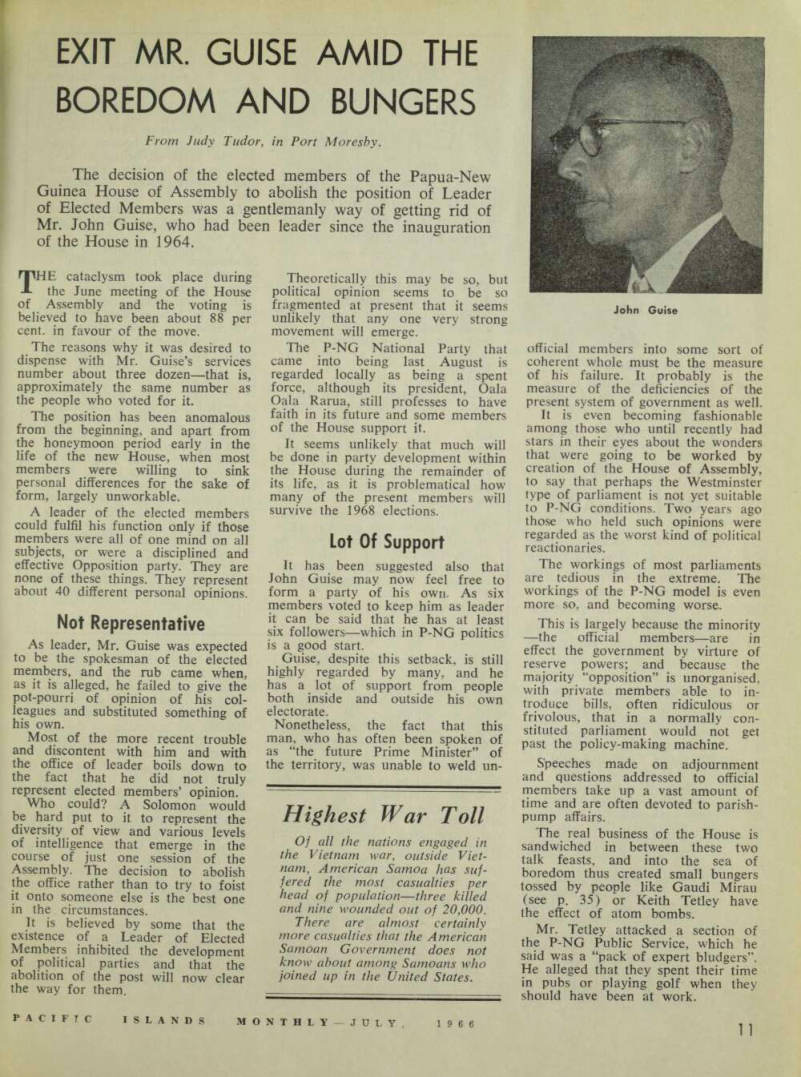
John Guise