Pacific Commerce and Produce
pp. 141-145 · Read in the full issue


New Fiji Development
Plan Caters For Big
Growth In Population
Highly-qualified research officers in many fields of agri culture are to be appointed in Fiji under a new development plan for the Colony to be published in June.
\ N outline of what will be in gL volved in the plan was given 0 the annual conference of the 7 ijian Teachers’ Association in Suva n May by the Member for Natural Resources, Ratu K. K. T. Mara.
Ratu Mara said that the plan oughly divided itself into two parts —firstly the projects on which action yould proceed within the next five ears, and, second, surveys for the uture.
Ratu Mara emphasised the import nce of research, but said: “We are /ell aware that results may not show luickly, particularly with long-term rops, but the benefits will be reaped 1 the future.
“We do not subscribe to the theory, Why should we care about posterity, /hat has it done for us?’ ”
He said the basic problem in agri ulture in Fiji was the limitation of rable land, and added that by the ear 2,000 the population of the Colony would be not less than li lillion.
Extra Half Million
Even if only 70 per cent, of the eople continued to live on the land, s against 80 per cent, at present, lis would mean an extra half million eople seeking livelihood from a land rea already largely settled.
“These bare facts of themselves ictate our agricultural policy,” Ratu lara said. “This must be, firstly, to litigate the effects of population ressure on the scarce resources of gricultural land; second, to increase nd diversify agricultural exports and lereby assist in maintaining the liv ig standards of the population; and, lirdly, to increase production of ome-grown foods to feed the rising apulation and to conserve foreign ex lange. ‘To some extent land areas avail fie for cultivation can be augmented V irrigation and drainage, par
ticularly in the delta areas of the Rewa and Navua. ‘There is a prime necessity for the intensification of production of exist ing farms. This can be achieved by the application of better methods, more capital, more fertilisers, soil erosion control, weed and pests and diseases control and intensified effort.
Some crop totals could be doubled, particularly rice, bananas, root crops and dairy products.
Difficulties
‘That there are difficulties we are aware. Some farmers have units which are not economically viable.
This leads them into other occupa tions so that they become part-time farmers and even the area that they have is not properly farmed. ‘There are the problems arising from insecurity of tenure, and here Government is at present considering the introduction of Agricultural Land lord and Tenant Legislation.
“It is important that land should be reserved for its optimum use whether it be forestry, tree crops or annual crops. Furthermore, more people will have to be absorbed out side agriculture in industry, fishing and tourist work; but increased pro duction will in itself create more em ployment in transport and processing.
For example, the making of coir and desiccated coconut.
“On the export side, three main crops remain predominant—sugar, coconuts and bananas. Sugar is efficiently managed with its own re search facilities by the SPSM Limited, but there is a limited quota which we are able to sell in the markets of the world.
“Our coconut policy is predomin antly one of implementing Lord Silsoe’s admirable report—doubling production and improving the quality of copra.
“Both these aims are being vigor-
ously pursued and though prices may fluctuate, indications are that world production is not keeping up with the increase in world demand and that a good market will continue.
“Our banana policy, in addition to improving quality by research, is to concentrate the industry within easy reach of Suva in closely planted areas where plantation methods, with all the advantages of scale and super vision, are fully realised. ’’Cocoa has been subject to the vagaries of world price; and has pre sented problems both on that count and as a new crop. However, most recent advice from authoritative sources indicates that we should now push ahead with this crop in the most favourable areas and thus add to our export earnings.
“Tea trials will shortly be com menced and oil palm trials are already proceeding under the aegis of the Fiji Development Company. ‘This company is also experiment ing with rubber. In crops of this nature, it is envisaged that there will be a central processing plant with a nucleus area under expert manage ment supervising production of small holders on the periphery.
I
Fisheries
“Among products on which efforts will be made to cut down imports are meat, dairy products, fish, rice, pulses, onions and potatoes. With re gard to dairy products, the policy is to increase production per cow and per acre of pasture rather than to increase stock numbers in the total area devoted to dairying.
“Fisheries, too, offer a widespread scope both for research and for in crease exploitation. One field of marine wealth which has not been sufficiently exploited is that of the sea food found on the reefs.
“Conservation also has its part to
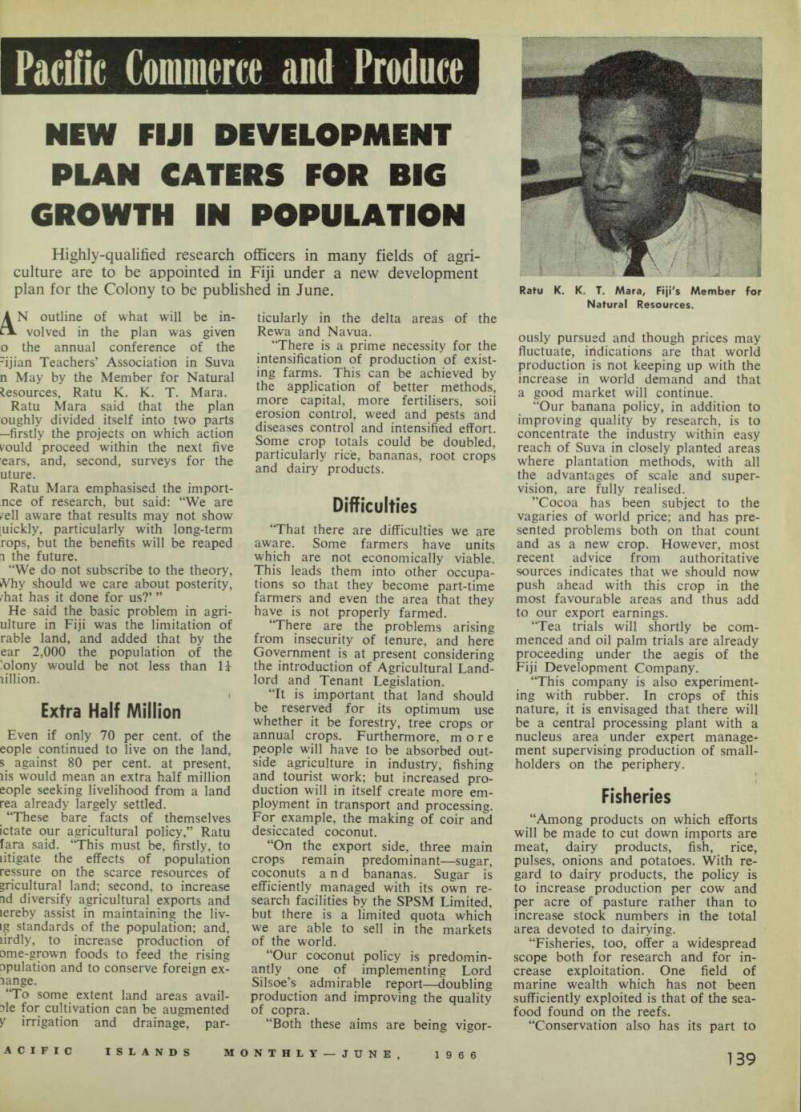
Ratu K. K. T. Mara, Fiji's Member for Natural Resources.
play in our fisheries policy, and already the increase in the legally per mitted mesh dimensions have meant more sport for fishermen in Suva Harbour, and a welcome addition to the protein diet of many households.
“Forestry offers perhaps the biggest potential for large-scale development in Fiji. In the development plan, there is a hardwood and soft-wood total planting target of more than 18,000 acres.
“A rough estimate shows that the gross return on hardwood is some £1,400 per acre and softwood is esti mated at £1,500 per acre.
“Private planting of wood-lots will also be encouraged and I am pleased to find that people are beginning to realise the value of timber planting, both for supplying their short-term needs and as an investment for the future.
“As with agriculture, research is vital to forestry and this will proceed by means of introducing new species, establishing seed orchards, cheaper methods of raising seedlings, and de termining of growth rates.
“On the utilisation side, there will be practical testing of local timbers; assessments of the sawmilling in dustry; investigation of the establish ment of fibre particle board; utilisa tion of pine and mahogany, and in vestigation into assessing timber pre servation.
Long-Term Planning
“All these activities will fully occupy the present staff of the De partment of Natural Resources, but ong-term planning is even more im portant for a long-term crop and therefore an application has been prepared and submitted to the UN Special Fund to: • Diversify the present two-crop jconomy of sugar and copra and to ■educe the reliance on sugar as our main crop. • Establish man-made forest with quick-growing species on non-agri mltural land so as to supply forest •aw materials, • Establish pulp and paper, ply vood, fibreboard and particle board mills where appropriate. • Provide employment opp o r unities. • Produce processed forest pro ducts for export. • Ensure protective benefits in vatershed and catchment areas. • Develop forest and allied amen ties, such as national parks, botanical gardens, nature reserves.”
Ratu Mara continued; “We have already been advised hat our softwood is eminently suit able for the manufacture of pulp and
we are justified in saying that the prospects for this industry with its high labour content are bright.
“The exploitation of Fiji’s mineral potential is largely a matter for com mercial concerns, but the Geological Survey and the Lands Department have important roles to play in pro viding information services, maps and other facilities.
“The story of gold mining is already well known and in the future we can look forward to the exploita tion of copper, lead and zinc; while bauxite is still being investigated.
“Phosphates on a number of islands in the Lau group are responding well to tests and can make a notable con
tribution towards an increase in our fertiliser supplies.
“In addition to the revenue that would be realised in exploiting these minerals, there are, of course, con siderable benefits in the added em ployment they provide.
“Moreover, in most cases it would mean employment in areas at present far from the centres of industry and commerce providing an incentive to keep people working and living in these areas.”
Referring to co-operatives, Ratu Mara said that the primary emphasis in the development plan was on pro ducer marketing societies. Already a considerable increase in copra pro cessing and marketing societies was in evidence.
Future policy was that the Co operatives Department should handle the marketing of much produce throughout the Colony and undertake tasks such as the purchase and dis tribution of fertilisers to its members.
Provision was made in the develop ment plan for the department to undertake all these duties on an en hanced scale.
New Mineral Finds
On New Britain
GEOLOGISTS in New Guinea are studying samples of drillings believed to indicate the presence of copper and gold deposits in the remote Bainings area of New Britain.
A spokesman for the Administra tion in Rabaul said on May 25, that an area of 132 square miles, believed to contain these deposits, had been marked out and proclaimed a re servation for further geological investigation.
Preliminary reports indicated that the finds might be of high quality, he said. If so instruction in mining methods would be given to the natives of the area by Administra tion geologists.
First news of the discovery broke when natives in the rocky area east of Mount Sinemut, about 50 miles from Rabaul, took odd-coloured stones to a planter in the area, Mr.
Roy Ashton, who is a member of the House of Assembly for the New Britain Special Electorate.
Mr. Ashton had the samples as sayed by a Government geologist who found traces of gold and copper.
If the deposits prove too great for the natives to mine, Mr. Ashton hopes arrangements can be made with a large mining concern to work the area and pay villagers a royalty.
Mining Developments
In New Caledonia
SEVERAL important developments in the New Caledonia mining industry were reported in May.
The French Government has agreed to allow the world’s biggest nickel producer, the International Nickel Company, of Canada, to operate in New Caledonia, according to Noumea’s reliable Bulletin du Commerce.
Another local report says that the French mining company Pennarroya has just bought 289,863 shares in Societe le Nickel, which runs the New Caledonian nickel industry. The purhase represents 10.6 per cent, of Societe le Nickel’s capital, Societe le Nickel plans to install a new nickel treatment centre at its mines at Nepoui, on the west coast, if certain proposals for tax and customs concessions are ap proved by the local Territorial Assembly, Another recent development is that the French company, Colimax Molybdenum, has opened a branch in New Caledonia in association with a local mining concern.
Burns Philp (SS)
Profit Up Again
Burns philp (ss) go. ltd. had a net profit for the year to January 31 of £202,337, or £10,541 more than in the previous financial year.
The 10 per cent, dividend of the last 17 years remains unchanged.
The directors report that group
sales showed a further satisfactory increase during the year, although keen competition challenged profit margins in many cases.
The hurricane in the Samoas caused considerable damage to local crops and buildings, but the com pany’s losses were not severe.
However, the hurricane, a decline in the market price of sugar and the likely effect of a drought in Fiji on sugar and copra, were expected to have some impact on purchasing power.
Good Year For
Rubber Companies
TWO Papua rubber planters, Rub berlands and Kerema, had higher profits in 1965.
The Rubberlands profit of $A16,221, was 24.2 per cent, higher than in 1964, when the dividend was trimmed from 1\ per cent. (1963) to 5 per cent. The 5 per cent, dividend has been maintained for 1965.
Kerema Rubber lifted profit from $A 13,029 in 1964 to $22,617 in the latest financial year, and increased the dividend from per cent, to 5i per cent.
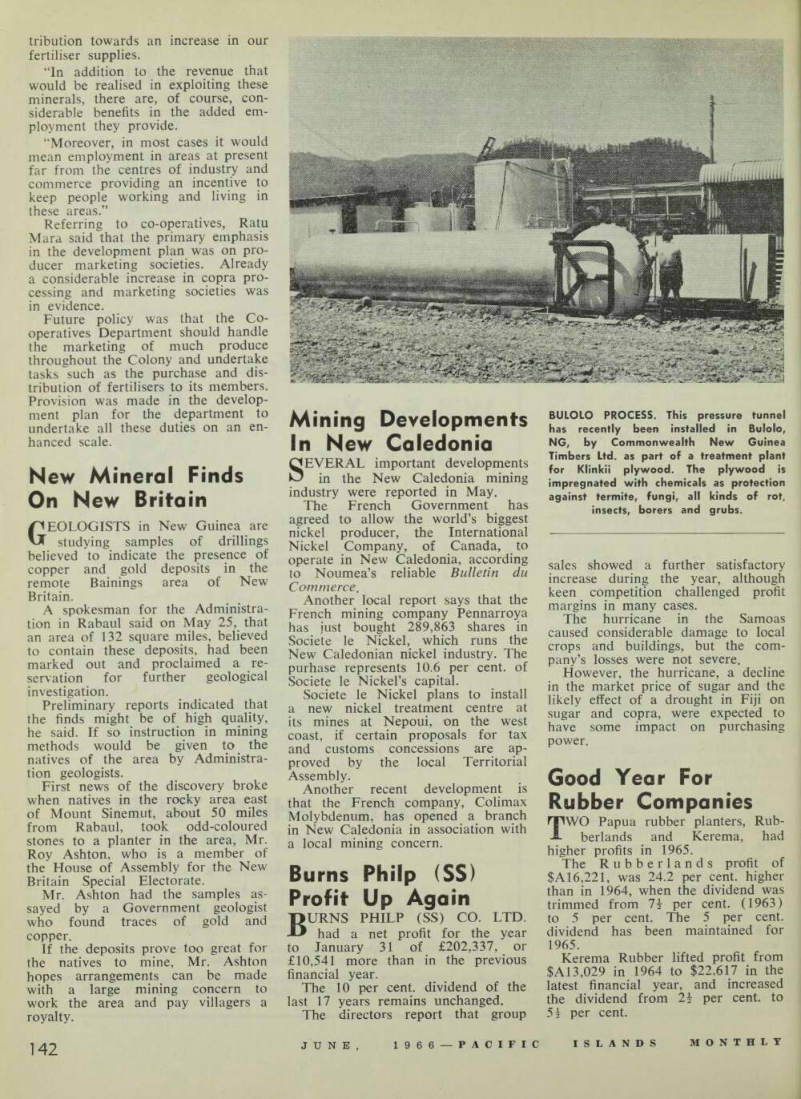
BULOLO PROCESS. This pressure tunnel has recently been installed in Bulolo, NG, by Commonwealth New Guinea Timbers Ltd, as part of a treatment plant for Klinkii plywood. The plywood is impregnated with chemicals as protection against termite, fungi, all kinds of rot, insects, borers and grubs.
World Cocoa Prices
Being Discussed
rHE UN Cocoa Conference, which is attempting to bring about an nternational agreement on cocoa irices and to stabilise the market, re :onvened in New York at the end of Hay. It was expected the conference vould last until about June 22.
The conference will consider imong other things the establishment )f floor and ceiling prices and a ystem of sales quotas. Major cocoa producing and consuming countries vill be represented.
The previous UN cocoa conference vas held in Geneva in 1963, and idjourned without an agreement.
New Guinea delegates to the con erence are Mr. N. Thomson, acting lirector of the Department of Trade, Hr. W. L. Conroy, acting director of \griculture, and Yin Tobaining, a uundation member of the Tolai 7ocoa Project, New Britain.
Copra Prices Should
Be Fairly Constant'
[T appears unlikely that there will be any great variation one way >r the other in the copra market for ome time, according to the Papua- Guinea Copra Marketing Board.
The board believes that prices are ikely to remain around the SUSI9O evel. This figure is a drop on the iverage price of recent months.
Chairman of the board, Mr. lan HcDonald, says that soya beans lave been a big influence on the narket for some time, but it is likely hat supply and demand will con inue to run very closely together, bus maintaining edible oil seed irices “at a reasonable level”.
Officially Open
rHE pyre thrum extraction factory at Mt. Hagen, New Guinea, ifficially got going on May 16, when \ustralia’s Governor-General, Lord -asey, pressed a button to start the nachinery.
The machinery had in fact been ?oing very well for several months 3ut the official opening was a re minder to the native people in the iistrict that the business was re garded as important to the country’s economy.
The New Guinea factory is owned by Stafford Allen (New Guinea) Pty.
Ltd. It occupies 15 acres of land near Kagamuga airport, outside of Mt. Hagen, Manager is Mr. M. N, Stravs.