Flying-boat Service
pp. 133-135 · Read in the full issue

Priest Sees New
Guinea Atoll As
Tourist Centre
A missionary priest on a re mote coral atoll in the New Guinea islands wants to see his atoll developed into a tourist centre.
IN May, at the priest’s invitation, an aircraft landed there, bringing the general manager of Airlines of NSW, Captain S. Middlemiss, to assess the situation. The atoll, Nissan Island, is north of Bougainville and 150 miles from Rabaul. It is the site of a Pacific War emergency land ing field reopened only last year.
Captain Middlemiss decided to fly there because of the enthusiasm of Father R. O’Sullivan, who runs a mission station for the local native population of a few hundred. Because he believes a tourist industry would help the people under his care, Father O’Sullivan has written letters asking for support. He welcomed his airline visitors with a native style feast and a tour of the coral-fringed beaches.
There are no cars on Nissan so the visitors travelled on a trailer drawn behind a tractor.
Flying-boat Service
Captain Middlemiss indicated that his company—part of the Ansett group—was investigating a flying boat tourist service between Sydney and the New Guinea Islands. He did
not commit himself on the possibility of including Nissan in the venture.
Captain Middlemiss said American tourists, in particular, were becoming increasingly interested in flying-boat cruises to the Pacific Islands. A big part of the attraction seemed to be the use of flying-boats instead of land based aircraft. He envisages a ser vice which would take in the Queens land coast, the islands of Papua-New Guinea and the British Solomon Islands. Captain Middlemiss left Rabaul on May 20 to continue his survey in Papua-New Guinea.
Mr. George Whisenand, A
prominent Honolulu architect, was due in American Samoa in May to begin design work on a 60-room addition to the Pago Pago Intercon tinental Hotel.
Mr. Whisenand is a partner in the
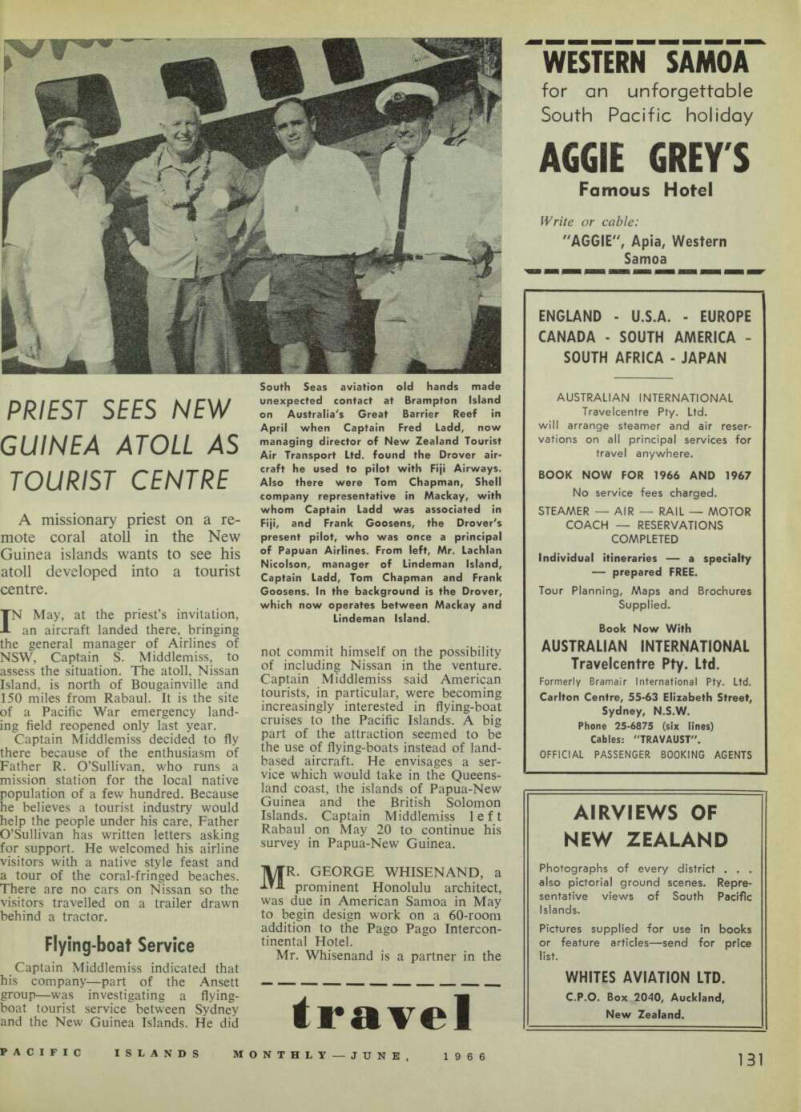
South Seas aviation old hands made unexpected contact at Brampton Island on Australia's Great Barrier Reef in April when Captain Fred Ladd, now managing director of New Zealand Tourist Air Transport Ltd. found the Drover air craft he used to pilot with Fiji Airways.
Also there were Tom Chapman, Shell company representative in Mackay, with whom Captain Ladd was associated in Fiji, and Frank Goosens, the Drover's present pilot, who was once a principal of Papuan Airlines. From left, Mr. Lachlan Nicolson, manager of Lindeman Island, Captain Ladd, Tom Chapman and Frank Goosens. In the background is the Drover, which now operates between Mackay and Lindeman Island.
firm of Wimberly, Whisenand, Alli son and Tong, which designed the hotel, MR. B. K. G. MAHNKOPH arrived in Nukualofa, Tonga, on May 10, to take up the position of manager of the new Dateline Hotel. He was accompanied by his wife and two daughters.
Mr. Mahnkoph, who was born in Germany in 1941, has lived in Aus tralia for the past two years. He has recently been manager of the Sheraton Hotel, Melbourne.
Progress on the hotel will probably quicken after June 16 when the official mourning period for the late 3ueen Salote will come to an end. rHE last Solent flying-boat of Air New Zealand went to its final lome in Auckland in May.
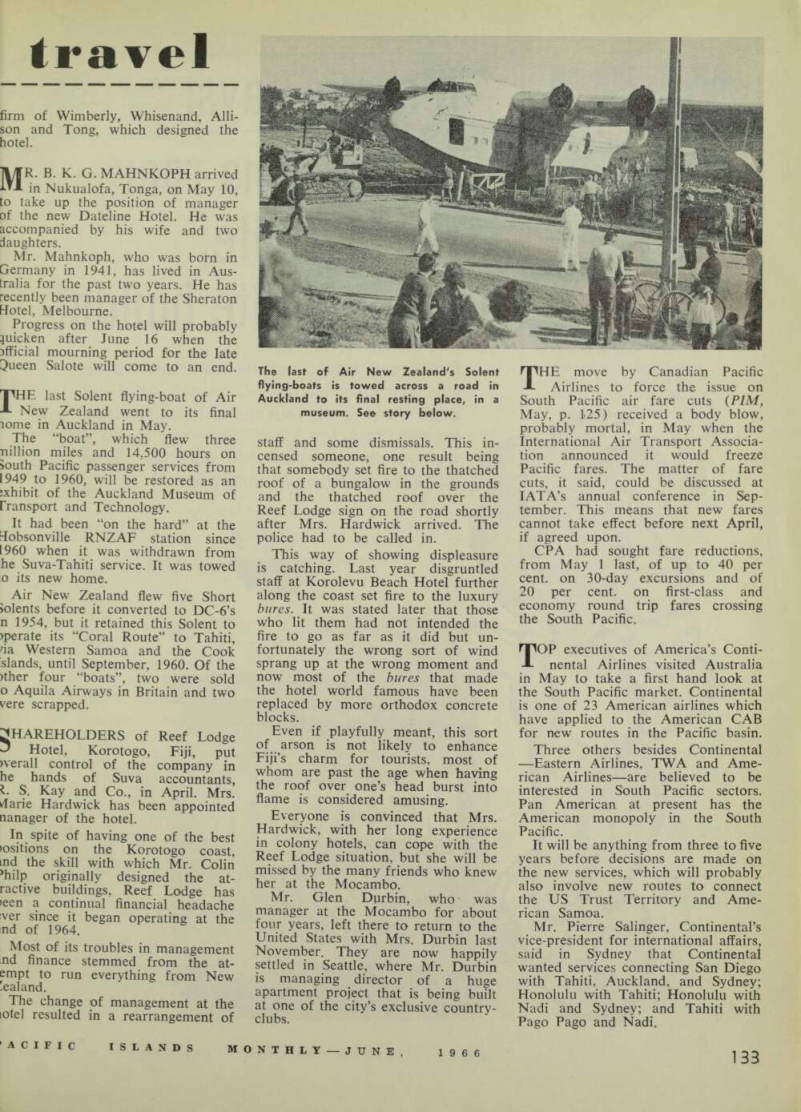
The “boat”, which flew three nillion miles and 14,500 hours on South Pacific passenger services from 1949 to 1960, will be restored as an exhibit of the Auckland Museum of transport and Technology.
It had been “on the hard” at the Hobsonville RNZAF station since 1960 when it was withdrawn from he Suva-Tahiti service. It was towed o its new home.
Air New Zealand flew five Short Solents before it converted to DC-6’s n 1954, but it retained this Solent to )perate its “Coral Route” to Tahiti, da Western Samoa and the Cook slands, until September, 1960. Of the )ther four “boats”, two were sold o Aquila Airways in Britain and two vere scrapped.
SHAREHOLDERS of Reef Lodge Hotel, Korotogo, Fiji, put >verall control of the company in he hands of Suva accountants, I. S. Kay and Co., in April. Mrs. tfarie Hardwick has been appointed nanager of the hotel.
In spite of having one of the best tositions on the Korotogo coast, ind the skill with which Mr. Colin *hilp originally designed the at ractive buildings, Reef Lodge has teen a continual financial headache ver since it began operating at the nd of 1964.
Most of its troubles in management nd finance stemmed from the at empt to run everything from New Zealand, The change of management at the iotel resulted in a rearrangement of
staff and some dismissals. This in censed someone, one result being that somebody set fire to the thatched roof of a bungalow in the grounds and the thatched roof over the Reef Lodge sign on the road shortly after Mrs. Hardwick arrived. The police had to be called in.
This way of showing displeasure is catching. Last year disgruntled staff at Korolevu Beach Hotel further along the coast set fire to the luxury hures. It was stated later that those who lit them had not intended the fire to go as far as it did but un fortunately the wrong sort of wind sprang up at the wrong moment and now most of the bures that made the hotel world famous have been replaced by more orthodox concrete blocks.
Even if playfully meant, this sort of arson is not likely to enhance Fiji’s charm for tourists, most of whom are past the age when having the roof over one’s head burst into flame is considered amusing.
Everyone is convinced that Mrs.
Hardwick, with her long experience in colony hotels, can cope with the Reef Lodge situation, but she will be missed by the many friends who knew her at the Mocambo.
Mr. Glen Durbin, who was manager at the Mocambo for about four years, left there to return to the United States with Mrs, Durbin last November. They are now happily settled in Seattle, where Mr. Durbin is managing director of a huge apartment project that is being built at one of the city’s exclusive country clubs.
THE move by Canadian Pacific Airlines to force the issue on South Pacific air fare cuts ( PIM, May, p. 125) received a body blow, probably mortal, in May when the International Air Transport Associa tion announced it would freeze Pacific fares. The matter of fare cuts, it said, could be discussed at IATA’s annual conference in Sep tember. This means that new fares cannot take effect before next April, if agreed upon.
CPA had sought fare reductions, from May 1 last, of up to 40 per cent, on 30-day excursions and of 20 per cent, on first-class and economy round trip fares crossing the South Pacific.
TOP executives of America’s Conti nental Airlines visited Australia in May to take a first hand look at the South Pacific market. Continental is one of 23 American airlines which have applied to the American CAB for new routes in the Pacific basin.
Three others besides Continental —Eastern Airlines, TWA and Ame rican Airlines—are believed to be interested in South Pacific sectors.
Pan American at present has the American monopoly in the South Pacific.
It will be anything from three to five years before decisions are made on the new services, which will probably also involve new routes to connect the US Trust Territory and Ame rican Samoa.
Mr. Pierre Salinger, Continental’s vice-president for international affairs, said in Sydney that Continental wanted services connecting San Diego with Tahiti, Auckland, and Sydney; Honolulu with Tahiti; Honolulu with Nadi and Sydney; and Tahiti with Pago Pago and Nadi.
The last of Air New Zealand's Solent flying-boats is towed across a road in Auckland to its final resting place, in a museum. See story below.