The many
pp. 119-121 · Read in the full issue
faces of fiji
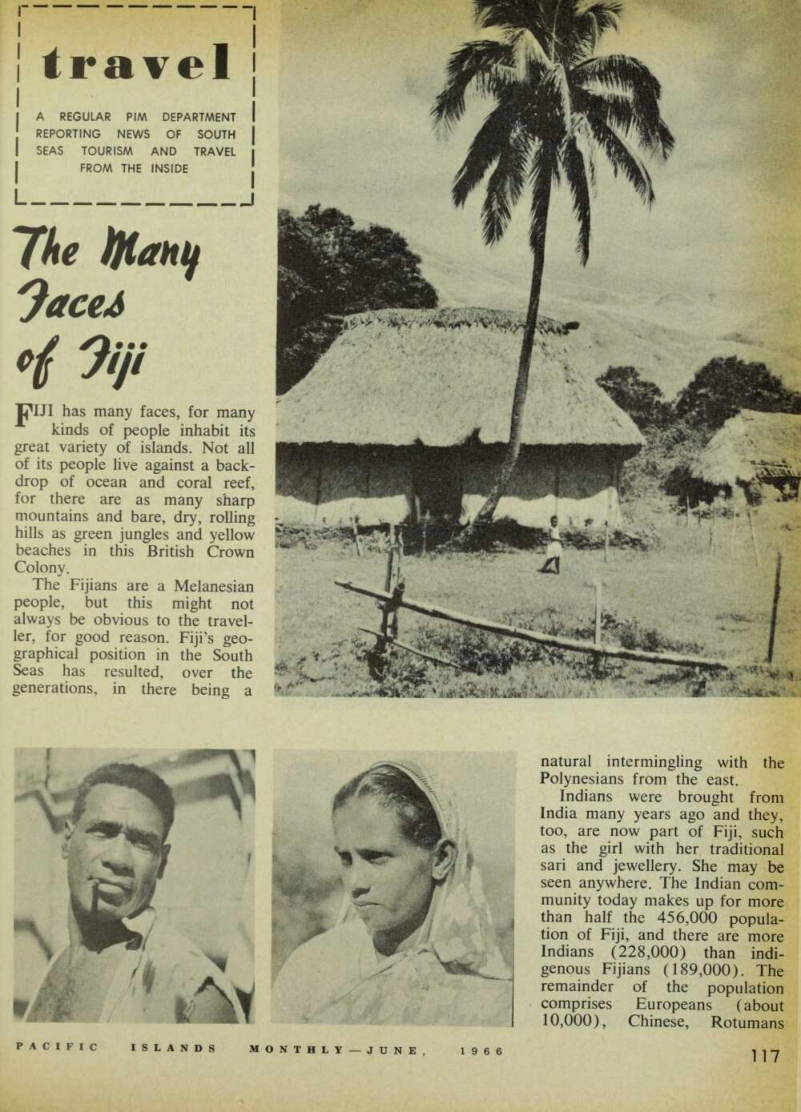
has many faces, for many kinds of people inhabit its great variety of islands. Not all of its people live against a back drop of ocean and coral reef, for there are as many sharp mountains and bare, dry, rolling hills as green jungles and yellow beaches in this British Crown
Colony.
The Fijians are a Melanesian people, but this might not always be obvious to the travel ler, for good reason. Fiji’s geo graphical position in the South Seas has resulted, over the generations, in there being a
natural intermingling with the Polynesians from the east.
Indians were brought from India many years ago and they, too, are now part of Fiji, such as the girl with her traditional sari and jewellery. She may be seen anywhere. The Indian com munity today makes up for more than half the 456,000 popula tion of Fiji, and there are more Indians (228,000) than indi genous Fijians (189,000). The remainder of the population comprises Europeans (about 10,000), Chinese, Rotumans
travel
A Regular Pim Department
Reporting News Of South
Seas Tourism And Travel
From The Inside
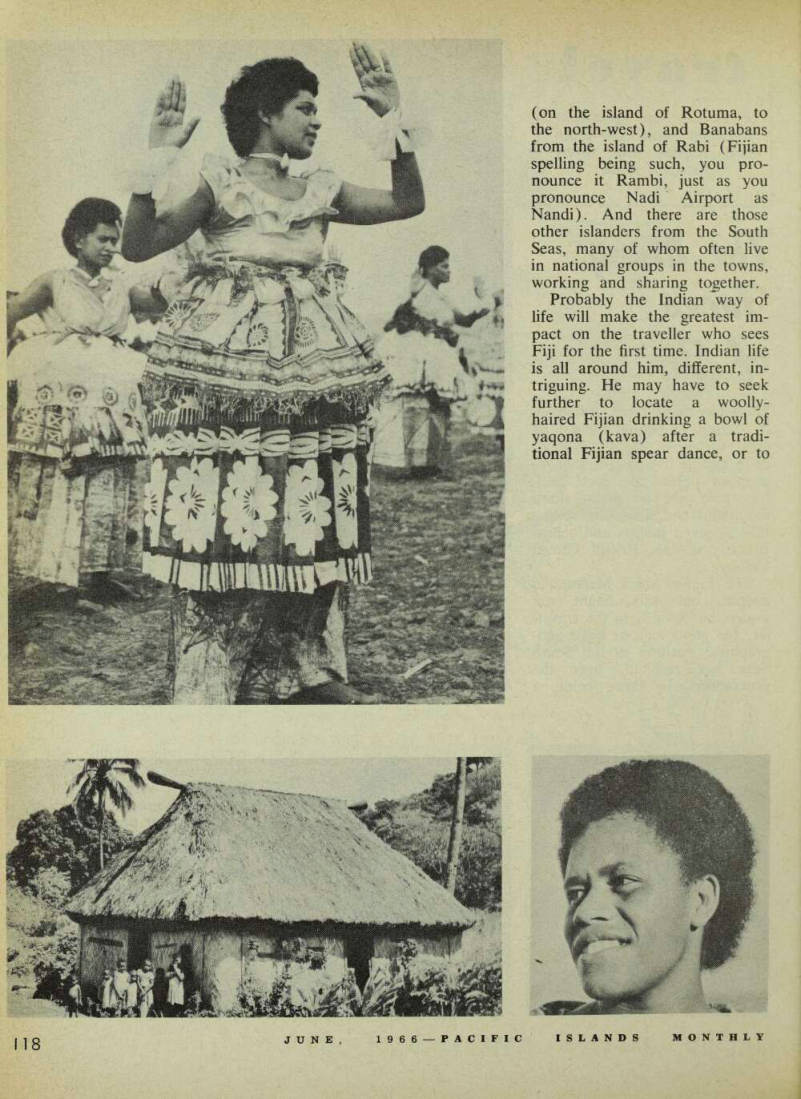
(on the island of Rotuma, to the north-west), and Banabans from the island of Rabi (Fijian spelling being such, you pro nounce it Rambi, just as you pronounce Nadi Airport as Nandi). And there are those other islanders from the South Seas, many of whom often live in national groups in the towns,
working and sharing together.
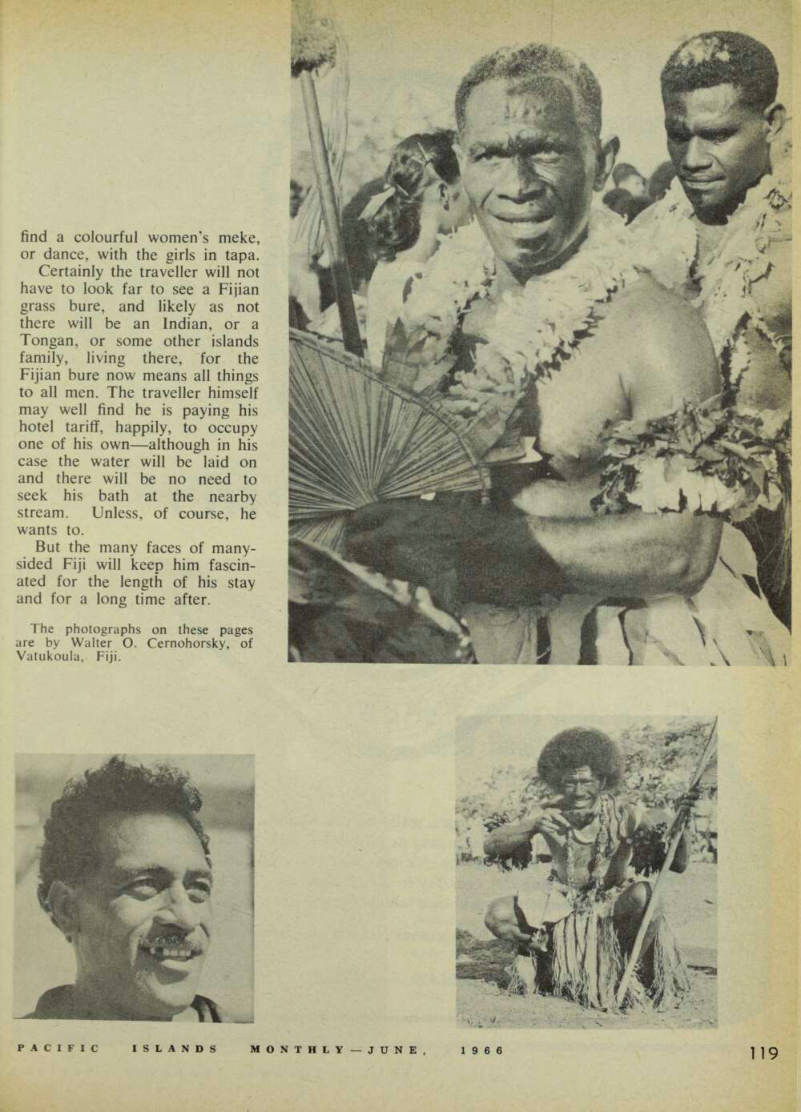
Probably the Indian way of life will make the greatest im pact on the traveller who sees Fiji for the first time. Indian life is all around him, different, in triguing. He may have to seek further to locate a woolly haired Fijian drinking a bowl of yaqona (kava) after a tradi tional Fijian spear dance, or to
find a colourful women’s meke, or dance, with the girls in tapa.
Certainly the traveller will not have to look far to see a Fijian grass bure, and likely as not there will be an Indian, or a Tongan, or some other islands family, living there, for the Fijian bure now means all things to all men. The traveller himself may well find he is paying his hotel tariff, happily, to occupy one of his own—although in his case the water will be laid on and there will be no need to seek his bath at the nearby stream. Unless, of course, he wants to.
But the many faces of many sided Fiji will keep him fascin ated for the length of his stay and for a long time after.
The photographs on these pages are by Walter O. Cernohorsky, of Vatukoula, Fiji.