Cruising Yachts
pp. 103-109 · Read in the full issue
Pacific Shipping And Cruising Yachts
New Harbour
Facilities At
Papeete Nearly
Completed
New port facilities at Papeete, Tahiti’s capital, which have been created by reclaiming about 35 acres of coral reef from the sea, are due to be completed in July, several months sooner than ori
ginally expected.
fFHE new facilities have cost about 600 million Pacific francs (SA6 million).
A survey for the project was com pleted in October, 1963, and work on it began a few months later. The project has completely transformed the appearance of the harbour.
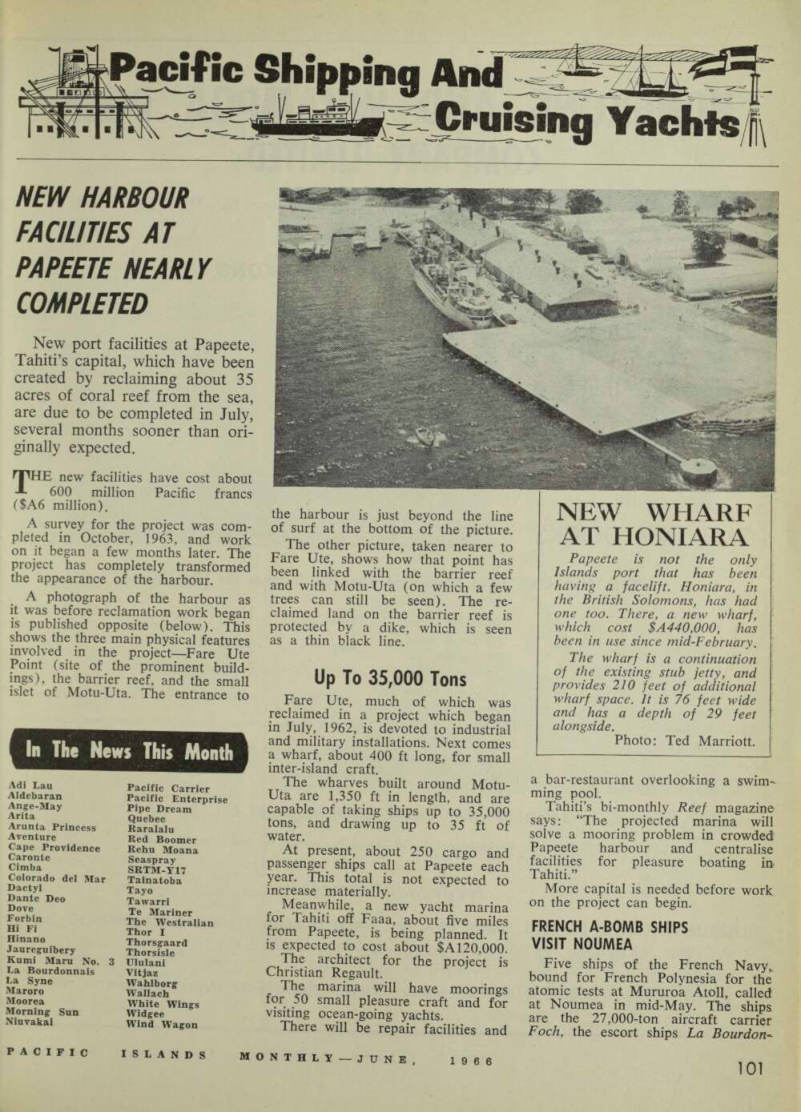
A photograph of the harbour as it was before reclamation work began is published opposite (below). This shows the three main physical features involved in the project—Fare Ute Point (site of the prominent build ings), the barrier reef, and the small islet of Motu-Uta. The entrance to
the harbour is just beyond the line of surf at the bottom of the picture.
The other picture, taken nearer to Fare Ute, shows how that point has been linked with the barrier reef and with Motu-Uta (on which a few trees can still be seen). The re claimed land on the barrier reef is protected by a dike, which is seen as a thin black line.
Up To 35,000 Tons
Fare Ute, much of which was reclaimed in a project which began in July, 1962, is devoted to industrial and military installations. Next comes a wharf, about 400 ft long, for small inter-island craft.
The wharves built around Motu- Uta are 1,350 ft in length, and are capable of taking ships up to 35,000 tons, and drawing up to 35 ft of water.
At present, about 250 cargo and passenger ships call at Papeete each year. This total is not expected to increase materially.
Meanwhile, a new yacht marina for Tahiti off Faaa, about five miles from Papeete, is being planned. It is expected to cost about $A 120,000.
The architect for the project is Christian Regault.
The marina will have moorings for 50 small pleasure craft and for visiting ocean-going yachts.
There will be repair facilities and
a bar-restaurant overlooking a swim ming pool.
Tahiti’s bi-monthly Reef magazine says; “The projected marina will solve a mooring problem in crowded Papeete harbour and centralise facilities for pleasure boating in Tahiti.”
More capital is needed before work on the project can begin.
French A-Bomb Ships
Visit Noumea
Five ships of the French Navy* bound for French Polynesia for the atomic tests at Mururoa Atoll, called at Noumea in mid-May. The ships are the 27,000-ton aircraft carrier Foch, the escort ships La Bourdon
New Wharf
At Honiara
Papeete is not the only Islands port that has been having a facelift. Honiara, in the British Solomons, has had one too. There, a new wharf, which cost $A440,000, has been in use since mid-February.
The wharf is a continuation of the existing stub jetty, and provides 210 feet of additional wharf space. It is 76 feet wide and has a depth of 29 feet alongside.
Photo: Ted Marriott.
nais, Forbin and Jaureguibery, and the supply ship La Syne.
The escort ships berthed at the wharf on May 13, but the other two remained in the outer roadstead.
They were thrown open to public inspection on the afternoons of May 14 and 15. The flotilla continued its voyage for French Polynesia on the 16th and reached Papeete on the 22nd.
According to one Noumea news paper, there was a persistent rumour in the town that the Foch was carry ing one of the bombs to be exploded.
During the flotilla’s stay in Noumea, some 2,000 sailors were given leave each day. Postal authorities put on extra staff to cope with the rush, and most stores benefited considerably, athough the sailors are far from rich.
Local newspapers asked the public to extend the friendliest welcome to the “pom-pom rouges”, but the request was hardly needed. Every body did his utmost to make them feel at home and the sailors returned the courtesies by being on their best behaviour.
In this department the sailors gave a lesson to Australian sailors, who, even when visiting Noumea in small numbers, generally create a couple of scandals.
New Tanker For
Pacific Trade
The Pacific Carrier, a small bulk petroleum tanker, will enter the South Pacific trade soon and, like the Pacific Enterprise, will have a largely Fijian and Gilbertese crew.
The Pacific Carrier is of 220 tons, or slightly larger than the Pacific Enterprise. She was due in New Guinea in May from Germany. Both ships are chartered by Mobil Oil from S. Berg and Company, of Sydney.
Timber Cargoes For
"Niuvakai"
The Tonga Copra Board’s ship Niuvakai is now operating profitably in both directions between Fiji, Tonga and Samoa and the east coast of Australia, according to authorita tive sources.
Her return journeys to the islands from Australia have always been profitable, but little cargo, except some desiccated coconut, was avail able for the downward trips until recently.
On her last two trips to Australia the Niuvakai carried timber, loaded at Malau, near Labasa, Vanua Levu.
The last cargo totalled 171,000 super feet. The ship can carry 300,000 super feet.
The Niuvakai will not pick up the
next load of timber offering as she has been chartered to pick up labour from the Gilberts for copra estates in the Line Islands, and to re patriate Gilbertese who have been working in the Line Islands for about 12 months.
Her next trip to Australia is ex pected to be early in July.
"Aldebaran" Wrecked
In New Caledonia
The 300-ton coastal vessel Alde baran, trading between Mare (Loyalty Islands) and New Cale donia, went ashore on the barrier reef, about five miles from Havan
nah Passage, in late April and be came a total wreck.
Havannah Passage is one of the entrances to Noumea Harbour, and a notorious graveyard for ships.
Despite repeated attempts by a tug from Noumea and the vessel Colorado del Mar, the ship could not be moved.
She was laden with islands produce, mostly copra, and was doing about seven knots when she struck the reef at 7 p.m.; darkness had fallen and the Havannah lights were obscured by a rain squall.
This was the second time in IS months that the Aldebaran had gone aground. The first time was on
Nanukulevu Reef, Fiji, in November, 1964, when she was sailing from Noumea to Futuna. The ship was refloated on that occasion after 32 days, but 9i months passed before she was ready for service again ( PIM , Nov., 1965, p. 105).
A couple of weeks after the Havan nah Passage disaster, several Mare Island natives of Noumea went out to the wreck in a small cutter to recover merchandise that had been consigned to them from Mare. The expedition cost one of them, Marie Joseph Gaica, his life, Gaica, a young man, was left in charge of the cutter after it had been anchored in deep water on the edge of the reef, and the others had waded over the reef to the wreck.
Gaica was found floating in the water, drowned, when the party returned from the wreck. He is thought to have suffered a stroke and fallen into the water.
New Ship For
South Pacific Trade
The passenger-freighter Thorsgaard, of 7,850 tons, is to enter the South Pacific trade, replacing the Thorsisle, which will be withdrawn.
The Thorsgaard is a sister ship of the Thor 1, which has been serving the South Pacific for several years.
Both ships have a speed of about 15 knots, and have accommodation for 12 first-class passengers. They also have about 10,000 cubic feet of refrigerated holds.
The ships are operated by the Pacific Islands Transport Line from US west coast ports to Papeete, Pago Pago, Apia, Suva, Lautoka and Noumea at intervals of about 40 days.
Small Ship Sinks
Near Wakaya Island
The Ange-May, a 14-ton motor ship, owned by Mr. Robin Powell, of Levuka, caught fire and sank near Wakaya Lighthouse, Fiji, in the early hours of May 8.
The Ange-May was on the way
to Batiki with cargo when the fire broke out.
Fiji Marine Practice
Under Fire
A Fiji marine court recently de plored the system of inter-island ships being allowed to employ un certificated men in charge of watches at night, and has recommended an appropriate amendment to the Marine Board Regulations as soon as pos sible.
The court, headed by a magistrate, Mr. T. L. von Pokorny, conducted a formal inquiry into the stranding of the Tainatoba at Solo Reef, Kadavu, on November 3.
During the inquiry there were allegations that the bosun, Peni Makiwaki, had said he had de liberately grounded the ship, but the court found it could not say with any degree of certainty whether there was any truth in the allegations.
It recommended that the attention
of the police be drawn to the allegations.
The court also referred to the report of the 1964 Commission for Safety at Sea (which followed the Kadavulevu disaster), which recom mended the implementation of marine training.
Mr. von Pokorny said that such a training system would be a factor in ensuring that better discipline in watchkeeping became standard.
The court found that the master, Isei Valel evuka, should be “admonished to introduce a stricter system of watchkeeping and of relief of watchkeepers”. This system should be “noted in the log book of the Tainatoba, which is, on the whole, well kept”.
The court found that the certificate of competency of the master should not be suspended or cancelled.
Lighthouse Ship Transferred
The 80 ft lighthouse supply vessel Wallach, which has serviced lighthouses in Papua-New Guinea from Samarai for many years, is being transferred to Thursday Island, and will be replaced by a new vessel.
Changes In Fleet Of
Societe Le Nickel
The New Caledonian nickel com pany, Societe le Nickel, has sold one of its ships, the Tayo, to a French company, but it will acquire two more soon.
The Tayo will be delivered to France via Suez by a local crew after repairs in Australia.
She has been one of a fleet of three
The " A Idebaran " aground at Havannah Passage at the entrance to Noumea Harbour.
Photo: Courtesy of “Journal Caledonien", Noumea.
ships owned by Societe le Nickel. The other two are the Quebec and Caronte. The Quebec was the first vessel constructed for Societe le Nickel after World War 11. The Caronte was a collier bought second hand in France.
Societe le Nickel expects to take delivery soon of two 15,000-ton ves sels built in Japan. One is expected about August, and the other early in 1967.
Queensland Fisherman
Not Imprisoned
Mr. K. M. (Bluey) Bedford, the Queensland fisherman, who was re ported to have been imprisoned by the Indonesian authorities in West New Guinea (PIM, May, p. 105) arrived in Port Moresby on May 3.
He explained that he had not been in prison at all.
He said he had sailed to Merauke in his workboat The Westralian, to gain permission for a crocodile shooting expedition up the Wongoee River. On arrival in Merauke, the In donesian authorities found that his papers were not in order and asked him to remain in port while inquiries were made in Sukarnapura. He was treated courteously and was allowed to sail back to Australian territory when his papers were put in order on April 27.
Indonesian officials promised to in form him if his application to shoot crocodiles was granted.
First Ship Built In
P-Ng For Export
A shipbuilding company in Rabaul recently completed the first ship ever built in the New Guinea islands for export.
The ship will be called Raratalu.
She is a 42-ft general workboat des tined for the Seventh-day Adventist Mission in the Solomons Islands.
Raratalu cost $15,000 and took five months to build. She was launched on May 12 for her first trials.
Russian Ship Calls
At Fanning Island
The Russian research ship SRTM- Yl7, which visited Suva in January, called at Fanning Island, 1,100 miles south of Honolulu, in late April with a sick seaman.
She was the second Russian re search vessel to put into Fanning with a sick seaman in less than 12 months.
Last June Vitjaz called there for that purpose after visiting Manuae, Cook Islands, for the solar eclipse {PIM, July, 1965, p. 15).
As with the Vitjaz, Mr. P. F. D.
Palmer, manager of the Burns-Philp copra plantation, sought assistance
for the SRTM-Yl7 from the US Coast Guard in Hawaii.
New Commander For
Coast Guard
Lieut. William Sobeck left Pago Pago for the US on May 1, after handing over command of the Coast Guard cutter Cape Providence.
The new CO is Lieut, (jg) Harry Allen, a graduate of the US Coast Guard Academy in 1962. Lieut. Allen arrived with his wife and two sons.
Fiji Cutter Aground
The Adi Lau, a Fiji cutter, owned by Mr. A. Chung, Suva, went aground on a reef off Moala Island in the
Lau Group, on May 12, Part of her cargo was removed and taken to the island.
Facelift For Navigational
Aids In New Caledonia
New Caledonia’s maritime warning lights system is to be given a face lift. A programme to cost 60 million Pacific francs ($600,000) is under way. It is being financed by Metro politan France.
Existing lights on the coast are to be modernised and new ones in stalled.
The workshops of the Lighthouse and Buoys Service, in Noumea, will also be enlarged and modernised.