A Unique
pp. 73-75 · Read in the full issue
“Mrs.” Joyce: A Unique Woman
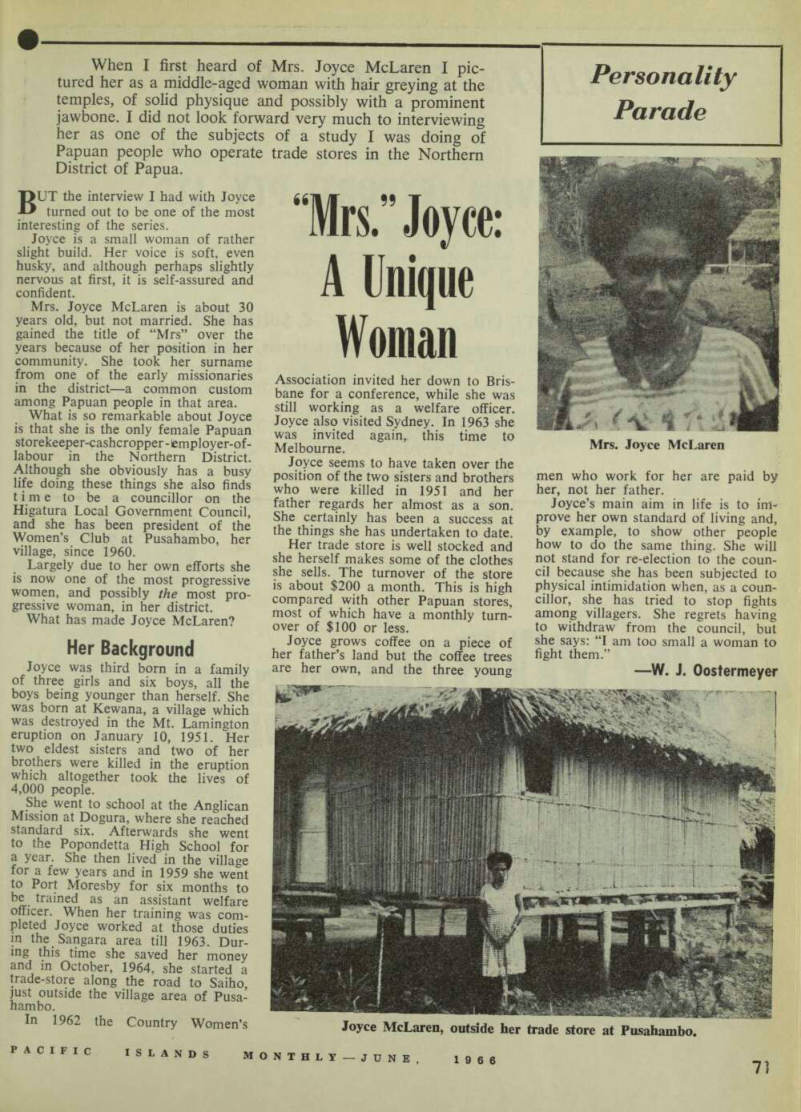
When I first heard of Mrs. Joyce McLaren I pic tured her as a middle-aged woman with hair greying at the temples, of solid physique and possibly with a prominent jawbone. I did not look forward very much to interviewing her as one of the subjects of a study I was doing of Papuan people who operate trade stores in the Northern District of Papua.
BUT the interview I had with Joyce turned out to be one of the most interesting of the series.
Joyce is a small woman of rather slight build. Her voice is soft, even husky, and although perhaps slightly nervous at first, it is self-assured and confident.
Mrs. Joyce McLaren is about 30 years old, but not married. She has gained the title of “Mrs” over the years because of her position in her community. She took her surname from one of the early missionaries in the district—a common custom among Papuan people in that area.
What is so remarkable about Joyce is that she is the only female Papuan storekeeper-cashcropper - femployer-of labour in the Northern District.
Although she obviously has a busy life doing these things she also finds ti m e to be a councillor on the Higatura Local Government Council, and she has been president of the Women’s Club at Pusahambo, her village, since 1960.
Largely due to her own efforts she is now one of the most progressive women, and possibly the most pro gressive woman, in her district.
What has made Joyce McLaren?
Her Background
Joyce was third born in a family of three girls and six boys, all the boys being younger than herself. She was born at Kewana, a village which was destroyed in the Mt. Lamington eruption on January 10, 1951. Her two eldest sisters and two of her brothers were killed in the eruption which altogether took the lives of 4,000 people.
She went to school at the Anglican Mission at Dogura, where she reached standard six. Afterwards she went to the Popondetta High School for a year. She then lived in the village for a few years and in 1959 she went to Port Moresby for six months to be trained as an assistant welfare officer. When her training was com pleted Joyce worked at those duties m the Sangara area till 1963. Dur ing this time she saved her money and in October, 1964, she started a trade-store along the road to Saiho, just outside the village area of Pusa hambo.
In 1962 the Country Women’s
Association invited her down to Bris bane for a conference, while she was still working as a welfare officer.
Joyce also visited Sydney. In 1963 she was invited again,, this time to Melbourne.
Joyce seems to have taken over the position of the two sisters and brothers who were killed in 1951 and her father regards her almost as a son.
She certainly has been a success at the things she has undertaken to date.
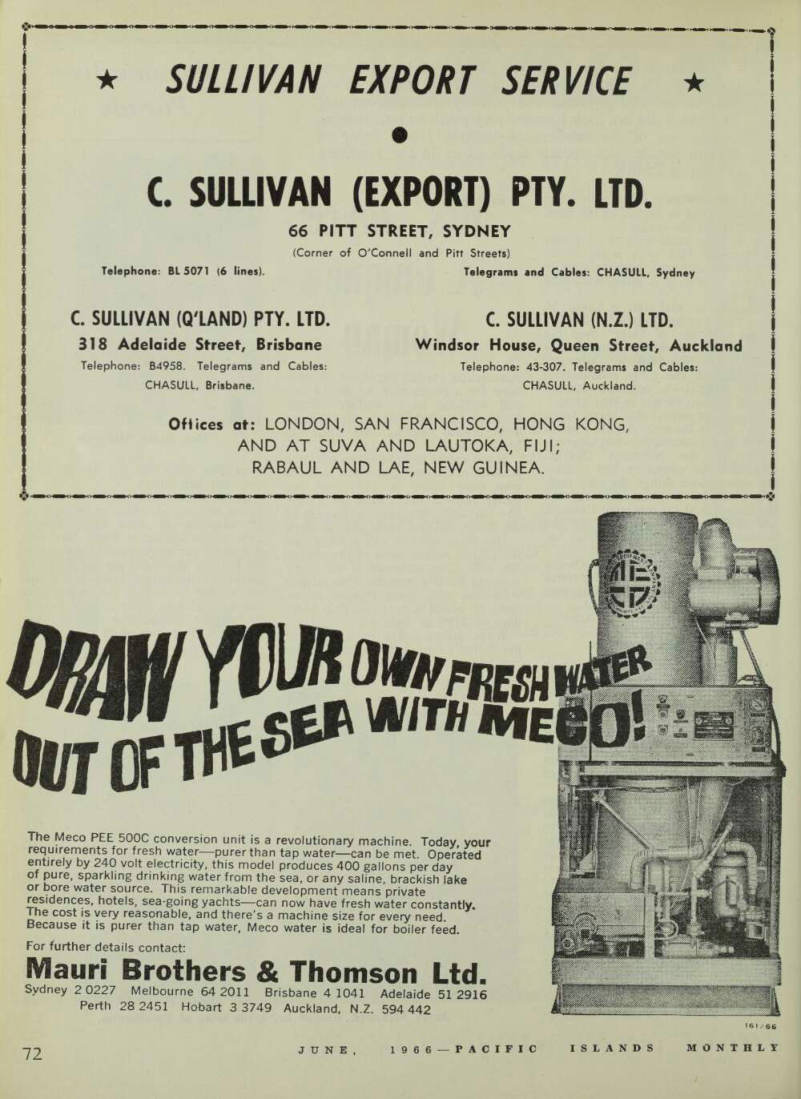
Her trade store is well stocked and she herself makes some of the clothes she sells. The turnover of the store is about $2OO a month. This is high compared with other Papuan stores, most of which have a monthly turn over of $lOO or less.
Joyce grows coffee on a piece of her father’s land but the coffee trees are her own, and the three young
Personality Parade
men who work for her are paid by her, not her father.
Joyce’s main aim in life is to im prove her own standard of living and, by example, to show other people how to do the same thing. She will not stand for re-election to the coun cil because she has been subjected to physical intimidation when, as a coun cillor, she has tried to stop fights among villagers. She regrets having to withdraw from the council, but she says: “I am too small a woman to fight them.”
W. J. Oostermeyer
Mrs. Joyce McLaren
Joyce McLaren, outside her trade store at Pusahambo.
• The South Pacific Commission held a training course in vital and health statistics in New Zealand from April 18 to May 13. An experienced panel of lecturers gave instruction in every phase of statistical procedures, especially designed to suit the needs of Assistant Medical Officers, medical records personnel, and other staff engaged in medical and public health work in various Islands territories. The course was designed by Mr. Cedric E.
Gardiner, the South Pacific Com mission’s medical statistician, who here explains the medical statistic ian’s role in the South Seas.