Tropicalities
pp. 25-27 · Read in the full issue
Some Irreverent
Thoughts About
An Old Tortoise
The death in Nukualofa on May 16 of the ancient tortoise, Tui Malila, which roamed the grounds of the Royal Palace for many years, has inevitably raised the question once again of whether the tortoise really was brought to Tonga by Captain Cook, as Tongan tradition claims.
ACCORDING to the tradition—or, at least, one version of the tradition—Cook gave two tortoises, a male and a female, to one of the chiefs of Ha’apai 192 years ago.
The female tortoise died soon after his departure, and later, when the Tuitonga (sacred king of Tonga) visited Ha’apai with his daughter, the tortoise was presented to the daughter.
Taken to Mua, which was then the capital, the tortoise was established in a compound and attendants were appointed to look after it. The compound was called Malila, and so the tortoise came to be known as Tui Malila (King of Malila).
When the last of Tonga’s Royal line became Christian, Tui Malila was cared for by Catholic priests and later by nuns.
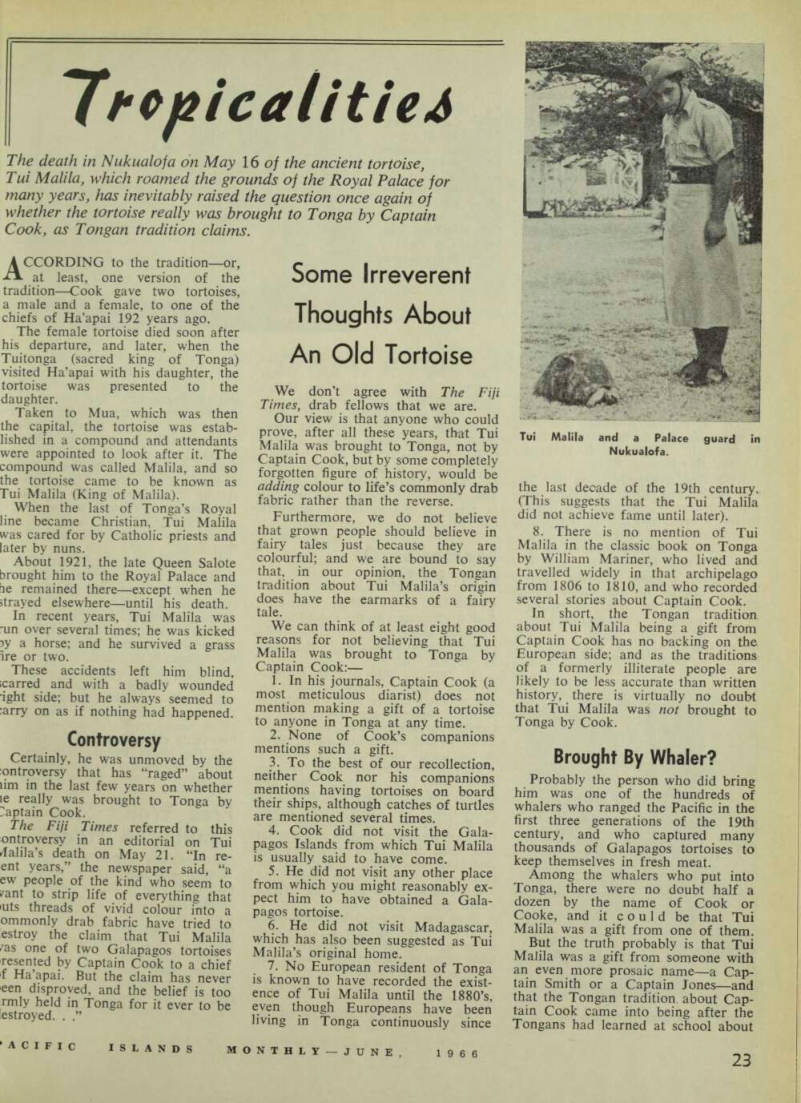
About 1921, the late Queen Salote brought him to the Royal Palace and he remained there—except when he strayed elsewhere—until his death.
In recent years, Tui Malila was run over several times; he was kicked by a horse; and he survived a grass fire or two.
These accidents left him blind, scarred and with a badly wounded right side; but he always seemed to carry on as if nothing had happened.
Controversy
Certainly, he was unmoved by the controversy that has “raged” about him in the last few years on whether he really was brought to Tonga by Captain Cook.
The Fiji Times referred to this controversy in an editorial on Tui Malila’s death on May 21. “In recent years,” the newspaper said, “a few people of the kind who seem to want to strip life of everything that puts threads of vivid colour into a commonly drab fabric have tried to destroy the claim that Tui Malila was one of two Galapagos tortoises presented by Captain Cook to a chief of Ha’apai. But the claim has never been disproved, and the belief is too firmly held in Tonga for it ever to be destroyed. .
We don’t agree with The Fiji Times, drab fellows that we are.
Our view is that anyone who could prove, after all these years, that Tui Malila was brought to Tonga, not by Captain Cook, but by some completely forgotten figure of history, would be adding colour to life’s commonly drab fabric rather than the reverse.
Furthermore, we do not believe that grown people should believe in fairy tales just because they are colourful; and we are bound to say that, in our opinion, the Tongan tradition about Tui Malila’s origin does have the earmarks of a fairy tale.
We can think of at least eight good reasons for not believing that Tui Malila was brought to Tonga by Captain Cook:— 1. In his journals, Captain Cook (a most meticulous diarist) does not mention making a gift of a tortoise to anyone in Tonga at any time. 2. None of Cook’s companions mentions such a gift. 3. To the best of our recollection, neither Cook nor his companions mentions having tortoises on board their ships, although catches of turtles are mentioned several times. 4. Cook did not visit the Galapagos Islands from which Tui Malila is usually said to have come. 5. He did not visit any other place from which you might reasonably expect him to have obtained a Galapagos tortoise. 6. He did not visit Madagascar, which has also been suggested as Tui Malila’s original home. 7. No European resident of Tonga is known to have recorded the existence of Tui Malila until the 1880’s, even though Europeans have been living in Tonga continuously since
the last decade of the 19th century. (This suggests that the Tui Malila did not achieve fame until later). 8. There is no mention of Tui Malila in the classic book on Tonga by William Mariner, who lived and travelled widely in that archipelago from 1806 to 1810, and who recorded several stories about Captain Cook.
In short, the Tongan tradition about Tui Malila being a gift from Captain Cook has no backing on the European side; and as the traditions of a formerly illiterate people are likely to be less accurate than written history, there is virtually no doubt that Tui Malila was not brought to Tonga by Cook.
Brought By Whaler?
Probably the person who did bring him was one of the hundreds of whalers who ranged the Pacific in the first three generations of the 19th century, and who captured many thousands of Galapagos tortoises to keep themselves in fresh meat.
Among the whalers who put into Tonga, there were no doubt half a dozen by the name of Cook or Cooke, and it co u 1 d be that Tui Malila was a gift from one of them.
But the truth probably is that Tui Malila was a gift from someone with an even more prosaic name—a Captain Smith or a Captain Jones—and that the Tongan tradition about Captain Cook came into being after the Tongans had learned at school about
Tui Malila and a Palace guard in Nukualofa.
the famous British navigator from British missionaries.
One of these days, perhaps, positive evidence supporting our suggestion will be found in one of the numerous whalers’ logbooks now lying in libraries and museums in the United States and elsewhere.
Meanwhile, Tui Malila’s body has been sent to New Zealand, by order of Tonga’s King Taufa’ahau, to be preserved and in an effort to establish his age. The body will probably be kept in the Auckland Museum until a resting place is built for the old chief in a proposed Tongan Museum.
Thumbs Down For
Another Tradition
WHILE we’re in this iconoclastic mood about old traditions, we might as well reveal what appears to be the grim truth about the 300year-old book, which the late Cyril Barnevelt Cameron, popularly known as King Cam of Kitava, bequeathed to the Tasmanian Museum and Art Gallery, Hobart, on his death in Port Moresby in March ( PIM , May, p. 17, and this issue p. 87).
King Cam always believed that his old book, The Life of Johan van Oldenbarnevelt, in Dutch, was bound in the skin of one of his ancestors —apparently old JVO himself—who was executed for his part in an in surrection in 1619.
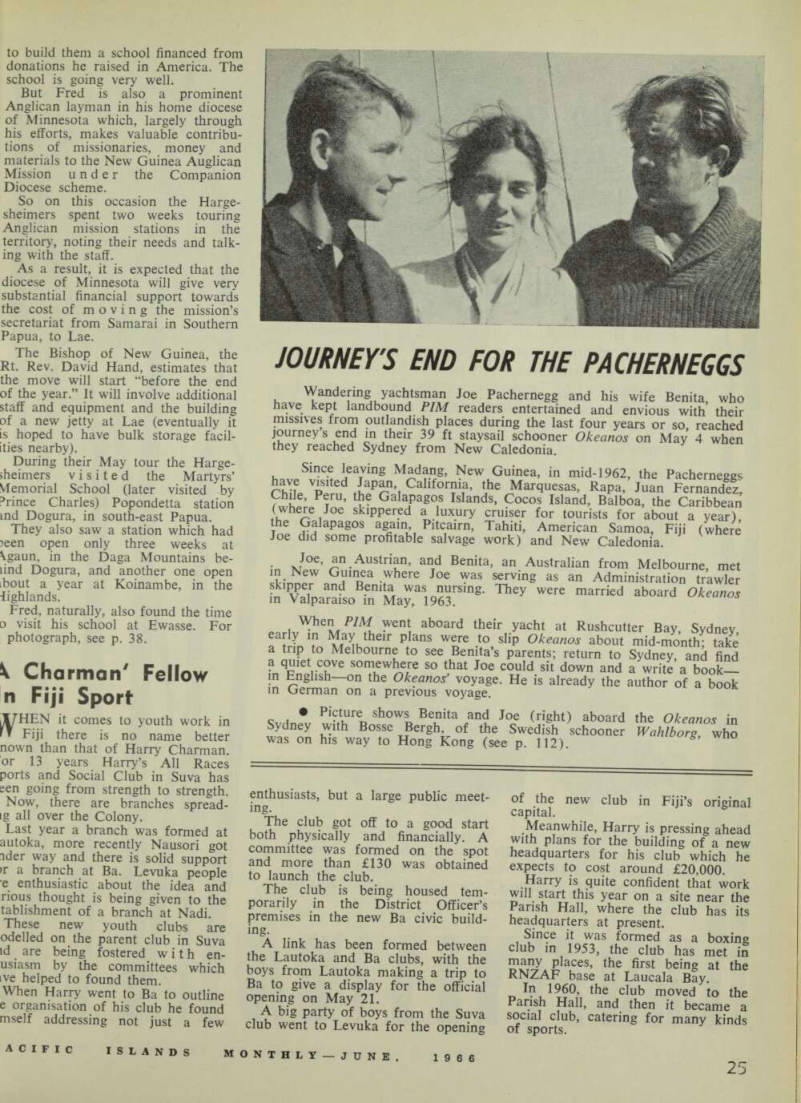
However, when Capain Brett Hilder, skipper of the Burns Philp fleet, brought the book to Sydney in May, a dealer in antiquarian books —not human skins—gave it as his unqualified opinion that the book was bound in vellum, not human skin.
Captain Hilder, by the way, has been doing a lot of other things lately besides carting old Dutch books around. He’s organised an exhibition of paintings in 10 Aus tralian cities to mark the 50th anni versary of the death of his painter father, J. J. Hilder; and he’s been pro ducing a book of his father’s paintings called The Heritage of J. J. Hilder.
The exhibition opened in Brisbane in April. It will end its run in Perth next March.
Memories Of
Old Ptio9
PIERRE SALINGER, one-time Press Secretary to President John F.
Kennedy, is one of those human balls of energy who bounce in 14 directions at any one time.
He bounced into Sydney in May in his capacity as vice-president for international affairs with Continental Airlines, one of the companies in terested in new trans-Pacific services.
You will find a story about their plans in the travel section of this issue.
Despite his busy itinerary, Salinger found the time to telephone Reg Evans and try to organise him (un successfully) into some drinks. Evans is the wartime coastwatcher who rescued Kennedy and his PT boat crew after their collision with a Jap destroyer in Blackett Strait, in the Solomons. Salinger and Evans met when Evans visited the White House a few years ago.
Over a cup of breakfast coffee with us at his hotel, Salinger recalled how delighted President Kennedy had been when he learned that Evans had been located in Sydney.
“How do we get him over here?”
Kennedy had asked.
The coconut on which Kennedy
sent his message for help to Evans, and the note from Evans in reply, were always in Kennedy’s office dur ing his Presidency. The coconut was on the desk and the note hung in an alcove just outside Kennedy’s door. ‘These things are now held by the National Archives,” said Salinger, “and they will go into the Kennedy Library, Cambridge, Massachusetts.
At the library people will be able to see Kennedy’s office just the way it was the day he was killed, and the coconut, of course, will remain on that desk.”
Kennedy’s rescue had been “a very sentimental area of the President’s life,” said Salinger, and “he liked to reminisce about it.”
The President had intended to make a visit to Australia in 1964 and “somehow” planned to get back to the Solomons during it, Salinger told us.
Pierre Salinger himself is no stranger to the South Pacific. During the war he was commanding officer of an American sub-chaser, and spent two years kicking around the Gilberts and the North Pacific. He has re cently completed a book on President Kennedy.
Fred Won'f Stop
Lending A Hand
THERE are many sides to Fred Hargesheimer, who in May made his fourth visit to Papua-New Guinea in the last six years. With him this time —taking her first look at the territory which Fred has such regard for—was his charming wife, Dorothy.
Fred Hargesheimer is best known as the former American pilot whose life was saved by the New Britain people when he was shot down dur ing the war, and returned in gratitude
King Cam's book, from the outside.
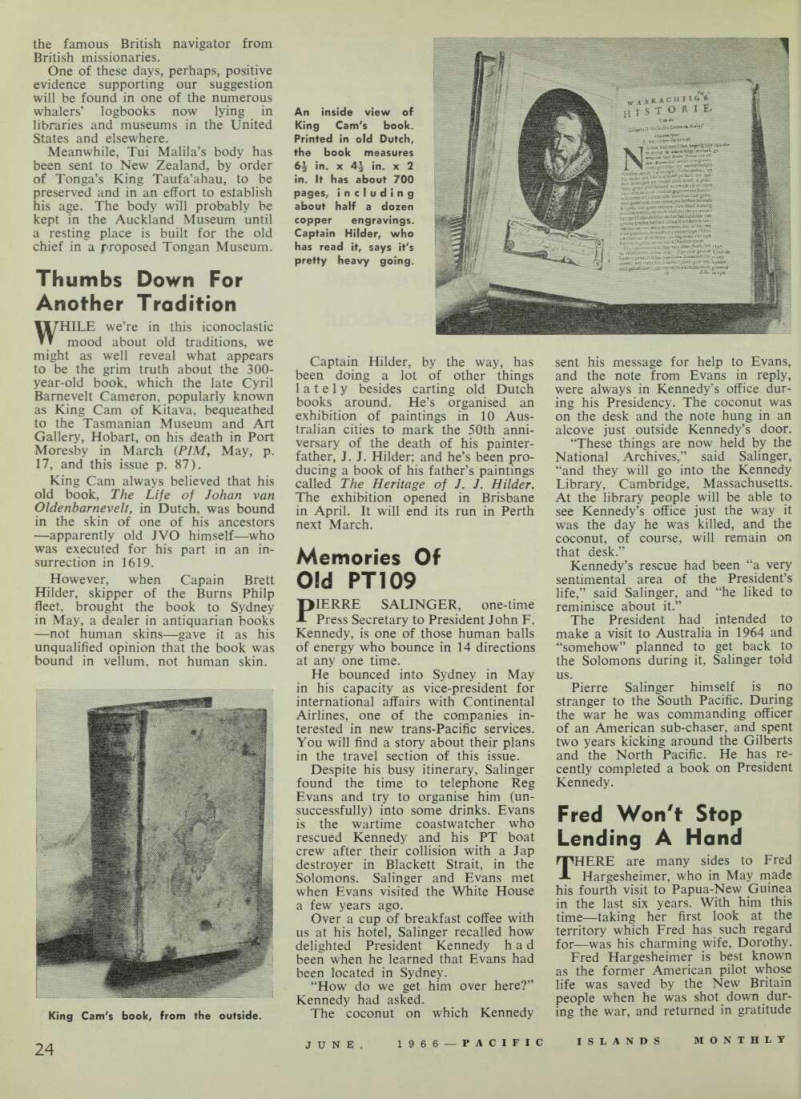
An inside view of King Cam's book.
Printed in old Dutch, the book measures in. x[?] in. x 2 in. It has about 700 pages, including about half a dozen copper engravings.
Captain Hilder, who has read it, says it's pretty heavy going.
to build them a school financed from donations he raised in America. The school is going very well.
But Fred is also a prominent Anglican layman in his home diocese of Minnesota which, largely through his efforts, makes valuable contribu tions of missionaries, money and materials to the New Guinea Auglican Mission under the Companion Diocese scheme.
So on this occasion the Harge sheimers spent two weeks touring Anglican mission stations in the territory, noting their needs and talk ing with the staff.
As a result, it is expected that the diocese of Minnesota will give very substantial financial support towards the cost of moving the mission’s secretariat from Samarai in Southern Papua, to Lae.
The Bishop of New Guinea, the Rt. Rev. David Hand, estimates that the move will start “before the end of the year.” It will involve additional staff and equipment and the building of a new jetty at Lae (eventually it is hoped to have bulk storage facil ities nearby).
During their May tour the Harge jheimers visited the Martyrs’
Memorial School (later visited by 3 rince Charles) Popondetta station md Dogura, in south-east Papua.
They also saw a station which had ?een open only three weeks at \gaun, in the Daga Mountains be lind Dogura, and another one open ibout a year at Koinambe, in the lighlands.
Fred, naturally, also found the time o visit his school at Ewasse. For photograph, see p. 38.
Charmcm' Fellow
n Fiji Sport
l/'HEN it comes to youth work in Fiji there is no name better nown than that of Harry Charman. dr 13 years Harry’s All Races ports and Social Club in Suva has een going from strength to strength.
Now, there are branches spread ig all over the Colony.
Last year a branch was formed at autoka, more recently Nausori got ider way and there is solid support >r a branch at Ba. Levuka people e enthusiastic about the idea and rious thought is being given to the tablishment of a branch at Nadi.
These new youth clubs are odelled on the parent club in Suva id are being fostered with en usiasm by the committees which ive helped to found them.
When Harry went to Ba to outline e organisation of his club he found mself addressing not just a few
enthusiasts, but a large public meet ing.
The club got off to a good start both physically and financially. A committee was formed on the spot and more than £l3O was obtained to launch the club.
The club is being housed tem porarily in the District Officer’s premises in the new Ba civic build ing.
A link has been formed between the Lautoka and Ba clubs, with the boys from Lautoka making a trip to Ba to give a display for the official opening on May 21.
A big party of boys from the Suva club went to Levuka for the opening
of the new club in Fiji’s original capital.
Meanwhile, Harry is pressing ahead with plans for the building of a new headquarters for his club which he expects to cost around £20,000.
Harry is quite confident that work will start this year on a site near the Parish Hall, where the club has its headquarters at present.
Since it was formed as a boxing club in 1953, the club has met in many places, the first being at the RNZAF base at Laucala Bay.
In 1960, the club moved to the Parish Hall, and then it became a social club, catering for many kinds of sports.