More Elected
pp. 21-157 · Read in the full issue
Members Proposed
For Solomons
From a Honiara Correspondent For the second time in two years the British Solomon Islands Protectorate plans to re vise its constitution. And for the second time the revision has
caused only one difficulty—that
of getting the population in terested in the proposals.
THE BSIP is one Pacific territory where political changes are signalled ahead of general public de mand. For most of almost 142,000 Solomon Islanders central politics are still a mystery.
The new proposals are in a White Paper introduced at the May meet ing of the Legislative Council. The White Paper will be debated in the next meeting of the council in December, and if approved—and the general proposals no doubt will be— a new constitution will be put into effect before the next general election in mid-1967. The present council is due to be dissolved by Tune 2, 1967.
The present council was established as a result of elections in April, 1965.
It consists of the High Commissioner
(Continued on p. 155)
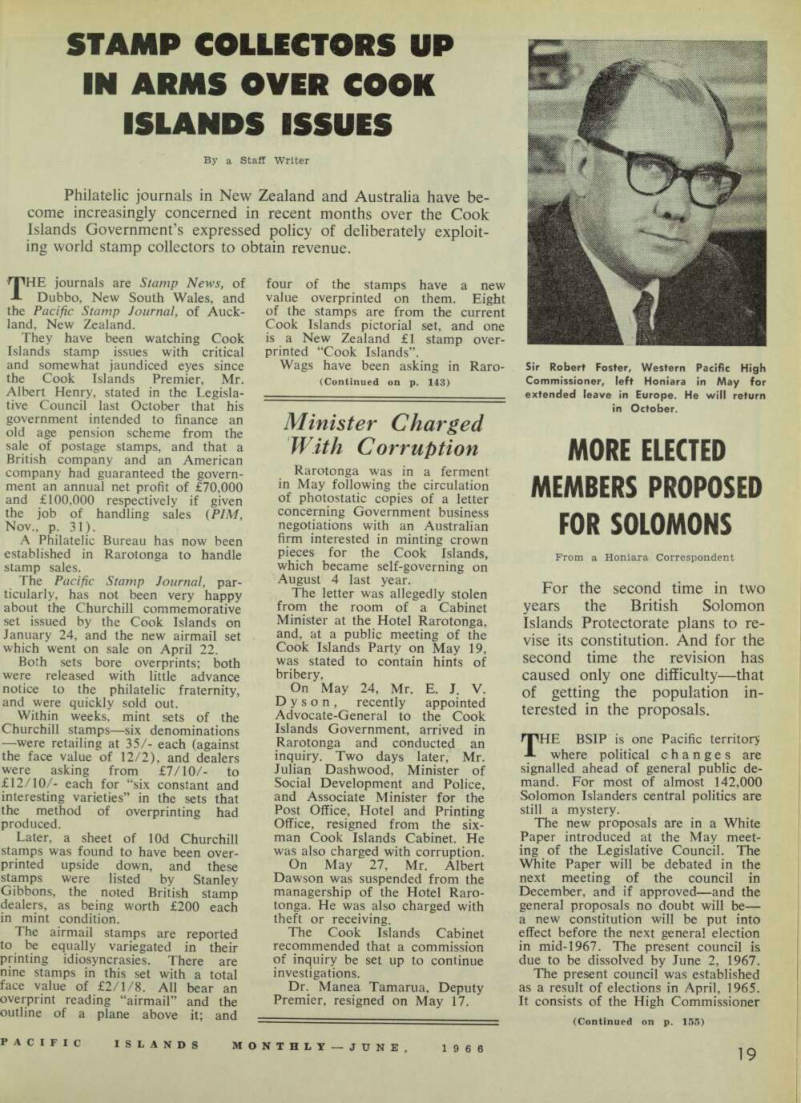
Sir Robert Foster, Western Pacific High Commissioner, left Honiara in May for extended leave in Europe. He will return in October.
; president, and 11 official and 10 lofficial members. Eight of the 10 aofficials are elected, and represent e eight constituencies of Western ilomons, Central Solomons, Guadal mal, North Malaita, Central Malaita, >uth Malaita, Eastern Solomons and oniara. The two remaining un ficial members are nominated.
Of the eight elected unofficials only le has his seat as a result of a rect election by universal adult iffrage—Mr. E. V. Lawson, of oniara. Voting age was 21. In the her seven constituencies members ere elected indirectly under the ectoral college system.
The new proposals call for the imber of elected members to be creased from eight to 14, to give re seats in Malaita (including kaiana and Ontong Java), four in the ;ntral District, one in Honiara and each in the Western Solomons id the Eastern Solomons.
All 14 members would be elected by rected election “as far as possible”, le White Paper says that in some attered constituencies direct elec ms might, “unfortunately”, be und impossible.
The official majority in the council mid be retained.
A system of “collective responsi bly” would be introduced, which mid probably mean that Executive mncil members would have to sup >rt majority decisions and thus they mid constitute an embryo cabinet, this system were introduced, says e White Paper, the number of ficial members in the Legislative mncil would probably be reduced.
Among the most important of the her proposals are: The High Commissioner would be •le to appoint a Speaker to the uncil; he could also appoint non iting nominated members; election ould be from a common roll and am the Local Government Councils’ ►ters lists; the Executive Council ould continue to be advisory and msist of the Chief Secretary, ttorney - General and Financial cretary and not more than five her members of whom not more an one should be an official; a iblic Service Commission should be tablished, “in due course”.
On the need for a Public Service Dmmission, the White Paper says at the proposed new constitutional langes “make it desirable to com ence the process of removing the iblic Service from the influence of Aides”.