New Hebrides Plan
p. 146 · Read in the full issue
For More And Better Beef
By D. I. Allen, Condominium Agricultural Department, New Hebrides.
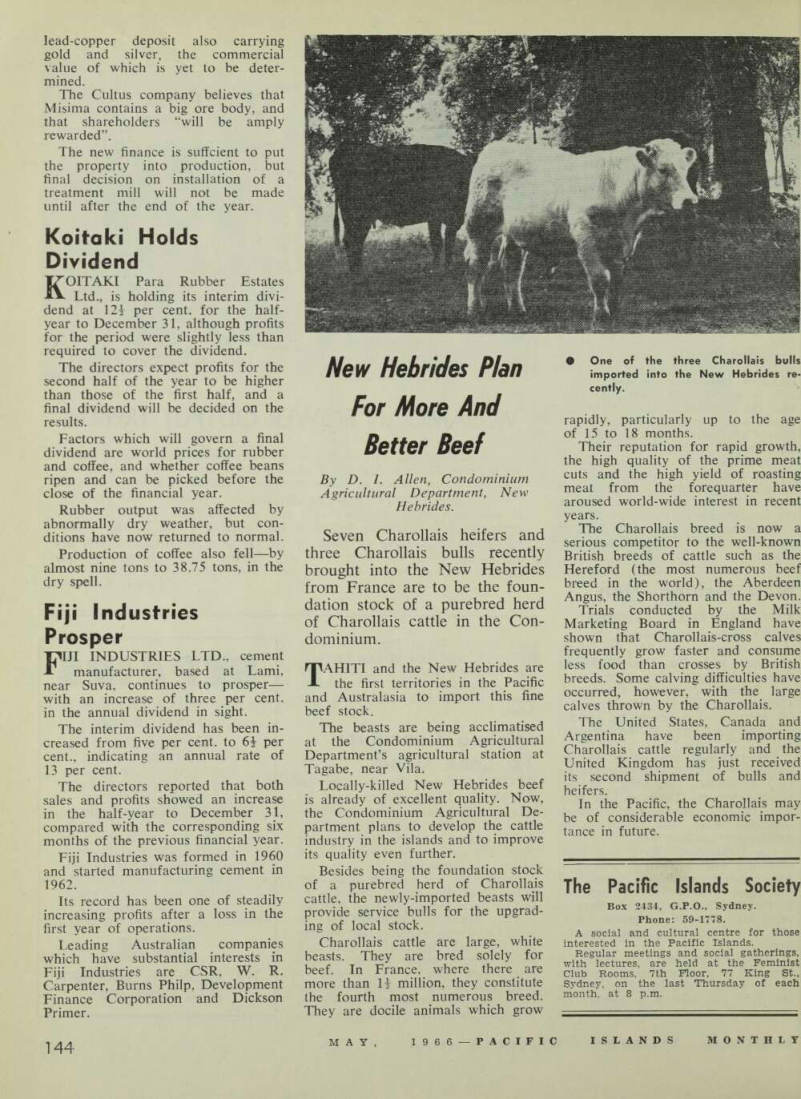
Seven Charollais heifers and three Charollais bulls recently brought into the New Hebrides from France are to be the foun dation stock of a purebred herd of Charollais cattle in the Con dominium.
TAHITI and the New Hebrides are the first territories in the Pacific and Australasia to import this fine beef stock.
The beasts are being acclimatised at the Condominium Agricultural Department’s agricultural station at Tagabe, near Vila.
Locally-killed New Hebrides beef is already of excellent quality. Now, the Condominium Agricultural De partment plans to develop the cattle industry in the islands and to improve its quality even further.
Besides being the foundation stock of a purebred herd of Charollais cattle, the newly-imported beasts will provide service bulls for the upgrad ing of local stock.
Charollais cattle are large, white beasts. They are bred solely for beef. In France, where there are more than H million, they constitute the fourth most numerous breed.
They are docile animals which grow
rapidly, particularly up to the age of 15 to 18 months.
Their reputation for rapid growth, the high quality of the prime meat cuts and the high yield of roasting meat from the forequarter have aroused world-wide interest in recent years.
The Charollais breed is now a serious competitor to the well-known British breeds of cattle such as the Hereford (the most numerous beef breed in the world), the Aberdeen Angus, the Shorthorn and the Devon.
Trials conducted by the Milk Marketing Board in England have shown that Charollais-cross calves frequently grow faster and consume less food than crosses by British breeds. Some calving difficulties have occurred, however, with the large calves thrown by the Charollais.
The United States, Canada and Argentina have been importing Charollais cattle regularly and the United Kingdom has just received its second shipment of bulls and heifers.
In the Pacific, the Charollais may be of considerable economic impor tance in future.
• One of the three Charollais bulls imported into the New Hebrides re
cently.