Pacific Commerce and Produce
pp. 141-146 · Read in the full issue
Chances For More
Aust. Trade In
French Polynesia
French Polynesia, of which Tahiti is the principal island, can be regarded as a market of
growing importance to Aus
tralia, according to Mr. W. R.
Carney, Australia’s Trade Com missioner for the Pacific Islands.
IN an article in the April issue of Overseas Trading, issued by the Commonwealth Department of Trade and Industry, Mr. Carney says that he existing demand from French Polynesia for Australian foodstuffs, building materials, tools and hard ware is expected to increase in line with the rapid rate of population growth in French Polynesia.
The present population is 90,000. 3y 1975, it is expected to be 121,000.
Apart from massive governmental ;xpenditure in the area, private levelopmental projects are bringing ;reat changes to Papeete, Tahiti’s apital. New solid constructions are eplacing many of the older com nercial buildings. ln 1964-65, Australian exports to Tench Polynesia amounted to > A 1.448 m. Among the items were resh meat, including cuts freighted >y air, powdered milk, butter, -iscuits, jams, confectionery, lubricat ag oils, louvres, and liquid petroleum as.
"Inhibiting Factors"
“The trade is growing, but inhibit ag factors are import licensing and Customs duty,” Mr. Carney says.
“Goods from member countries of be European Economic Community nter duty-free and are not subject o licensing. Selected items, such as efined sugar, from other European ountries who are members of the Organisation of Economic Co-opera ion and Development also do not equire import licences.
“For the same goods from Aus ralia, import licences are needed.
“The Matson shipping line carries Australian goods to Tahiti, but the lain sea connection with Australia 5 the regular six-weekly passenger
service provided by Messageries Maritimes. Its vessels take fresh produce, but transport of fresh meat by the service is restricted by limited frozen storage space.
“Work on Papeete’s modern harbour is being pressed ahead with great energy and the harbour is expected to be ready later this year.
“The old wharves and warehouses were designed for a monthly intake of about 5,000 tons of cargo. The present monthly traffic is 25,000 tons, resulting in overcrowded wharves and excessive manhandling. In these con ditions, combined with a hot, steamy climate, Australian products have suffered some bad examples of packaging breakdown.
“When the new wharves are ready, the shipping companies will have their own sheds and the situation will ease. However, Australian exporters should continue to give serious at tention to the provision of extra strong packaging for all items going to Tahiti by sea. <
New Storage Facilities
“One reason for using aircraft to transport meat, eggs and seafoods to Papeete has been the lack of refrigerated storage. However, new storage facilities will be completed soon and should provide new op portunities for Australian exporters of meat and other fresh produce.”
Speaking of export prospects, Mr.
Carney says that the export of Aus tralian refined sugar to Tahiti ceased
in 1958 because of the introduction of import restrictions. However, import licences are now available, and an opportunity exists for Australia to share again in this trade.
Mr. Carney says that until recently the main source of French Polynesia’s rice was South Vietnam, but long grained rice is now being imported from the United States. This country has the advantage of a three-weekly service, against the six-weekly service from Australia.
Because of the big construction programme in French Polynesia,, there is a strong demand for build ing materials and hardware of all kinds. The EEC countries are the main suppliers, but Australian ex porters are showing an interest in the market and a variety of Aus tralian hardware is now going to Tahiti.
The construction of a major military base at Papeete, with per manent barracks, houses for married personnel, and canteens, is opening new °oportunities for Australian sup pliers of seafoods and other fresh foods, Mr. Carney’s article lists the main importers in Tahiti, and gives, information on banking, payments for imports, tariffs and Customs,
Copra Production At
New Peak In BSIP
A BONUS of SA2O per ton has produced a record crop of 7,333 tons of copra in the British Solomon Islands during the first quarter of 1966. This compares with the previous record of 5,654 tons for the same period in 1965. The bonus on copra ceased from March 31.
Solomons copra is marketed through the official Copra Board at prices based on the Philippines rate.
The prices on April 1, were Ist grade, SAI4O; 2nd grade, SAI36; 3rd grade, SAI26, per ton, delivered to Copra Board agents at Honiara, Yandina and Gizo.
Copra production in the Solomons —and elsewhere in the Pacific for that matter—is expected to increase even further before long following the opening at Yandina on March 21 of research laboratories for the Coconut Research Scheme.
This scheme is operated jointly by the BSIP Department of Agriculture and Lever’s Pacific Plantations Pty.
Ltd. Also co-operating with the Yandina laboratories are such organisations as the Waite Agri cultural Research Institute, Adelaide, the Royal Tropical Institute in Amsterdam, and the Institut de
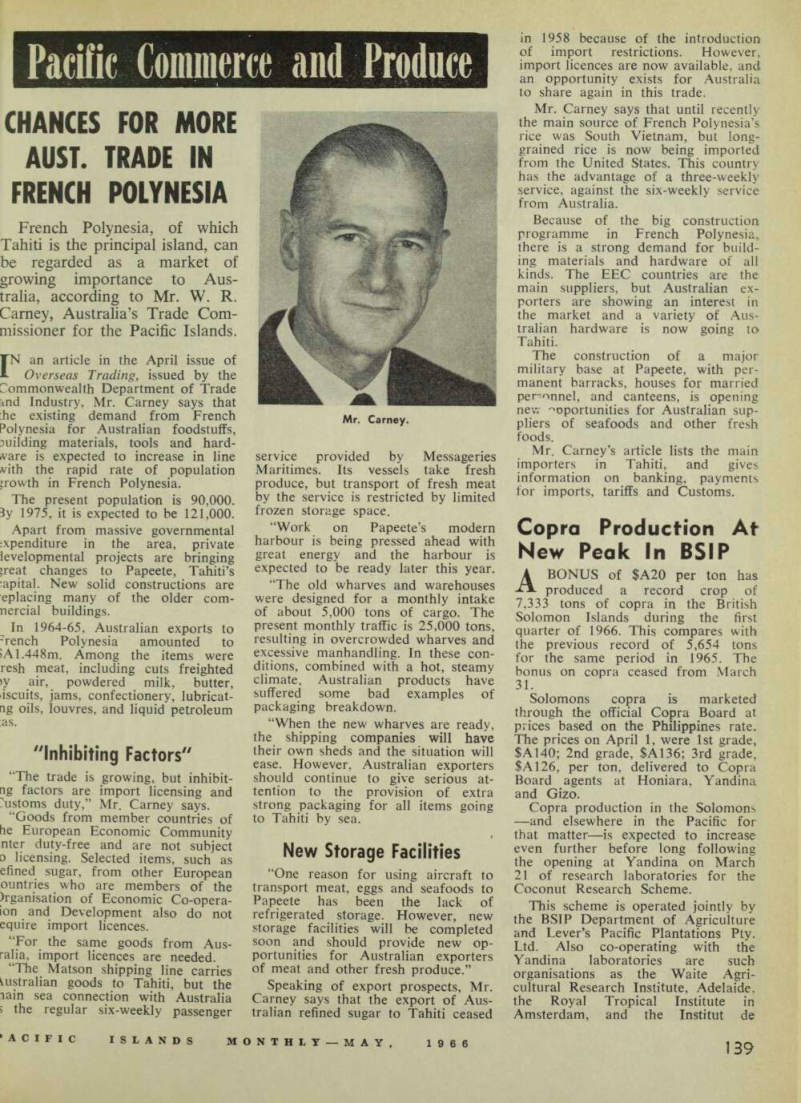
Mr. Carney.
Recherches pour les Huiles et Oleagineux in Paris.
The Yandina centre also exchanges information and experimental materials with research workers in South Africa, Jamaica, India, West Africa and other countries.
At the opening of the centre, Mr.
A.D.S. Dutf, plant breeder for Lever’s, said that the work of the centre was directed to all means of increasing coconut production.
These included the development of palms yielding up to 50 per cent, more coconuts than present varieties, palms that would begin to bear earlier and the finding of the most economic methods for replanting and replacing old plantation stands.
Pyrethrum Factory's
Production Slow
PRODUCTION at the South Pacific’s first pyrethrum factory had been handicapped by a shortage of pyrethrum flowers, but it is pro ceeding intermittently, the managing director of Stafford Allen and Sons Ltd., Mr. Peter Muller, said in Sydney in April.
Stafford Allen pioneered the in dustry in the South Pacific when it established last year a $400,000 pyrethrum processing factory at Kagamuga, near Mt. Hagen, New Guinea.
It now employs a staff of five Europeans and 28 natives.
Mr. Muller said that the factory would be officially opened by the Australian Governor-General, Lord Casey, on May 16.
He hoped the arrival of Lord Casey would stimulate interest in the crop among the 2,000 New Guinean growers and local government coun cillors who would attend the opening ceremony.
Dylup Profit
Down
Dylup plantations ltd., New Guinea cocoa, copra and rubber grower, suffered a 23 per cent, drop in net profit in the financial year ended January 31, when com pared with the previous financial year.
The net profit was $81,278 ($109,308) in 1964-65.
The directors say the fall in profit was caused by very low cocoa prices and reduced cocoa production because of an unprecedented drought in the second half of the year.
They recommend a final dividend of 6i per cent., making 12i per cent, for the year.
Major Move In N.C.
Nickel Industry
NEWS recently that the world’s biggest nickel producer, the International Nickel Company, of Canada, intended to begin operations in New Caledonia resulted in some 400 applications for prospecting permits being lodged with New Cale donia’s Mines Department by the end of March.
Most of the applications were for low grade nickel ore in southern New Caledonia, where International Nickel hopes to build a refinery.
Noumea’s reliable Bulletin du Com
merce stated in mid-April that negotiations in France to pave the way for the entry of International Nickel to New Caledonia were pro ceeding smoothly.
The start of the company’s opera tions would be a major step in the development of the southern tip of New Caledonia.
Although it is almost a block of metal, with iron, nickel, chrome, manganese and cobalt all being present, the region has only been opened up since the war and parts of it are still unexplored.
This is the region of the Plain of Lakes and the Yate hydro electric complex; of the “wastelands” and exotic flora, much of which is found nowhere else on the island. It is also thought to be the last stronghold of the cagou, New Caledonia’s flightless bird.
Japanese interests mined iron ore at Goro, on one corner of the Plain of Lakes, just before the war.
It is generally believed that they took the iron ore for its small nickel content —the very content that makes New Caledonian iron ore generally unacceptable for smelting.
The Bulletin says that International Nickel expects to take about two years of experimentation and research to find the best system for treating the local nickel ores.
At present, nickel accounts for well over 90 per cent, of New Caledonia’s exports.
New Fishing Plan
For Norfolk Island
TWO Sydney businessmen, Mr. L.
A. Semple and Mr. R. Davis, discussed with the Norfolk Island Council in April their plan for a new fishing industry for the island.
They hope to get Canberra approval for erection of a processing factory on Crown land west of the Kingston pier.
The proposed installation will be serviced by fishing boats designed by De Havilland, working around Norfolk waters. There will be two way radio communication between ship and shore, and echo-sounding devices for tracking fish.
The businessmen have said local fishermen will be given preference in the recruiting of fishing crews and that local women will be employed in the packing department. Surplus vegetables from island growers may also be processed for local consump tion.
A correspondent says that if approval of the plan for the erection of the factory is given this will be the third fish factory to operate on the island in recent years. One was
built by the Burnt Pine Investment Coy. Ltd. and later taken over by the Norfolk Whaling Coy. Ltd., and the other was built by Norfolk Island Fisheries Ltd. and had to close down.
Misima Continues
To Look Good
HOPES of an El Dorado on Misima Island, Papua, have in creased following the latest investiga tions of Cultus Explorations Ltd., the Canadian company which has a large interest in the Pacific Island Mines Ltd. property, Cultus has successfully concluded negotiations for major financing of further development work on Misima.
The Canadian company has re ported to its shareholders that Misima has two main features: A gold and silver deposit some 400 ft to sea level, one lode alone having a potential value of at least $l4 million Canadian, and possibly $37 million if lodes are connected; and a zinc
lead-copper deposit also carrying gold and silver, the commercial value of which is yet to be deter mined.
The Cultus company believes that Misima contains a big ore body, and that shareholders “will be amply rewarded”.
The new finance is suffcient to put the property into production, but final decision on installation of a treatment mill will not be made until after the end of the year.
Koitaki Holds
Dividend
KOITAKI Para Rubber Estates Ltd., is holding its interim divi dend at I2i per cent, for the half year to December 31, although profits for the period were slightly less than required to cover the dividend.
The directors expect profits for the second half of the year to be higher than those of the first half, and a final dividend will be decided on the results.
Factors which will govern a final dividend are world prices for rubber and coffee, and whether coffee beans ripen and can be picked before the close of the financial year.
Rubber output was affected by abnormally dry weather, but con ditions have now returned to normal.
Production of coffee also fell—by almost nine tons to 38.75 tons, in the dry spell.
Fiji Industries
Prosper
Fiji Industries Ltd., Cement
manufacturer, based at Lami, near Suva, continues to prosper— with an increase of three per cent, in the annual dividend in sight.
The interim dividend has been in creased from five per cent, to 6i per cent., indicating an annual rate of 13 per cent.
The directors reported that both sales and profits showed an increase in the half-year to December 31, compared with the corresponding six months of the previous financial year.
Fiji Industries was formed in 1960 and started manufacturing cement in 1962.
Its record has been one of steadily increasing profits after a loss in the first year of operations.
Leading Australian companies which have substantial interests in Fiji Industries are CSR, W. R.
Carpenter, Burns Philp, Development Finance Corporation and Dickson Primer.