travel
pp. 127-129 · Read in the full issue
Fare Cuts For 'World's Most Expensive Piece Of Water'
By a Staff Writer
The South Pacific can expect a big increase in tourist travel by air as a result of proposals for big fare cuts, which have sent most major airlines serving the area hastily climbing aboard the economy bandwagon.
THE showdown seems likely to take place at the International Air Transport Association conference at Honolulu in September.
The first crack in the harmony of the airlines Pacific fare structure came in Suva on April 1, when the newly appointed Fiji manager of Canadian Pacific Airlines, Mr. R. A.
Godfrey, announced that his airline would seek fare reductions of up to 40 per cent, on 30-day excursions and of 20 per cent, on all first class and economy round-trip fares cross ing the South Pacific.
Authority would be sought to intro duce these cuts from May 1, Under the 30-day economy ex cursion arrangement a Sydney- Vancouver return would cost £F239/17/-, a £FIS9/16/- reduction and the regular round trip fare re duced 20 per cent, would be first class £F44B/3/-, economy £F3I9/8/-.
Mr. Godfrey advanced cogent reasons for seeking the reduction in air fares over what he termed, “the most expensive piece of water in the world to fly over”. He said the pro posed cuts “would make the South
travel
Pacific much more competitive in attracting visitors”.
He said the new low fares would be justified by the economic efficiency and passenger-carrying capacities of the big jet aircraft now serving the South Pacific routes.
The CPA decision was also in line with: • A resolution of the recent Pacific Area Travel Association con ference in India, calling on air lines to lower their fares across the Pacific. • Pressure from the United States Civil Aeronautics Board to re duce air fares in the South Pacific which were currently higher than those in other parts of the world.
Mr. Godfrey’s announcement was given support by CPA vice-president Mr. Hugh Main, who arrived in Suva soon after to say that if all airlines
adopted the reduced fares proposed by his company, total passenger traffic would increase by more than 40 per cent, above normal growth.
Among points Mr. Main made were that air fares across the Pacific were almost double the cost per passenger mile across the Atlantic.
One of the effects of this was that the cost of transportation on a Euro pean tour represented only 18 per cent, of the total cost, compared with 67 per cent, in the South Pacific.
As a result the traveller to the South Pacific spent only 24 per cent, of the total cost of the tour in the
host country compared with 58 per cent, in Europe.
He said that lower fares would mean more potential travellers and it was well-known that there was particular elasticity in the North American market.
In an editorial, The Fiji Times commented: “Air travellers and all interested n the tourist industry in the South Pacific will watch with interest to >ee where the ripples finish from the done thrown into the pool by CPA.
“The initiative taken by CPA has made it inevitable that the whole question of air fares in the South Pacific should be brought out into he open, which is the proper place 'or all such things.”
Mr. Main flew on to Australia and Zealand to seek support for the ower fares policy from Qantas and \ir New Zealand.
His proposals received a cautious eception in NZ, the New Zealand )fficials reported as being sympa hetic, but taking the view that the :urrent fare structure in the South s acific had been agreed upon already md was due to run until next year.
Qantas and Pan American were nore definite. A Qantas spokesman aid his company had been seeking ower tourist fares for some time.
He said “massive” reductions on fares could occur from April next year, if other airlines operat ng South Pacific routes agreed to the uts at the lATA conference.
The New Zealand director of Pan American, Mr. W. L. Rolph, said hat his company would welcome alks with other carriers in an effort o introduce practicable fare reduc ions.
When the first ripples had reached he side of the pond by the end of kpril it seemed there would be no
fare cuts until next year and that all the airlines, including CPA, would have more talks through the regular lATA conference channels.
Meanwhile, top executives from American-owned Eastern Airlines and Continental Airlines visited New Zealand.
The two airlines are among many which all hope to be chosen as the United States’ second South Pacific operator.
Mr. D. D. Taylor, the vice president of public affairs of Eastern Airlines, warned New Zealand to get ready for a great upsurge of tourism.
“Jets have transformed tourist and travel concepts in Honolulu, Mexico City, Acapulco and Tahiti,” he said.
“That is going to happen to New Zealand, whose tourist potential has not been scratched so far.” • The ground was broken in Saipan, US Trust Territory, in April for the start of a 50-room private enterprise hotel costing SUS4OO,OOO.
It will give the northern Marianas facilities to attract a bigger tourist trade. The hotel is being built by the Micronesian Hotel Corporation, which is making 40 per cent, of its shares available to territory citizens, and offers transfer to Micronesian ownership after 20 years if an offer to buy is forthcoming.
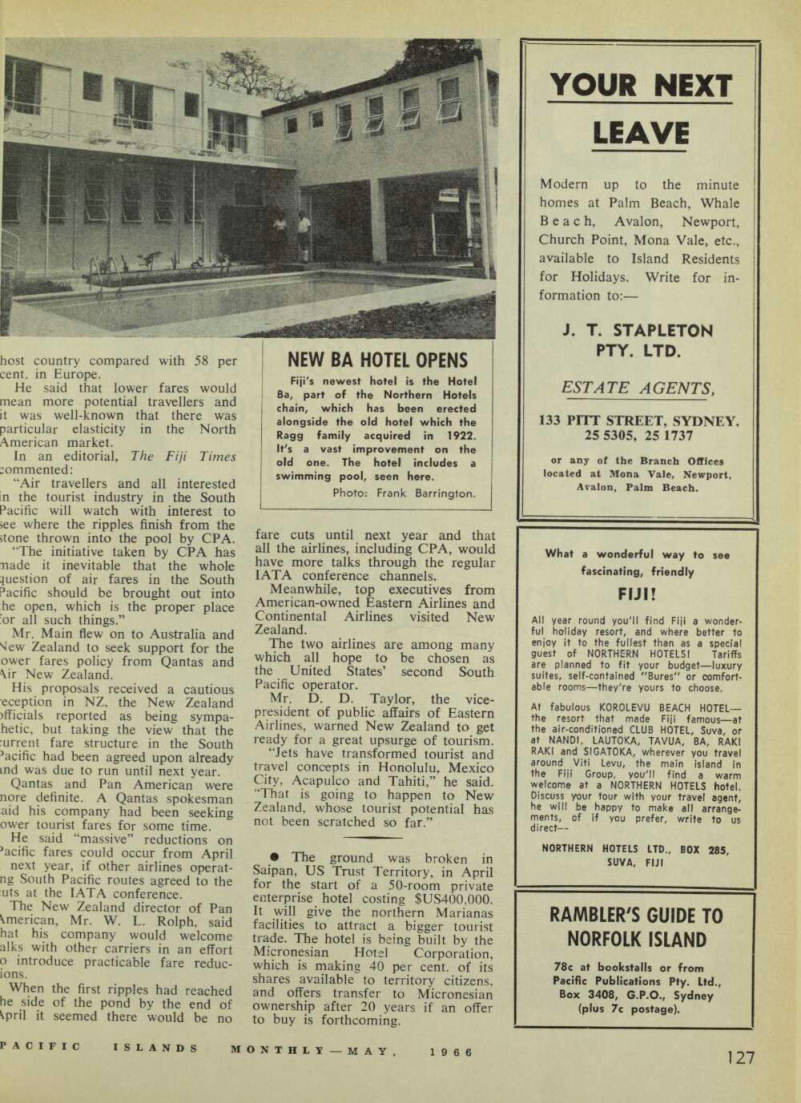
New Ba Hotel Opens
Fiji's newest hotel is the Hotel Ba, part of the Northern Hotels chain, which has been erected alongside the old hotel which the Ragg family acquired in 1922.
It's a vast improvement on the old one. The hotel includes a swimming pool, seen here.
Photo: Frank Barrington.