Cruising Yachts
pp. 101-113 · Read in the full issue
Pacific Shipping And Cruising Yachts
New Zealand Help
For Cook Islands
Harbour Projects
The New Zealand Government decided in early April to make a grant of £9,000 towards the cost of replacing the wharf at Avarua,
Rarotonga.
BUT no decision had been made to mid-month on loans sought by the Cook Islands Government to develop Avatiu Harbour at Rarotonga as the principal port in the group, and to widen the reef passage and improve landing facilities at the outer island of Mangaia.
The jetty at Avarua, which is to be replaced, was put out of action by the hurricane that swept through the Central South Pacific at the end of January. The entire structure was buckled when the hurricane snapped its piles ( PIM, March, p. 49).
The New Zealand Minister of Is land Territories, Mr. I. R, Hanan, said on April 12 that his Government was considering granting loans total ling £101,500 for harbour facilities at Avatiu Harbour and at Mangaia.
Technical Data
He said information on the tech nical aspects of both harbour develop ment projects was being supplied by the Cook Islands Government, and the means of servicing the loans was being studied.
The question of harbour develop ment at Avatiu and Mangaia was dis cussed with a 10-man Cook Islands economic mission, headed by the Premier, Mr. Albert Henry, in Wellington last December ( PIM, Feb., p. 107).
However, on that occasion Mr.
Henry’s party asked for loans total ling £76,500. Mr, Hanan’s statement did not explain why his government was now considering granting loans totalling £101,500 for the two pro jects.
Ship Given To
G.E.I.C. Government
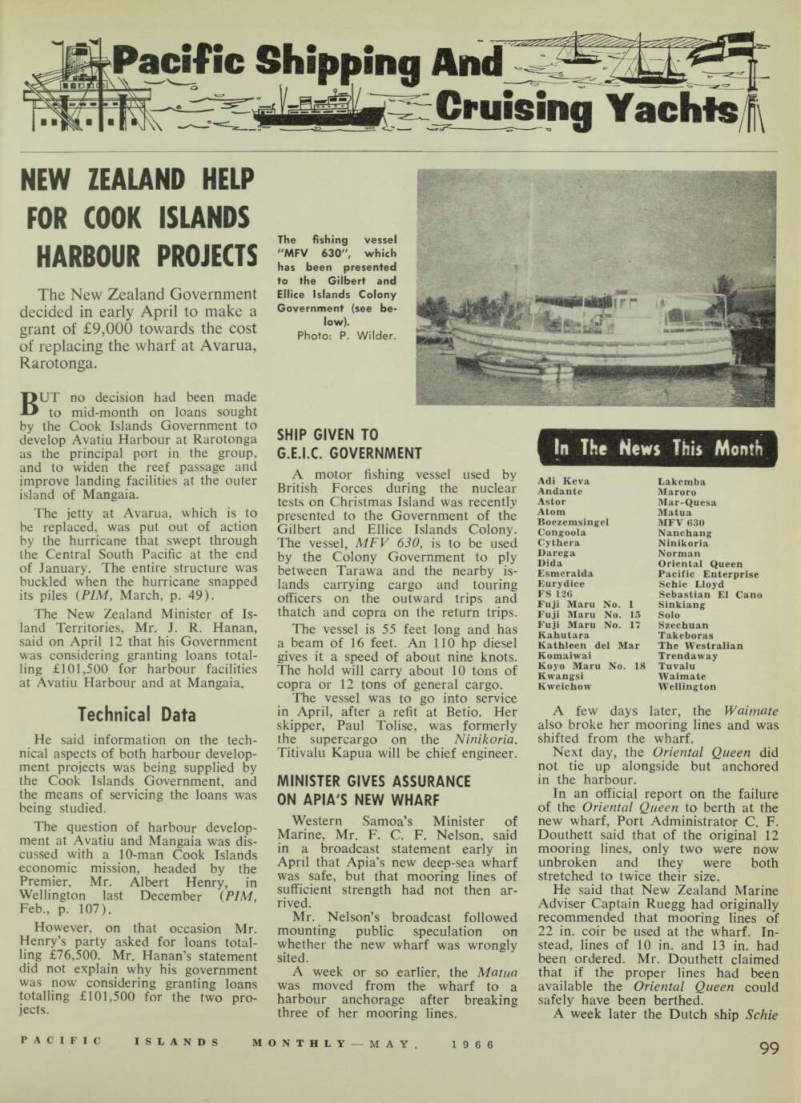
A motor fishing vessel used by British Forces during the nuclear tests on Christmas Island was recently presented to the Government of the Gilbert and Ellice Islands Colony.
The vessel, MFV 630, is to be used by the Colony Government to ply between Tarawa and the nearby is lands carrying cargo and touring officers on the outward trips and thatch and copra on the return trips.
The vessel is 55 feet long and has a beam of 16 feet. An 110 hp diesel gives it a speed of about nine knots.
The hold will carry about 10 tons of copra or 12 tons of general cargo.
The vessel was to go into service in April, after a refit at Betio. Her skipper, Paul Tolise, was formerly the supercargo on the Ninikoria.
Titivalu Kapua will be chief engineer.
Minister Gives Assurance
On Apia's New Wharf
Western Samoa’s Minister of Marine, Mr. F. C. F. Nelson, said in a broadcast statement early in April that Apia’s new deep-sea wharf was safe, but that mooring lines of sufficient strength had not then ar rived.
Mr. Nelson’s broadcast followed mounting public speculation on whether the new wharf was wrongly sited.
A week or so earlier, the Matua was moved from the wharf to a harbour anchorage after breaking three of her mooring lines.
A few days later, the Waimate also broke her mooring lines and was shifted from the wharf.
Next day, the Oriental Queen did not tie up alongside but anchored in the harbour.
In an official report on the failure of the Oriental Queen to berth at the new wharf, Port Administrator C. F.
Douthett said that of the original 12 mooring lines, only two were now unbroken and they were both stretched to twice their size.
He said that New Zealand Marine Adviser Captain Ruegg had originally recommended that mooring lines of 22 in. coir be used at the wharf. In stead, lines of 10 in, and 13 in. had been ordered. Mr. Douthett claimed that if the proper lines had been available the Oriental Queen could safely have been berthed.
A week later the Dutch ship Schie
The fishing vessel "MFV 630", which has been presented to the Gilbert and Ellice Islands Colony Government (see be low).
Photo: P. Wilder.
Lloya of 550 feet, berthed at the wharf with no trouble, using nylon towing lines on loan from the har bour contractors.
Western Samoan Wharf
Stamps Show Profit
The opening of Western Samoa’s first deep sea wharf at Apia in March has been commemorated by a special issue of postage stamps.
The stamps, which are in four denominations with a total value of 5/9 per set, will remain on sale until June 2, unless stocks are exhausted earlier.
Sales on the first day of issue re turned the Western Samoan Govern ment £8,600. Overseas orders repre sented £7,200.
They cost £2,500 to produce.
The Minister of Post Office and Radio, Fa’alava’au Galu, said the sales reflected increasing international interest in Western Samoan stamps.
P-Ng Administration To
Train Engineers
A course to train young Papuans and New Guineans to work on coastal vessels started at Port Moresby on April 15.
The course, the third to be or ganised by the Division of Marine, Department of Trade and Industry, will last one year.
Fifty Papuans and New Guineans, who have reached standard six or higher qualifications, were selected from more than 200 applications.
Twenty of these trainees will learn about maintenance and operation of diesel engines, outboard motors, and the names and usage of tools. Suc cessful trainees will become marine engine operators, grade one.
The remaining students will study various aspects of seafaring, includ ing rope, sail, anchor and chart work, the use of mariner’s compass and general ship maintenance.
Successful trainees from the two previous courses are now working aboard Administration and commer cial vessels on the coast.
More Volcanic Activity
In The Solomons
The BSIP’s Chief Geologist, Mr.
John Grover, who has taken a keen interest recently in predicting the activities of volcanoes ( PIM , Jan., p. 15), believes that Tinakula Volcano in the Santa Cruz Group may erupt violently about September and October this year.
Tinakula has been active since
November 23 last year when it blew its top after 14 years of quiescence.
On March 12 it was reported that eruptive activity was every 10 minutes, that a cloud of white steam was being emitted, but that there were no earth tremors. The 187 men, women and children who live on Tinakula were staying on the island for the time being.
Mr. Grover said in late March: “As Tinakula Volcano has cleared its throat, and the type of eruption is known to be one of basaltic lava from a conduit with a westerly bias away from the populated side of the island, the islanders should be able to
remain for the time being in reason able safety.
“Basaltic lava eruptions under these conditions are relatively safe.
“Notable earth tremors and changes in gas emission should provide adequate warning to the islanders and give them time to get away.
“Intermittent eruptions are ex pected in the immediate future but of no greater magnitude than re cently, “Present calculations suggest the convergence of effects in the mantle beneath the earth’s crust in the Tina kula Volcano area in September and October, 1966, when there will be a
ansiderable risk of a much more iolent eruption.
“The District Commissioner will be dvised with full details closer to te event, when it will be recom lended that the islanders be evacu ted from the volcano.”
Meanwhile, there has been further :tivity from the submarine volcano Dout 20 miles south of Vangunu, hich was first reported to be erupt ig irregularly in mid-December p /M, Feb., p. 21).
The crater rim of the volcano was ten about a foot above sea level, it a month later it was reported to j subsiding, and Mr. Grover said j expected it to settle down as much > 30 ft below the surface (PIM, farch, p. 99).
The latest report on the volcano is come from Mr. Wolf Lackshewitz, ho found it in eruption and cine- Imed its activity on March 21.
Mr. Lackshewitz described the >lcano as being totally submerged, id not visible.
Every five minutes there was a ries of explosions, the first hurling it with great violence a pillar of ack rocks and fragments, the next iing an eruption of steam im ediately following, and the next ack.
Within a short period there were ternately black and white columns irsting through the surface of the a: rocks and steam alternately, his was followed by about five inutes of no activity.
Far East-Fiji Service
Rearranged
The China Navigation Co. ships, Sinkiang and Szechuen, which have been servicing Suva and Lautoka from Japan and Hong Kong, are to be sold.
In May the Fiji service by the China Navigation Co. will be taken over by four ships which now operate a Japan - Hong Kong - New Zealand service.
These ships are the Kwangsi, Norman, Nanchang and Kweichow.
After calling at Suva and Lautoka on southbound voyages they will go on to Auckland, Wellington, Lyttle ton, Dunedin, Bluff (occasionally), Napier and Mt. Maunganui.
Port Moresby Seamen
Seek Award
The Port Moresby Workers’ Asso ciation is seeking an award for sea men working on coastal ships based in Port Moresby. About 40 members of the union are affected.
All employers operating Port Moresby-based ships will be asked to take part in negotiations.
The employers include Steamships Trading, Burns Philp, the Federation of Native Societies, New Guinea Co. and Keith Tetley.
Book Out Soon On
Epic Drift Voyage
A book describing the ordeal of Teehu Makimare on his 64-day drift voyage from Rakahanga, Cook Is lands, to Erromanga, New Hebrides, in 1963, has been selected as the alternative Book Society choice for June.
The book, The Man Who Refused To Die, will be published in the first week of June.
The book was written by an English author, Barry Wynne, and has a foreword by the New Zealand Prime Minister, Mr. Holyoake.
It was serialised in an English Sunday newspaper late last year, at about the time that Makimare visited London to receive the Royal Humane Society’s Stanhope Gold Medal for Bravery ( PIM, Jan., p. 97).
In August, 1963, Makimare and six companions were blown off course in a storm while making the 26-mile crossing from Rakahanga to their home island in a 17 ft boat. An un successful sea and aerial search was made for them, and they were given up for lost.
Two months later, however, Maki mare and three companions—three having died en route —reached Erro-
manga, having drifted about 2,000 miles.
One of Makimare’s companions died shortly afterwards.
Makimare was awarded the Stan hope Medal for his outstanding endurance, self-sacrifice and qualities of leadership during the epic voyage.
Dutch Purchase Arrives
For Fiji Trade
The 339-ton Dutch ship Boezem singel, which Island Industries Ltd., of Suva, bought recently for the inter island trade in Fiji, arrived in Suva on April 14 from Holland. She will go into service in May, joining the Komaiwai and Adi Keva.
The new ship, which was built in Holland in 1961, will be altered to suit tropical conditions. She has an overall length of 159 ft, a beam of 27 ft, and a draught of 10 ft 8 in.
She is powered by a 450 hp Industrie engine, has a service speed of about 10 knots, and can carry about 6,000 sacks of copra.
New Hebrides Ship
In The Geic
The 205-ton motor vessel Darega, owned by Captain Athol Rusden, of Vila, New Hebrides, was in somewhat unfamiliar waters in March when she delivered a cargo of aviation fuel to Tarawa, in the Gilberts, and Funa futi, in the Ellice Islands.
However, her chief engineer, Otto Poznaski, was not new to it all, as he was a resident of Funa futi in the days before 1956 when the Wholesale Society at Tarawa sold the 120 ft Tuvalu, of which he was also chief engineer, in Fiji. Otto went, too.
Otto told a reporter from Colony Information Notes, the GEIC news letter, that he was happy to see the many new buildings that had gone up in the Colony since he had left.
The only thing he did not like
ETCH SKIPPER: Well-known yachtsman fall Price arrived in Honiara, BSIP, at [?]e end of January with his 80 ft ketch Wellington", which he hoped to use or charter work in the Solomons, with oniara as his base. With him on the enture were Don Brug and Carl Green reet. Price made a name for himself as tipper of the tiny 22 ft "C'Est La Vie".
Teehu Makimare.
was the quietness of the place. At Funafuti, he said, there was hardly anyone walking about after 7 p.m.
The Darega was one of three ships from different territories that were at anchor at the same time off Betio Islet, Tarawa, in late March.
The others were the FS 126, a US Army craft, with a Filipino crew, which arrived on March 25 with a unit of 12 men who are to be stationed on Betio for the next 12 months to track satellites as part of a survey project; and the oil tanker Pacific Enterprise.
Japanese Trawler Saved
From Fiji Reef
The Japanese fishing trawler Fuji Mam No. 15 steamed into Suva on April 6 after being aground on a coral reef of Nukulau Island, 12 miles from Suva, for three days.
Listing to starboard, the trawler tied up at the slipway berth for an examination of her hull by divers, who found little damage.
The trawler was on her way from Levuka to Suva when she went aground on a spring tide. She was pulled off the reef by a sister ship, Fuji Maru No. 17, after about 40 tons of fuel (10,000 gallons) had been pumped out of her tanks.
Another sister ship, Fuji Maru No. 1, stood by outside the main barrier reef while she was being pulled off.
On the previous day, the Japanese fishing ship Koyo Maru No. 18, which capsized while refuelling at Levuka on December 14, and which was refloated on March 31, was towed outside Levuka Harbour and
sunk in deep water. Previous attempts to refloat the vessel had failed.
The successful attempt was made by Captain Stan Brown, of the Maroro, and Mr. Macleay Laurie, a marine contractor at Port Adelaide.
They won a contract to remove the ship, which had hampered berthing at the Levuka wharf.
Stop-Gap Dredging
Operations For Noumea
Dredging has started on a small scale in the port of Noumea, New Caledonia, following recent criticism in the local Press about the lack of sufficient depth of water for some of the ships calling there.
A sum of $4,000 has been allocated to carry out emergency dredging operations. Captain Cyriaque Mary is at present engaged in this work with a small dredge. Captain Mary was engaged in similar work around the wharf edges in 1965, when the depth of water was increased from about 22 feet to 26 feet.
Past operations have also turned up bombs and shells lost from the American ships during loading opera tions in World War 11.
Local experts are asking for the dredging operations to be repeated annually. They say that the harbour silt comes mainly from the mud and road metal in Noumea’s drains and the waste (scoria) from the nickel smelters which is being used for land reclamation in the vicinity of the smelters. Much of this waste is car ried into the harbour by currents.
Gen. Billotte, France’s Minister for
Overseas Territories, on a recent visit to Noumea promised that a new quay would be built in the harbour, running at right angles to the existing wharves.
Reported Imprisoned By
Indonesians
A Queensland fisherman, K. M. (Bluey) Bedford, was reported to be imprisoned in a West New Guinea gaol in mid-April after sailing to Merauke to buy crocodile skins.
Bedford, 38, sailed from Thursday Island on March 23.
Merauke is about 200 miles north west of Thursday Island.
Friends of Bedford in Daru, in the Western District of Papua, said in April that he had visited Merauke twice since the Indonesian take-over of West New Guinea.
They said that before the take-over Merauke had been a regular port of call for Bedford, as he had friends there.
However, an Administration spokes man in Port Moresby said it was now believed that Bedford had been gaoled by the Indonesian authorities.
He did not know on what charge he had been arrested and inquiries were continuing.
Bedford, who lives aboard his 42ft work boat The Westralian, has been operating in Northern Australian waters for the past 20 years.
His last shore address was Cairns, Queensland, but he spends most of his time at sea or in the islands between Cape York and the Papuan Gulf.
• Kathleen Del Mar, 55 Ft
ex-Scottish Fisheries Protection vessel, owned and skippered by Bern Cuth bertson and crewed by four of his children, Rodney, 18, Michael, 15, Charmaine, 15, and Adrian, 13, arrived at Rarotonga from Papeete on March 23.
Mr. Cuthbertson bought the vessel at Teddington, near London, and sailed from the United Kingdom on September 29 last year. His wife and youngest boy, aged 11, were originally in the crew, but left the vessel in Tahiti and returned home.
After leaving Rarotonga, Kathleen del Mar will call at Auckland, then proceed to Tasmania.
Mr, Cuthbertson is a cray fisher man from Tasmania and all his family are Australians. Last year he took the well-known racing schooner Astor from Australia to the US. • LAKEMBA, 26 ft yacht for merly owned by the author-yachtsman Harry Pidgeon, arrived at Rarotonga on March 25 from Papeete with lone hander John Roberts of San Pedro, California.
In the Society Islands, Lakemba almost met disaster on two occasions.
At Huahine, rough seas forced her on to a coral wharf, but she was saved by Islanders on their way to church who, disregarding damage to their “Sunday best”, refloated her.
As Lakemba was leaving Papeete harbour she was rammed by an ap proaching fishing boat which had failed to keep a proper watch. The bowsprit was smashed and the rudder and toe rail broken.
The Tahitian captain of the fishing boat made amends by paying for the repairs and playing host to Mr.
Roberts until Lakemba was ready to leave.
Mr. Roberts plans to visit Tonga, Fiji and New Zealand. In Fiji, he intends to visit Lakemba Island after which the vessel was named by Harry Pidgeon. • DID A, 52 ft ketch, owned and sailed by Englishman Geoffrey Mathews, left Durban, on March 3, for Cape Town, after about three months’ stopover in Durban.
Geoff, who is well known in the New Hebrides and Solomons for his crocodile hunting exploits, sailed Dida single-handed from Timor to Durban
last year. He bought her in the New Hebrides in 1963.
Accompanied on his latest voyage by Miss Raina Nieland and Raymond D’Abbadye, Geoff was considering sailing to the Mediterranean, then the West Indies to explore the possi bilities of charter work. • ATOM, 30 ft Tahitian ketch from New York, sailed solo by veteran yachtsman, Jean Gau, cap sized and was dismasted on February 27 soon after leaving Durban on the last leg of a voyage round the world from New York.
Masts, bowsprit, sails and dinghy went overboard while Gau was riding out a 50-knot gale about 50 miles off the southern coast of South Africa.
He cut away the rigging still attached to the masts and the following day made for the nearest port, Mossel Bay. In mid-March, Gau was planning to return to Durban for repairs. He will stay there for the rest of the year, as the hurricane season is now too far advanced for him to resume his voyage.
Gau, a naturalised American, crossed the Pacific in 1964, calling at Pitcairn Island, Tahiti, Samoa, New Zealand and New Guinea. He has been sailing since 1937 and has seven singlehanded Atlantic crossings to his credit, and one previous voyage round the world. • ANDANTE, 34 ft fibreglass sloop with American skipper Donald Wood and a crew of one, was scheduled to leave Whangarei, New Zealand, in late March, for Seattle, Washington, USA.
Andante made a Pacific cruise
last year with calls at Nukualofa, Nomuka, Vavau, Pago Pago, Apia, Savaii, Wallis and Futuna, Fiji, the New Hebrides and New Caledonia.
In a note to PIM from Whangarei, Mr. Wood said he planned to sail to the US via the Cook Islands, Tahiti and Hawaii. • SOLO, 57 ft Sydney yawl, with veteran Australian yachtsman Vic Meyer sailing single-handed, arrived back in Sydney on April 4, after a 13-month cruise around the world from east to west.
Meyer left Sydney in March last year, with a two-girl crew and sailed via Brisbane to Darwin, where one girl left because of seasickness and another signed on.
Solo then continued via Cocos Is land to the Mediterranean where the two girls got off. Vic Meyer picked up a male crew member, Bob Blaikie, in Gibraltar and continued across the Atlantic to Panama and Honolulu, where Geoff Swanson signed on as crew. Next call was at Nukualofa, Tonga, where Blaikie and Swanson signed off.
Mr. Meyer sailed the 2,200-mile leg from Tonga to Sydney in 13 days. ® CONGOOLA, 73 ft Bermuda rigged ketch, skippered by Mr. Wally Goddard, called at Lord Howe Is land, in early April, en route to Honiara, British Solomon Islands, where she is to be used in mineral survey work.
Congoola has been bought by the United Nations Organisation to assist the Solomons Government in a mineral resources survey which is
being carried out with the assistance af the United Nations Development Programme.
The vessel was built shortly after World War 11. She is fitted with two 115 hp diesel engines. She sailed round the world about 10 years ago and has since made many Tasman :rossings.
In 1963 she was “mother ship” for :he Sydney to Hobart yacht race. • EURYDICE, 20 ft yacht, sailed :o Lord Howe Island from Sydney n 1955 by Mr. Maurice de Verteil, las been refitted by Mr. Les Rohan and is now sailing in Lord Howe vaters after having been out of action iince her arrival at the island.
The original owner, Mr. de Verteil, recently wrote to Lord Howe Is. resi dent Mrs. A. Retmock, telling of his atest venture —a yacht trip from Canada to the West Indies, where he vas joined by his wife. • TREND AW AY, 35 ft ketch, vhich went aground but was refloated Torn Rarotonga’s reef in February, vas still in Avatiu harbour in April, awaiting full repairs. The ketch is 3wned and skippered by Mr. Norman 3aylay, a Canadian, of Oakland, ralifornia.
Through a friend in San Francisco, yir. Baylay is arranging to have oak Fames and H in. planking of Philip )ines mahogany shipped to him from he US. When the timber arrives he lopes to have Trendaway hauled out or repairs at Avatiu.
If the repairs cannot be done ocally, he will sail the ketch to Suva.
The vessel is insured with Lloyds, vhich means, according to Mr. laylay, that when the repairs are lone Trendaway will be as good as 'ew —if not better. The ship has oak rames and planking of Philippines nahogany.
Former crew members Jim Peterson nd Christopher Duncan have now -ft the ship, but Duncan intends
to return to Rarotonga after obtain ing an entry permit in NZ. • CYTHERA, 50 ft steel ketch, set sail from Sydney on April 16 on the world cruise that her owners, Mr. and Mrs. Peter Fenton, set out to accomplish three years ago.
The Fentons’ cruise of three years ago came to a halt only two weeks after they left Sydney when two crew members stole their ketch while they were attending a dance at Lord Howe Island.
The ketch was recaptured off Norfolk Island, but was damaged in a collision with the Colorado del Mar while the two thieves were trying to
out-manouevre that ship. The Fen tons flew to Norfolk Island to sail Cythera back to Sydney, and the two thieves were later sentenced to four years’ gaol each at the Sydney Quarter Sessions.
Because of the collision with the Colorado del Mar, Mr. Fenton had to replace a 12 ft by 5 ft section of Cythera's hull, install four new ribs and replace part of the decking.
He also modified the rigging to im prove the handling of the ketch.
On their new voyage, the Fentons are accompanied by their 12-year-old daughter Penny, and a crew member Bob Coupland.
The new voyage was planned to
"Congoola".
be along the lines of that envisaged originally, with calls at Lord Howe Is., New Zealand, Rarotonga, Tahiti, the Tuamotus. Marquesas, Hawaii and San Francisco. Mexico, Panama, the West Indies and Europe.
However, when the yacht was within 60 miles of Lord Howe the weather turned “dirty” and drove her 150 miles north of the island. Mr.
Fenton then decided to make for Brisbane, where he arrived on May 1, Fears had been held for the yacht’s safety.
The Fentons will now follow the Queensland coast to Thursday Island and cross the Pacific by way of Fiji and Tahiti to San Francisco. • MAR-QUESA, 40 ft Newporter ketch, which has been licking her wounds in Rarotonga since late December after a bad 4i-day trip from Bora Bora, was due to sail from New Zealand in early April.
All the yacht’s sails were ripped in heavy seas and gales during the passage from Bora Bora and had to be sent to New Zealand so new ones could be made.
Owner-skipper Harold Wilden and his wife are accompanied by Mr. and Mrs. James L. Anderson. Mr. Ander son is a freelance photographer of Honolulu.
The Mar-Quesa arrived in Papeete, Tahiti, on October 27 from Hawaii. • TAKEBORAS, sloop-rigged fibreglass yacht, reached Norfolk Island in March in the course of a round-the-world trip. Sailing her single-handed was Hans Mauren brecher, former fighter pilot in the Dutch Air Force.
Maurenbrecher left Holland in July, 1964. and sailed to New Zealand via England, Portugal, Spain.
Gibraltar, the Canary Islands, Panama, the Galapagos, Marquesas, and Tahiti, which he reached in April, 1965.
He married in New Zealand, but as his wife had had no previous sail ing experience, she decided to rejoin him at Aden.
From Norfolk Island, Takeboras (Indonesian for “the trip that goes far away on the sea”), was to call at Brisbane, Cairns, Torres Strait Islands, Cocos Island, Mauritius, Aden, Suez Canal ports, and Mediter ranean ports, before reaching Holland in April, 1967. • KAHUTARA, 45 ft Auckland registered ketch, arrived at Christmas Island on March 16 and Fanning Island on March 23 en route to Hawaii from the Marquesas. On board were Mr. Rex Kershaw, his wife, and three of their four children.