New Community Spirit
pp. 75-78 · Read in the full issue


Is Getting Things Done On Rarotonga
From W. H. Percival on Rarotonga Newly-created village and sub-district committees on Rarotonga, imbued with the old Polynesian community spirit, are getting things done on the island that previously were left undone or would not have been done anywhere near as quickly and efficiently.
THE committees have been formed at the suggestion of the Cook Islands Premier, Mr. Albert Henry, and his colleagues, whose aims include the restoration of “certain aspects of the traditional ways of Polynesian life, customs and culture”.
Allied with this is the desire to in crease the productivity of the little land available.
Productivity has fallen off over the years because of lack of labour, caused by the emigration of many active and useful Islanders to New Zealand; the dislike of many of today’s younger generation for work ing on the land; and the depredations of wandering livestock and thieves.
For these reasons, many land owners have been growing only sufficient crops for their own needs, leaving nothing for the local market.
To combat this problem, thereby reviving some of the old Polynesian ways, Mr. Henry decided to establish village and sub-district committees composed of people best equipped to sort out the peculiar difficulties of their own localities.
Committee members would be elected on merit, regardless of creed, colour or political leanings. People attending meetings of the com mittees would be free to express their own opinions and ideas; and the committees would give villagers a chance to make their own decisions and carry them out, without inter ference from the Government.
Almost Revolutionary
Early this year Mr. Henry and his colleagues spent a lot of time and effort getting these ideas across.
The notion that the Government would not be telling them what to do was regarded as almost revolution ary by many of the people. But once it was fully understood it was accepted with enthusiasm.
Nikao Village Committee was the first to take action under the new “charter”. Early in February after some native shacks had been destroyed by the edge of the late January hurricane ( PIM, March, p. 49), residents went to work in the true Polynesian manner. The men cleared a new building site and erected framing while the women plaited palm thatch for the roofs.
Those who could not attend con tributed money for hardboard, paint and nails, and food for the workers.
Europeans gave generous donations of corned beef, rice and sugar.
After two days’ work two small dwellings and a cookhouse had been built. And they cost the new oc
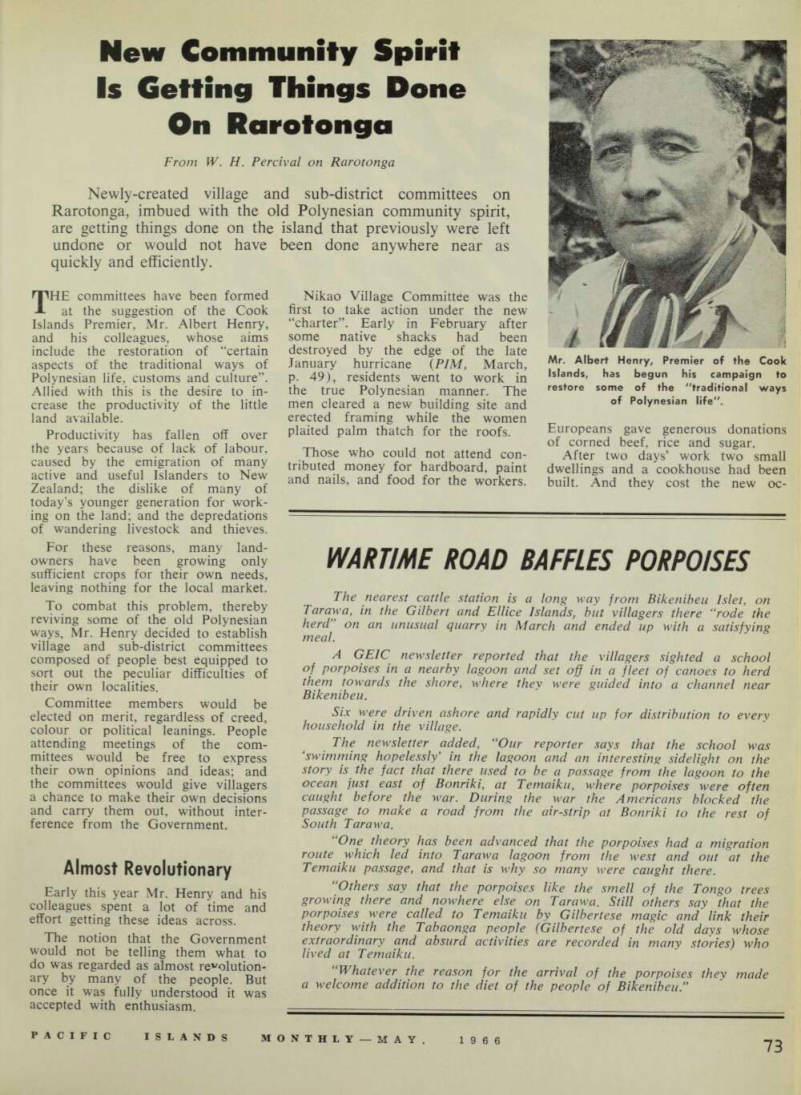
Mr. Albert Henry, Premier of the Cook Islands, has begun his campaign to restore some of the "traditional ways of Polynesian life".
cupants nothing, as even the land on which they stood had been donated.
Weeding
The next Nikao project was the weeding of taro patches and the cleaning of the ditches surrounding them. Then a good deal of other land was cleared and planted, mainly in kumara.
In the Titikaveka district, which has the heaviest rainfall in Raro tonga, 85 male volunteers cleaned out two of the nine creeks in record time, then planted 500 banana shoots for a planter short of labour.
Among the workers were five ordained ministers from the three local churches. The planter’s ap preciation took the form of a generous donation to the village com mittee funds.
In nearby Ngatangiia, a district exposed to the full force of the south and south-east Trades and the heavy seas that sometimes accompany them, the villagers have planted trees along the foreshore to form wind breaks.
Ancient Road
The village committee has also resolved that all land-owning males aged 18 and over must plant their land in food crops before the first week in May. It was made clear that legal action would be taken against those who failed to do so.
In late February the people of Arorangi, the richest growing area of Rarotonga, formed a working bee and removed underbrush and weeds from the private roads leading to the Ara Metua.
The Ara Metua is an ancient road
believed to have been built about 1,600 years ago. Parts of it are still in use today.
After clearing the access roads, the 70 or so Arorangi volunteers cleaned and repaired that part of the Ara Metua running through their district.
In another part of Arorangi the stream that drains extensive taro swamps had become blocked with fallen trees, watergrass and sedge, resulting in the taro beds becoming inundated and much of the crop being destroyed.
This problem, a major one requir
ing a large work force, was thrashed out at a committee meeting. The people living near the stream agreed to do the job and 40 men started work shortly afterwards. They worked like demons, giving each other frequent spells. The project was completed in li hours.
Extensive planting of bananas, taro, kumara and other subsistence crops was aso carried out.
In the Avatiu-Ruatonga village area, close to the main township of Avarua, 60 men worked together to clear the Avatiu sports ground and drains.
In early March, the people of Tutakimoa-Teotue, an area which is really part of Avarua, tackled the big project of clearing all the main drains extending for about half a mile.
The committee members said work would start at 7 a.m., but expected only about 30 men to turn up in “Maori time”—about an hour late.
The European committee members turned up a little late themselves— and were startled to find 120 men and boys already hard at work.
In places the drains were blocked by solid masses of weeds 7 ft high, and it appeared an impossible task to clear them. But as weary men fell out for a breather others leapt in to take their place, attacking the obstacles with supercharged energy.
In four hours all the main drains had been cleared.
There were generous contributions of food from Maori and European —bananas, bully beef, coffee, pies, cakes, biscuits, raw and fried fish, this latter item being almost a delicacy in fish-starved Rarotonga.
Hard-working and cheerful women prepared the food which was more than enough to feed the hungry workers and the children of the village. A quantity of tinned and cooked food remained uneaten, and this was given away later.
"Overwhelming Success"
In the words of the secretary of the village committee, in a letter of thanks in the Cook Islands News: “This, our first village project, was such an overwhelming success that it has shown us, as a committee, that we have the support of the whole village behind us.”
The sub-district and village com mittees are essentially in the old Polynesian tradition brought up-to date—which accounts for their success.
In the “old days” the activities they are now arranging were organised and directed by the chiefs and sub-chiefs of the various tribes.
Thieves, loafers and delinquents were heartily discouraged, and it is one of the safer bets that there was far less petty crime than we know today.
It is to be hoped that the com mittees will extend their activities to include the suppression of food stealing and the control of wandering livestock.
The latter task, among others, was once done by a body of Polynesian women known as Au Vaine, but this organisation lost its power under European influence, as did many others.