Firewalking
pp. 66-71 · Read in the full issue
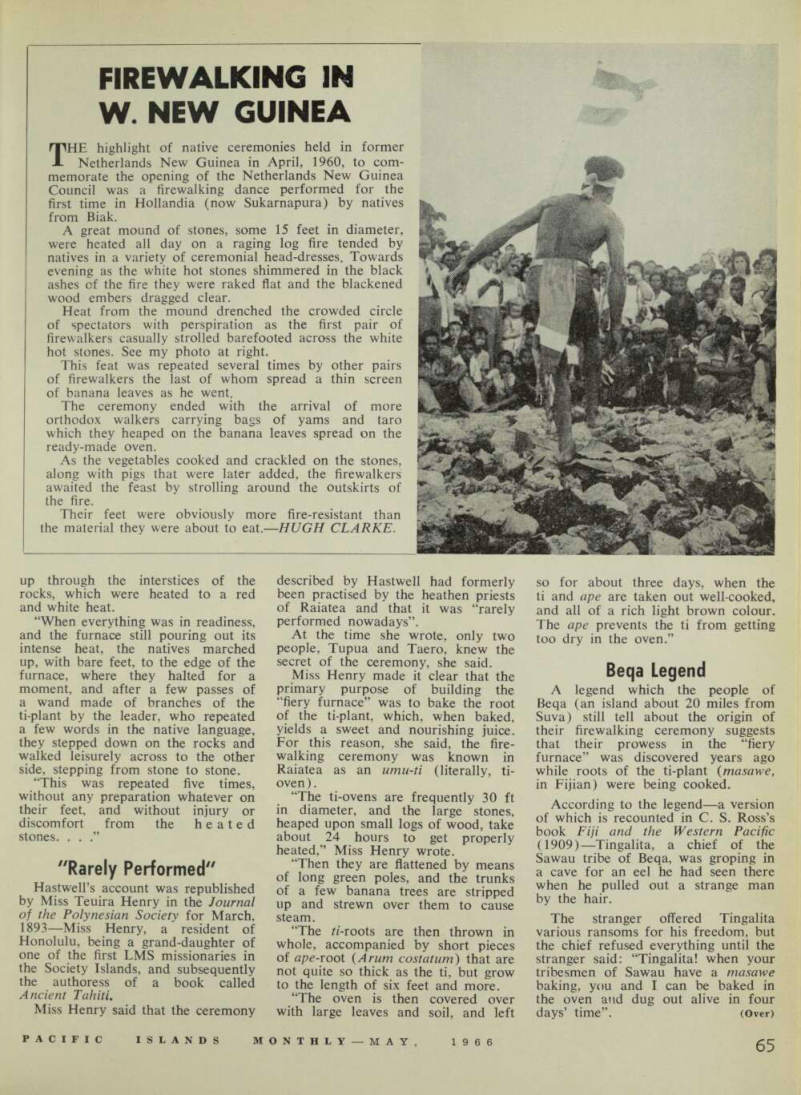


South Pacific
Has Some Odd Facets
By Robert Langdon
I have recently been reading everything I can find on the subject of firewalking in the South Pacific, and it has occurred to me that a scientist might make some valuable discoveries if he made a comprehensive study of this curious practice.
There are some interesting questions to be answered about Pacific firewalking that could yield information on all sorts of subjects, including such seemingly unrelated topics as pre-European migration, native trade routes, and so forth.
Why is it, for example, that although firewalking is found from one end of the South Pacific to the other, it is practised in only a hand ful of widely separated localities, whose people seem to have very little else in common?
Why is it that no Europeans ever seem to have heard of firewalking in the Pacific until about 80 years ago, even though the practice is almost invariably said to be of ancient origin wherever it is practised, and some of these localities have been well known to Europeans for nearly 200 years?
Another obvious question is: How is it that the firewalkers manage to do what they do without getting their feet burnt?
Four Centres
According to my, by-no-means exhaustive, researches, firewalking is practised by the indigenous Islanders at only four places in the South Pacific—Biak (West New Guinea); Gaulim (New Britain); Beqa (Fiji) and Raiatea (French Polynesia).
It is also occasionally practised elsewhere by performers from those islands, and by some of the Indians in Fiji—descendants of labourers
imported into that Colony between 1877 and 1916. The Indian practice is quite different from that of the Islanders.
I first heard of the Biak fire walkers from reading the accompany ing article by Mr. Hugh Clarke, of Canberra, which was what prompted my researches. As far as I could find out, these Biak firewalkers have not previously been described.
As for the New Britain firewalkers, I was able to find only one account of their ceremonies, and this was in an article in the Australian magazine Walkabout in April, 1961.
Gaulim Ceremony
The author, an Australian journalist, Raymond Pauli, who now lives in Fiji, saw the firewalking in New Britain with a party of delegates to the fourth South Pacific Con ference in Rabaul in April-May, 1959.
The demonstration took place at the village of Gaulim, in the Bainings Mountains, about 30 miles south of Rabaul. It was said to be an ancient ceremony, whose performers were restricted to members of a secret society whose roots ran only among the Bainings people.
The performers, for the purpose of the ceremony, were spirit men; and each had a tail, which seemed to link them with the legendary tailed men of New Guinea, of whom the late Sir Hubert Murray used to speak.
At one stage in their ritual, each performer carried a live python, which was finally cast into the pit oven.
As far as I could gather from Mr.
Pauli’s article, the Gaulim ceremony has nothing to do with the cooking of food, and therefore it differs in one important respect from the fire walking ceremonies of the people of Biak, Beqa and Raiatea.
The Beqa and Raiatea ceremonies, which appear to have grown out of the annual chore of baking the root of the ti-plant {Dracaena terminalis), are both said to date back to ancient times.
But Europeans, inexplicably, do not seem to have heard of them until quite recently, as the first ceremony of which I could find a description took place at Raiatea on September 20, 1885.
"Fiery Furnace"
This ceremony at Raiatea was witnessed by a man called Hastwell, who wrote about it in a pamphlet published in San Francisco. He described the ceremony as “passing through the fiery furnace”.
“The furnace that I saw,” he wrote, “was an excavation of three or four feet in the ground in a circular form (sloping upwards) and about 30 ft across. The excavation was filled with logs and wood and kept burning for about a day.
“When I witnessed it, on the second day, the flames were pouring
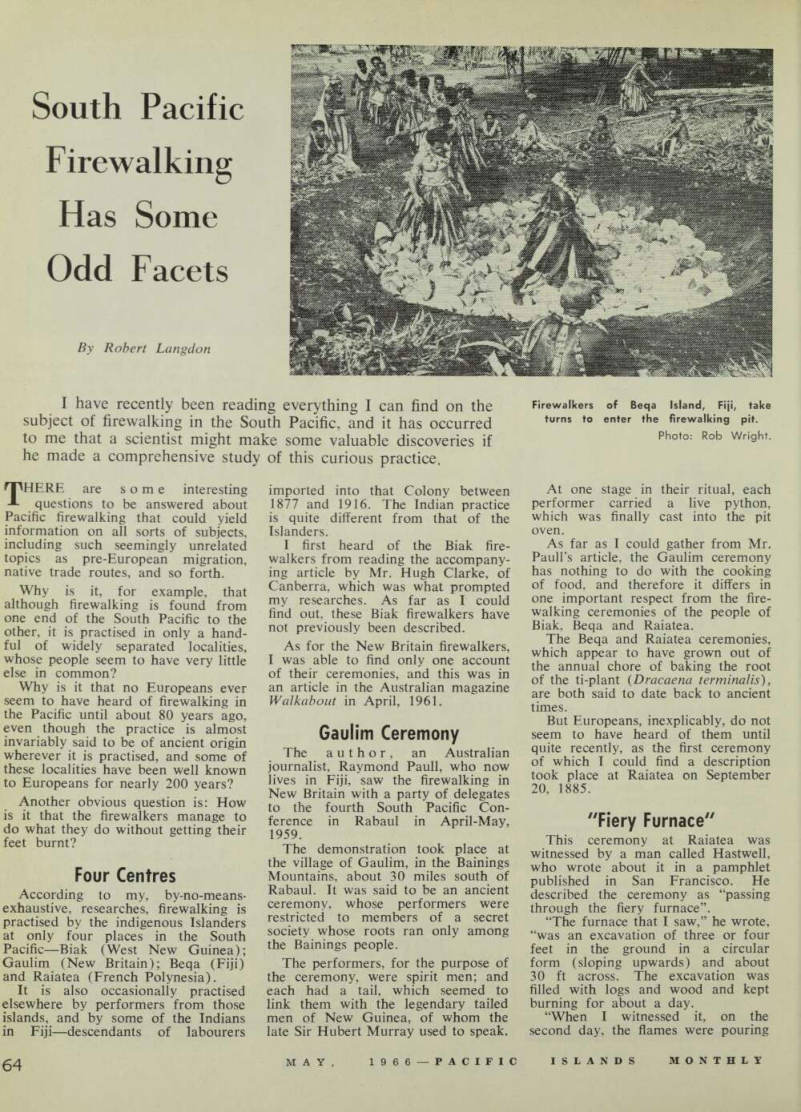
Firewalkers of Beqa Island, Fiji, take turns to enter the firewalking pit.
Photo: Rob Wright.
up through the interstices of the rocks, which were heated to a red and white heat.
“When everything was in readiness, and the furnace still pouring out its intense heat, the natives marched up, with bare feet, to the edge of the furnace, where they halted for a moment, and after a few passes of a wand made of branches of the ti-plant by the leader, who repeated a few words in the native language, they stepped down on the rocks and walked leisurely across to the other side, stepping from stone to stone.
“This was repeated five times, without any preparation whatever on their feet, and without injury or discomfort from the heated stones ”
"Rarplu PprfnrmpH"
Karely Performed
Harwell's account was republished by Miss Teuira Henry in the Journal of the Polynesian Society for March, 1893—Miss Henry, a resident of Honolulu, being a grand-daughter of mie of the first LMS missionaries in the Society Islands, and subsequently the authoress of a book called Ancient Tahiti.
Miss Henry said that the ceremony
described by Hastwell had formerly been practised by the heathen priests of Raiatea and that it was “rarely performed nowadays”.
At the time she wrote, only two people, Tupua and Taero, knew the secret of the ceremony, she said.
Miss Henry made it clear that the primary purpose of building the “fiery furnace” was to bake the root of the ti-plant, which, when baked, yields a sweet and nourishing juice.
For this reason, she said, the firewalking ceremony was known in Raiatea as an umu-ti (literally, tioven), “The ti-ovens are frequently 30 ft in diameter, and the large stones. heaped upon small logs of wood, take about 24 hours to get properly heated,” Miss Henry wrote.
“Then they are flattened by means of , gree n , d the y t k of a few banana trees are stripped up and strewn over them to cause steam.
“The //-roots are then thrown in whole, accompanied by short pieces of ape- root ( Arum costatum ) that are not quite so thick as the ti, but grow to the length of six feet and more.
“The oven is then covered over with large leaves and soil, and left
so for about three days, when the ti and ape are taken out well-cooked, and all of a rich light brown colour.
The ape prevents the ti from getting too dry in the oven.” n . lononrl oeqa 16 9 6 till A legend which the people of Beqa (an island about 20 miles from Suva) still tell about the origin of their firewalking ceremony suggests that their prowess in the “fiery furnace” was discovered years ago while roots of the ti-plant ( masawe, in Fijian) were being cooked, A . , According to the legend-a version of which is recounted in C. S. Ross s b ?SL I F ''V- r, e (1909)--Tingal.ta, a chief of the Sawau T of B f qa - * aa B r °P‘“B ln a cave for an eel he had seen there * hc " hq P ulled out a stran B e man by iiair ‘ The stranger offered Tingalita various ransoms for his freedom, but the chief refused everything until the stranger said: “Tingalita! when your tribesmen of Sawau have a masawe baking, you and I can be baked in the oven and dug out alive in four days’ time”. (Over)
Tingalita, who fancied the idea of being able to show off in this fashion, accepted this offer.
Some time later, when the ti-roots were being baked, the stranger from the cave sprang into the oven and seated himself upon the stones.
“Come on, Tingalita, my chief’, he cried, “and join me here”.
After some hesitation, Tingalita stepped in, and found to his surprise that the stones felt cool to his feet.
But wonderful as it was, he thought it would be unnecessary to spend four days in the oven, and that an occasional performance would be sufficient.
So he expressed himself to this effect to his friend from the cave, and his friend immediately bestowed on him the power, both for himself and all his descendants, of walking in the fiery oven unscorched by heat —and so it has remained with his tribe on Beqa to this day.
Europeans Try It
As far as I could discover, the Beqa firewalkers have never en couraged outsiders to attempt the feat that they perform. But those of Raiatea have not been so exclusive, with the result that even tender footed Europeans have “had a go” at firewalking from time to time.
The fact that these Europeans have performed the feat unscathed, and without any prior initiation or physical treatment, makes it clear that firewalking is not as dangerous as it looks, and that there is some quite simple explanation for the ability to do it.
Among the Europeans who have “passed through the fiery furnace” and have written accounts of their experiences are Lieut.-Colonel W. E.
Gudgeon, who was British Resident and later Resident Commissioner in the Cook Islands at the turn of the century; the Australian author Hector Macquarrie ( Tahiti Days, Vouza of the Solomons, etc.); and the Swedish writer Olle Strandberg ( Tigerland and South Sea).
Writing in the Journal of the Poly nesian Society in 1899, Colonel Gudgeon said that on January 20 of that year, he and three other Euro peans had taken part in an umu-ti on Rarotonga, superintended by a tohunga (priest) from Raiatea.
“I got across unscathed,” Colonel Gudgeon wrote, “and only one of the party was badly burned. ... I can hardly give you my sensations, but I can say this—that I knew quite well that I was walking on red hot stones, and could feel the heat, yet I was not burned. I felt something resembling slight electric
shocks, both at the time and after wards, but that is all. . . .
“Quite half an hour afterwards, someone remarked to the priest that the stones would not be hot enough to cook the ti. His only answer was to throw his green branch in the oven, and in a quarter of a minute it was blazing.
“I walked with bare feet, and after we had done so about 200 Maoris followed. No one so far as I saw went through with boots on. , . .
My impression as I crossed the oven was that the skin would peel off my feet . . . but the very tender skin of my feet was not even hardened by the fire. . .
Atiu Ceremony
Colonel Gudgeon’s experiment was repeated at Atiu, Cook Islands, a year or two later by a Major J. T.
Large, who crossed the oven “three times and more” and described his experience in the Journal of the Poly nesian Society for March, 1901.
As in the Rarotonga ceremony, the proceedings were conducted by a priest from Raiatea.
Major Large said he could not explain how the people taking part “escaped having the soles of their feet scorched to a cinder while going through this fiery ordeal”.
But he did have a theory on how some people—such as one of Colonel Gudgeon’s companions—occasionally got their feet burned. This was that they stepped off the stones them selves and into the live embers be tween them.
Moustache Curled Up
Two other Europeans who are known to have ventured into an umu-ti were George Eli Hall, Turkish Consul in San Francisco at the turn of the century, and a French naval commodore from the cruiser Protet. Their experience was at Tahaa, Raiatea’s nearest neighbour in the Society Group.
Describing the experience in the Journal of the Polynesian Society for 1901, Hall said: “We stripped off our shoes and took our places behind the chanting sorcerers. Then I wished I hadn’t been so bold. All the heat I ever experienced was as nothing compared to that. My moustache and hair curled up so that I could not get them straightened for days; my hands seemed cooking; in my ears was a feeling as if fires had been kindled against the drums; my eye balls seemed to boil out the water that ran from them. . . . But all this time my feet were cool and we passed through the ordeal unsinged and unharmed. . . .” (Over)
Among the theories that I know of that have been put forward to explain the immunity of the fire walkers’ feet to pain and injury, all but one ascribes the immunity to the firewalkers themselves. Thus it is said that: • The firewalkers walk on sharp, sun-scorched rocks from earliest childhood and so develop hard, calloused feet that can withstand the great heat. In addition, the fire walkers are imbued with extra ordinary bravado. • The firewalkers smear their legs with some solution or ointment which protects them from the heat. • The soles of the firewalkers’ feet produce a coating of sweat and this, combined with a thin cool skin on the outside of the boulders, is sufficient to protect them from harm. • Firewalking is made possible by auto-suggestion or by hetero-sugges tion on the part of a chief or other authority. • The firewalkers do their stuff while in a hypnotic trance.
Some of these explantations have been put forward by quite eminent scientists and medical men, but almost every one, merely on the evidence presented in this article, can be ruled out as incorrect, and the others sound by no means convincing.
Stones Theory
This leaves us with an explantation put forward in 1901 by one, S. P.
Langley, that the secret of immunity is not in the firewalkers but in the stones they use.
And considering that the Beqa firewalkers are said to take their own stones with them whenever they go firewalking outside Beqa, Langley’s theory seems to be highly reasonable.
Langley, who saw a firewalking ceremony in Tahiti in July, 1901, conducted by a priest from Raiatea, observed that the stones used in the pit were of water-worn basalt, weigh ing from 40 to 80 lb apiece.
After the firewalking ceremony had been in progress for some time, Langley had a large ovoid stone of about 65 lb removed from the centre of the trench after everyone had walked on it.
Its lower end had been in the hottest part of the fire, and when it was placed in a large bucket half filled with water, it boiled the water for about 12 minutes because it was “an exceedingly bad conductor of heat”.
“The most distinctive feature of the stone,” Langley wrote later in the scientific journal Nature, “was its porosity and non-conductibility, for
it was subsequently found that it could have been heated red hot at one end while remaining compara tively cool at the top.
“I brought a piece of it to Washington with me, and there determined its specific gravity to be 2.39, its specific heat 0.19, and its conductivity to be so small that one end of a small fragment could be held in the hand while the other was heated indefinitely in the flame of a blowpipe, almost like a stick of sealing wax. . . .
“To conclude, I could entertain no doubt that I had witnessed ... a most clever and interesting piece of savage magic, but ... I am obliged to say (almost regretfully) that it was not a miracle.”
Miracle or not, there is still a lot about Pacific firewalking that I would like to know, and I hope that the Bishop Museum or the Australian National University or someone will sool a scientist on to the subject to find these things out for me.