After 104 Years,
p. 53 · Read in the full issue
Samoa Gets A
New Dictionary
A new Samoan dictionary prepared by Dr. G. B. Milner of the School of Oriental and African Studies of the University of London was launched in Apia by Prime Minister Mataafa in
mid-April.
AT a ceremony in the Nelson Memorial Public Library he gave presentation copies to five Samoans who collaborated with Dr. Milner in his work.
The Samoans are Masiofo Fetaui Mataafa, Fa’alili Leilani F.S., Su’ifau Liumalo, Fa’api’o Faletose and Sione Fauatea.
Dr. Milner’s dictionary supersedes the Grammar and Dictionary of the Samoan Language prepared more than a century ago by the Rev, George Pratt, of the London Missionary Society. This first appeared in 1862 and passed through three more editions—in 1878, 1893 and 1911.
By the end of World War 11, however, the original plan of Pratt’s work had been lost in a maze of alterations and amendments, and it was also obsolete.
Under a plan sponsored by the two Samoan Governments, Dr. Milner, who is Reader in Oceanic Languages in the University of London, was in vited to undertake the preparation of an entirely new work.
Field Work
With the help of six dictionary assistants, he set to work in 1955, first in Savai’i (Western Samoa) and later in Tutuila (American Samoa), spend ing over a year in the field and col lecting a large quantity of material.
He then returned to London, where he spent the next three years prepar ing the first draft of the dictionary.
In 1959 he went back to Samoa for a second, shorter spell to check the data already in hand and to collect additional details.
He made it a point of special im portance to arrive at an understanding of the precise meaning of words by studying their use at first-hand, i.e., by spending as much time as possible in Samoan villages observing traditional activities—planting, fish ing, building, pastimes and ceremonies.
In 1961 the Samoan-English part of the work was ready for the press
and the second part was completed in 1963.
Dr. Milner says that the large num ber of Samoans and Europeans whose help is acknowledged in his book, represent “an interesting cross section of Samoa in the middle and late fifties.”
Special tribute is paid to the late Head of State, Tupua Tamasese Mea’ole, who took a great interest in the progress of the work.
The new dictionary was published in London by the Oxford University Press. Its dust jacket is in the traditional colours of Samoan cloth (white, black and brown) and it runs to close on 500 pages.
The first and the most important of its two parts (Samoan-English) is in tended not only for European residents of Samoa and for scholars, but for those Samoans who already have a fair knowledge of English and who wish to express themselves more accurately in it.
Bestseller
Part II (English-Samoan) is mainly intended for Samoans learning English at school or elsewhere and for translators into Samoan. But it will also be of use to all those whose mother tongue is English and whose work, travel or reading has brought them to Samoa or to an interest in its language.
The Nelson Memorial Public Library is handling sales of the dictionary in Apia, and according to senior librarian Mr. Bruce Turner, it looks like being a bestseller at £3/10/- per copy.
Its author, who is 47, is also the author of a Fijian grammar (published by the Government Press in Suva in 1956).
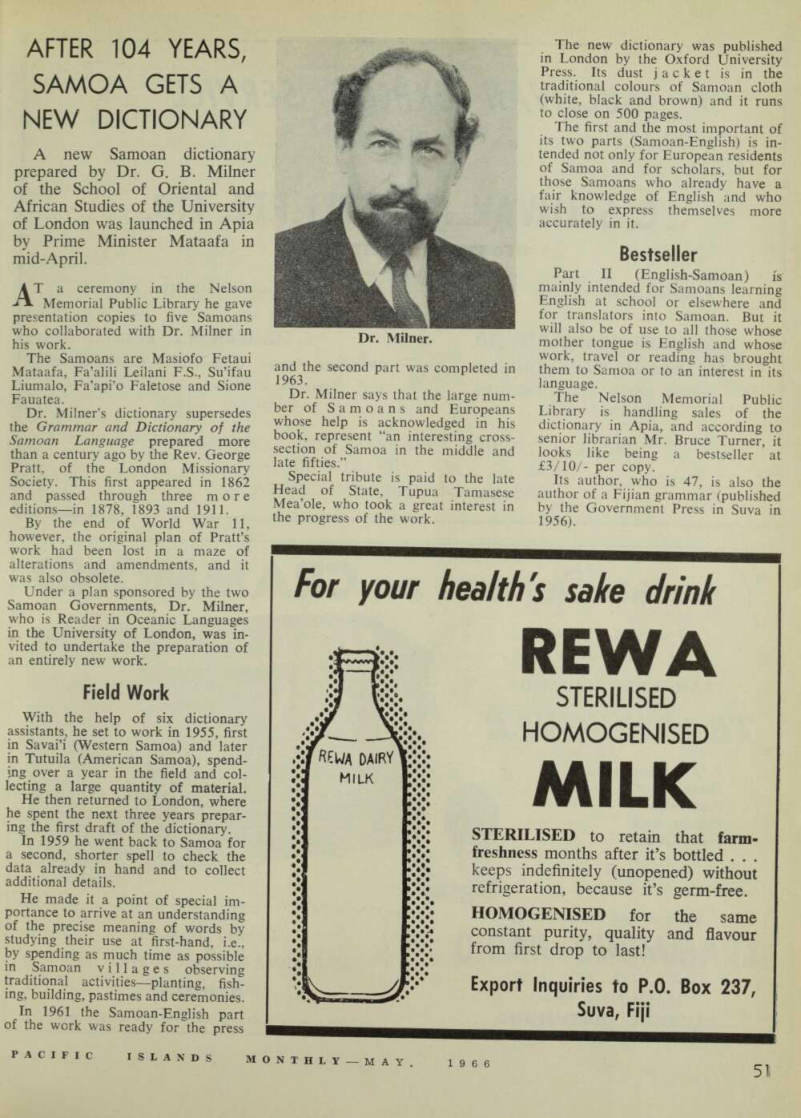
Dr. Milner.