Territories TALK-TALK
pp. 43-51 · Read in the full issue
With Tolala
Raking over dead ashes, one-time Australian Prime Minister Ben Chifley is reported to have said, is exactly what we will not do. He was answering a question in the House re garding the fall of Rabaul in World War II and about who was responsible for the tactical error of commission or omission, causing the deaths of the cream of New Guinea’s European population.
THERE has been a studied silence on this phase of the Pacific War, and I was surprised, but none the less interested, to read a story by Allan Barnes in Sydney’s Daily Telegraph on March 2, of his inter view with the US Rear-Admiral “Pete” Aurand, in charge of the Seventh Fleet, revisiting Pacific battle grounds on Operation Heritage.
“Pete” Aurand in 1942 was a lieutenant aviator on the aircraft cruiser Lexington and describes how, in February, 1942, the cruiser, with four other cruisers and 10 destroyers were dispatched to block an expected enemy invasion from Rabaul. The Admiral describes in detail the attack on the Japanese defence planes, which was successful, but the Admiral in charge of the operation ordered withdrawal from attack on the harbour [of Rabaul] as the “element of surprise had been lost”.
Commenting on the situation, Admiral Aurand said: “All of us make tactical errors, but that was a real blunder. We should learn from them. Those Japs from Rabaul soon were scattered all over the South Pacific and American and Australian soldiers had to dig them out with bayonets. A great opportunity was lost—because one admiral didn’t appreciate the capabilities of carrier borne aircraft and naval aviators”.
Speaking personally, and as a front seat observer in the Show in Feb ruary, 1942 (when I was in Rabaul), I am sure it could have caused un told damage to the Jap morale, if nothing else.
Air attacks on Rabaul following its fall in January, 1942, were desultory. I remember a couple of planes coming over on the night of the occupation and bombing the commissariat stores behind China town. It was quite near enough for us internees sleeping in the Kuomintang Hall—believe me! Other than that there were few alerts for air raids until 1944, when the blitz
We Should Have
Bombed Rabaul
Early In The War
really started in Rabaul on February 29, synchronising with the invasion of Manus by the Yanks, There were a few small raids in the early months, mostly on shipping in the harbour. Well do I remember the butterflies in my tummy one day when, working cargo in the hold of one of the Japanese transports anchored out in the stream, our planes came over and scored a few hits; fortunately not the one on which we were working. It’s a helpless, un comfortable feeling really.
The cargo-working days remind me of the time, a few days after the Jap landing, when we civilians were
rounded up and taken by lorry to a wharf, marched aboard a transport, which had brought some thousand odd females—mostly Koreans—for working on the coffee plantations (so they were told on embarkation).
That was a euphemistic term for work in the army and navy brothels.
Our task, the most degrading in the eyes of the Japanese, was to shift the baggage of these Little Ladies of a Thousand Delights from the ship to lorries on the wharf.
The highlight of this incident was not the feeling of degradation hoped for by the Japs, After we had fallen in and the roll called, Father Barrow, Rabaul’s parish priest, said to me rather sadly in his Irish brogue: “I wonder what His Holiness would think if he knew I was a-portering for prostitutes”, A few weeks later Father Barrow died in the Vunapope Hositpal, from typhoid.
That was 24 years ago, and a lot of water, etc., etc. . . . Anyway, I’ll go along with “Pete” Aurand in his
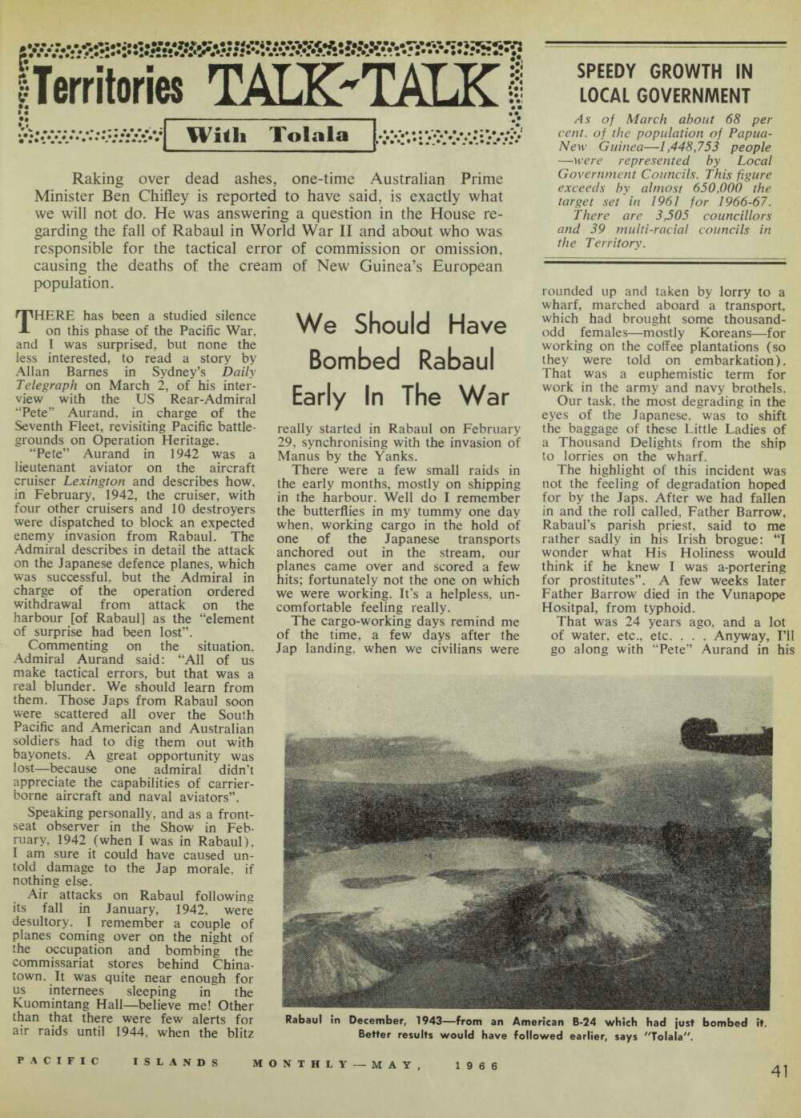
Rabaul in December, 1943—from an American B-24 which had just bombed it.
Better results would have followed earlier, says "Tolala".
theory that “if our planes had been allowed to attack Rabaul Harbour in February, 1942, the war in the South Pacific would have been very different'’.
I know only too well that in the early months of Rabaul’s occupation by the Japs, they were not well organised. They were “jumpy”, their ack-ack defence was not good, there was a lack of co-ordination in the air-raid warnings and a general lack of co-operation between the army and the navy units in the town.
It was the lack of Allied air-raids in those early months which was good for Jap morale, but the opposite for us whites and for the New Guineans. . . . But one must not rake over the dead ashes. . . OK. Ben!
Territorians At Surfers
ABOUT every 10 years—or so—l receive a letter from a neo- Before by the name of Ambrose Thomas. He arrived in New Guinea in the mid-thirties for the then new venturing firm of Colyer, Watson.
Ambrose was one of those quiet, studious types. You could never visualise him going out on the town and painting it red, as so many of the new-arrivals had a tendency to do—at times. (Itsh only 10 o’clock.
Letsh take a drive to Kokopo!) The link which drew us together, I think, was a letter addressed to me and delivered to him by mistake —after I had left New Guinea, It was from one of those dynamic Yankees who become delightful pen-friends.
And such was Reginald Orcutt, vice president of the Mergenthaler Lino type Coy, who travelled the world and has an exciting knowledge of linotypes and the varying type-faces which are distributed in the different countries of the world. (Well do I remember when New Guinea’s first lintoype arrived, it was installed in Harry Hamilton’s printing shop on Namanula in 1926 by a Mr.
Smith, of Smith & Miles, the lino typers of Sydney.) Back to Ambrose. His last letter comes from Surfers Paradise where, apparently, he has dug in along with many another ex-territorian. And among these he mentioned Tony Corlass and wife at Burleigh Heads; Toby Donald and family on Miami Keys; Bill Bailey, an old WRC man and later POW, has a block on one of the islands and will be building soon.
Ambrose writes: “I often bump into Ron Clammer doing the beat around Surfers. He’s changed very little in the years and has retired down here”.
Basil Challis was another old timer
he met who has made SP his home.
He also mentions the past president of the local RSL—Major Mollard.
Mollard was an officer of the 2/22nd AIF Bn. in Rabaul and receives very kindly mention by David Selby in his book Hell and High Fever. Unfor tunately, some time ago, Mollard had a heart attack, which has left its mark.
Added to these must be included Mrs. Una Adams, who has staked a claim on Mermaid Beach, and then Steve and Irene Lonergan have given Avalon away for the Gold Coast; also Wally Cordon, pioneer transport man of the early days at Wau, is also located up that-a-way, and last, but by no means least, there is Mrs.
Lillian Bennett-Miller who has settled for the simple life of Surfers Paradise.
Enclosed in the letter was a photo of a “smoko” send-off to NG recruits for the Second AIF and held in the Regent Theatre. It is not a good print, otherwise I would reproduce it here.
With a magnifying glass one can see many of the old faces of the early forties.
There is Bill Heinicke, who was sergeant-major of the First Con tingent, waving aloft his tankard of
ale; there is Syd. Costelloe. Jim Cromie, Tom Ellis, Sr., George Robins, lan Mac Lean, Keith Chambers, school teacher Monger, Bill Phillpot and his cobber Goodwin —all in uniform—a mixture of NGVR and 2nd AIF. At the top table, which is in the background
of the picture, one can pick out John Walstab, who formed the NGVR, Sir Walter McNicoll (Ad ministrator), Ross Field (CO NGVR) and then three chaps in whites— “Nobby” Clark (president, RSL), Major Watch (MO, NGVR) and the local pressman.
Above the top table, on the stage, is the orchestra and one member is Bert Rawnsely at the piano, and I expect another would be there, play ing the violin, Eric Hopkins.
There are not many of that crowd still alive.
A Message From Cairns
NOW, don’t think I am making a thing about receiving letters from old B4s, but one came recently from Cairns and the writer was “Ces Evans, the oldest of the Kids”. And if anyone could qualify as a copper plate handwriter it is Ces. Evans.
I always appreciate good hand writing and when it is from ex-pupils of Rabaul schools I try to work out who the teacher would have been.
In this case it could have been Mr.
Crouch. Many of his pupils write a good hand. But you don’t see such good handwriting these days, pupils
from Roman Catholic Schools ex cepted.
Ces. writes to tell me about his Dad, Edward George (Ted) Evans, who in 1937 was managing Tex Roberts’ Garage by the old Rabaul Hotel.
After the volcanic eruption in 1937 the Evans family moved to Cairns, and for the last six years Ted was in bad health, result of mustard gas in World War I. He was an original Anzac. In January last he died in the Cairns Base Hospital and was buried with military honours the following day. His widow, Mrs. E. B.
Evans, and five children survive him.
Turn down an empty glass for Ted; he was a good cove.
“The New Guinea
Villager"
THIS is the title of a book on the Papua and New Guinea people by a professorial type of chap named Charles Dunford Rowley, MA, all of whose life—he will be 60 this October—has been spent in matters relating to education of one type or another.
For 10 years he was a secondary school teacher, during the war he was an Education Officer of some tonnage, ending up a lieutenant colonel, and then with UNESCO he spread the Gospel of the Three “Rs” in Siam, Laos, Cambodia, S. Vietnam, the Philippines and Indonesia. After all that he became principal at the Australian School of Pacific Admini stration—the grooming ground in Mosman for P-NG government officials, and now he is in charge of a major project of the Social Service Research Council of Australia, some thing to do with the dinkum Aussies who at one time owned this country.
Little wonder then, with all this erudite build-up of his, I picked up his latest book on New Guinea, The New Guinea Villager (Cheshire), somewhat apprehensively, for I usually have a thing about these Wise Men from the West who tell us about the New Guinea people. But once started and after a short while I realised that here was a man who, despite the comparatively short period of residence in the Territory, had a very comprehensive knowledge of the New Guinean; and not only of the collar and tie sophisticated species, which is steadily now becom ing the accepted image by Australians of New Guineans, but the man (and woman) in the village, as the title implies.
With the delicate touch of the connoisseur he pulls the New Guinean
apart to see what makes him tick and, having seen, with knowing fingers then puts him together again —with no parts left over. He has reconstructed him as he actually is and not as Canberra would have him be in order to present an accepted, modern image to the world, and more especially to the Afro- Asian members of the UN.
His nicely defined reactions of Administration to Missions and Missions to Commerce, and vice versa, give an accurate picture of the expatriate activities within the Terri tory.
What I particularly like about his book is his easy style; there is nothing of the erudite, dogmatic, pragmatic savant as you might expect. He uses realistic language, not embellished with ornate gobbledegook, so often employed by many academics.
Get hold of a copy. It will be five bucks well spent.
The H.S.N.B.
THE initials stand for Historical Society of New Britain, the which many of you know. It has received a “shot in the arm” and is due to get cracking again this year, with Jack Thurston II as its president.
In the past, New Britain’s historical research has not thrived, due mainly to the transient domicile of its officers and members. There are few organisations which do not suffer from the same disability. Here today, gone tomorrow. In time, one supposes, all organisations of social activities, such as historical societies, Apex, Rotary, RSL and also, perhaps, fraternal societies, may lean more heavily upon the New Guineans.
They have the advantage, at least, of being permanent; the expatriates are not.
And whether New Guinea wants to commercialise its artifacts as was suggested recently, is a matter to be considered. It is to be hoped such an action can be clipped in the bud; we don’t want tourists to come along and buy New Guinea curios, turn them over and find them marked “Made in Japan”. Or then again: Are we willing to do just that in order to lead our New Guinea brother up the economic garden path?
We could be at that.
A job I would like to see the HSNB tackle is to get the government to proclaim Kuradui cemetery (where so many of Queen Emma’s kith and kin are buried) a national trust, or what ever is needed to preserve it as an historical area.
And let’s hope the New Britain
historians don’t become involved with their Port Moresby opposites to such an extent as to allow themselves to have the Indian sign put over them by the PM-ites and suddenly realise that their best antiques and curios are in the museum at Port Moresby.
FOOTNOTE: The above “hope” was not expressed with any special incident in mind. News that a Rabaul museum had been suggested, did not reach me until after my par was written.
Bits And Pieces
Pctcd dtaxtt* u •
ETER PIANTA, who died in February. 1963, in North Queensland, was well-known on the goldfields in the early days. His will was recently contested, and in the Supreme Court in Brisbane his legacy of $21,000 to the Australian Communist Party was declared invalid . . . Mrs. Hazel Cresswell,
old time miner of the Morobe fields and widow of “AH” has been visit ing her daughter in New Britain, She returned to her home in Switzer land the middle of April after a short spell in Hornsby Hospital, being de virused from one of the wogs picked U P i . n Sydney. . . .Mrs. Nairie Watkins, better known to old-timers ?s Nairie Campbell of Raua (Bougainville) is down to check her interests in the Bowral district. Her mother, the wife of C. I. H. Camp bell (Rabaul’s first Commonwealth Bank manager) died recently from a heart condition. . . . The Prince ot Wale . s is due for a trip to the- Anglican Mission in Papua this; month, visiting spots around Gena* (one-time home of my old friend James Benson), “The Prince will eat native foods and sleep in a native house”, says the spokesman. And thus racial discrimination is abolished and inter-denominational jealousies intensified.