Developers
p. 27 · Read in the full issue
Needed In
The B.S.I.P.
• PI M’s Honiara correspondent, Gabrielle Lawson, in February reported at length on Solomons development schemes. In the re port she said that BSIP experi ments with soya bean seemed to be a waste of money, and that the growing of rice would put money only into the pockets of big overseas companies. In this article Mr. Ken Dalrymple-Hay, of Honiara, managing director of Guadalcanal Plains Ltd., replies.
By K. H. Dalrymple-Hay.
It is obvious that Gabrielle Lawson has been obtaining her information on agriculture, in particular on rice and soya bean, from someone who has little knowledge of the subject, or is
suffering from “sour grapes”.
IT is commonly known that the economy of a country is depen dent upon its ability to develop its natural resources and in the first in stance to produce staple foods.
These, in the case of the BSIP, are rice and meat. To quote from the 1965 annual trade report, imports of rice were 3,277 tons, valued at 5A520,840, and fresh and canned meat 944,506 lb, valued at $A303,010.
The Solomons is in fact spending $A823,850 in importing foods which ;an easily be grown and consumed in the Protectorate. A large export Market in rice and soya bean could De built up.
If the vast sum of over SABOO,OOO emained in the country, it could luite easily be circulated three times )er annum with an ensuing tax re urn to Government and a general >enefit to the community.
Mrs. Lawson mentions that grow ng rice in the BSIP will only put noney into the pockets of the big overseas companies. She seems to jave overlooked the fact that >A520,840 already goes directly to werseas interests for rice purchases, rith no benefit financially to the JSIP Government by way of import luty. In addition it is well known hat some of the small Honiara usmess firms exist entirely on com mission received from these big over eas companies, and would go out f existence only for them.
It IS an established pattern that all t U h n . d pQ d Tp Ve ° pe ? countries, such as the BSIP must depend on the introduction of outside capital to develop their natural resources and not for ever be dependent on grant-in-aid. It is interesting to consider what the economy of the Solomons would be today without this aid.
The largest overseas company represented in the Solomons, namely Unilever, produces about one-third of the total production of copra on which Government levy an export t-ax
of 15 per cent. It not only produces the copra but it purchases almost the whole output of the Solomons at world prices.
The latest overseas company to commence operations is Guadalcanal Plains Limited, with a nominal capital of $A 1,500,000 paid up to $A600,000.
Local shareholders have invested $A286,000.
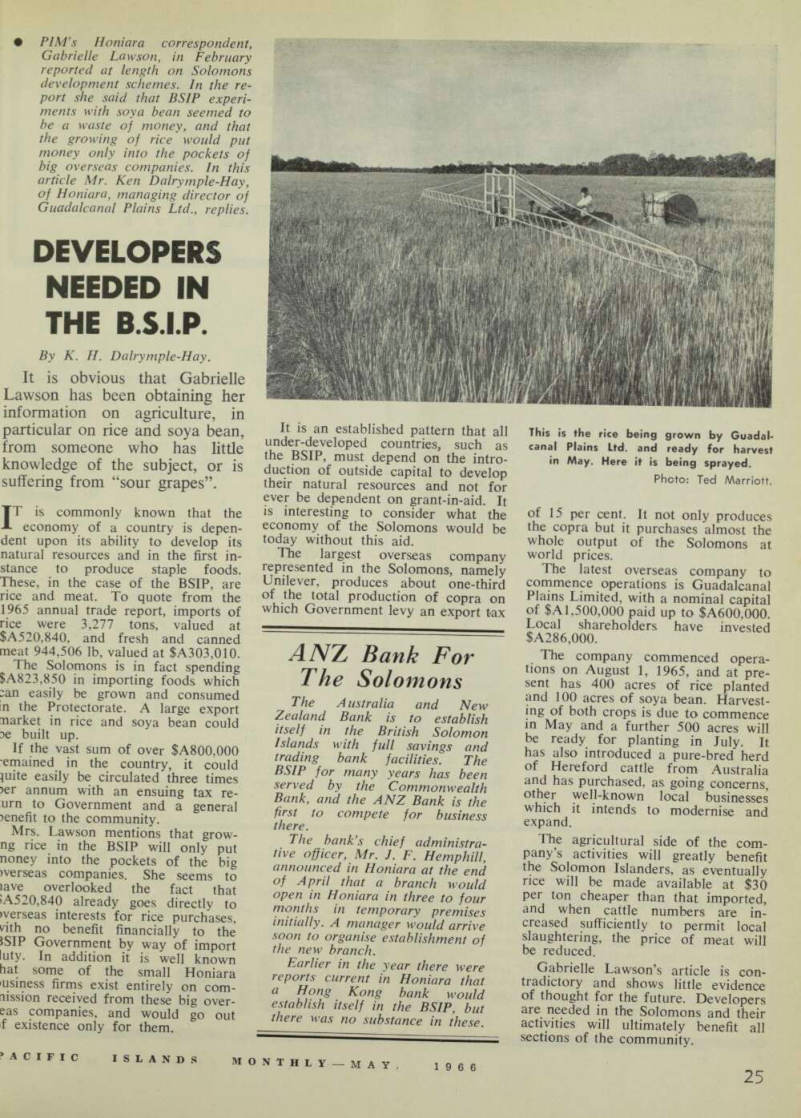
The company commenced opera tions on August 1, 1965, and at pre sent has 400 acres of rice planted and 100 acres of soya bean. Harvest ing of both crops is due to commence m May and a further 500 acres will be ready for planting in July. It has also introduced a pure-bred herd of Hereford cattle from Australia and has purchased, as going concerns, other well-known local businesses which it intends to modernise and expand.
The agricultural side of the com pany’s activities will greatly benefit the Solomon Islanders, as eventually rice will be made available at S3O per ton cheaper than that imported, and when cattle numbers are in creased sufficiently to permit local slaughtering, the price of meat will be reduced, Gabrielle Lawson’s article is con tradictory and shows little evidence of thought for the future. Developers are needed in the Solomons and their activities will ultimately benefit all sections of the community.
This is the rice being grown by Guadal canal Plains Ltd. and ready for harvest in May. Here it is being sprayed.
Photo: Ted Marriott.