topicalities
pp. 23-26 · Read in the full issue
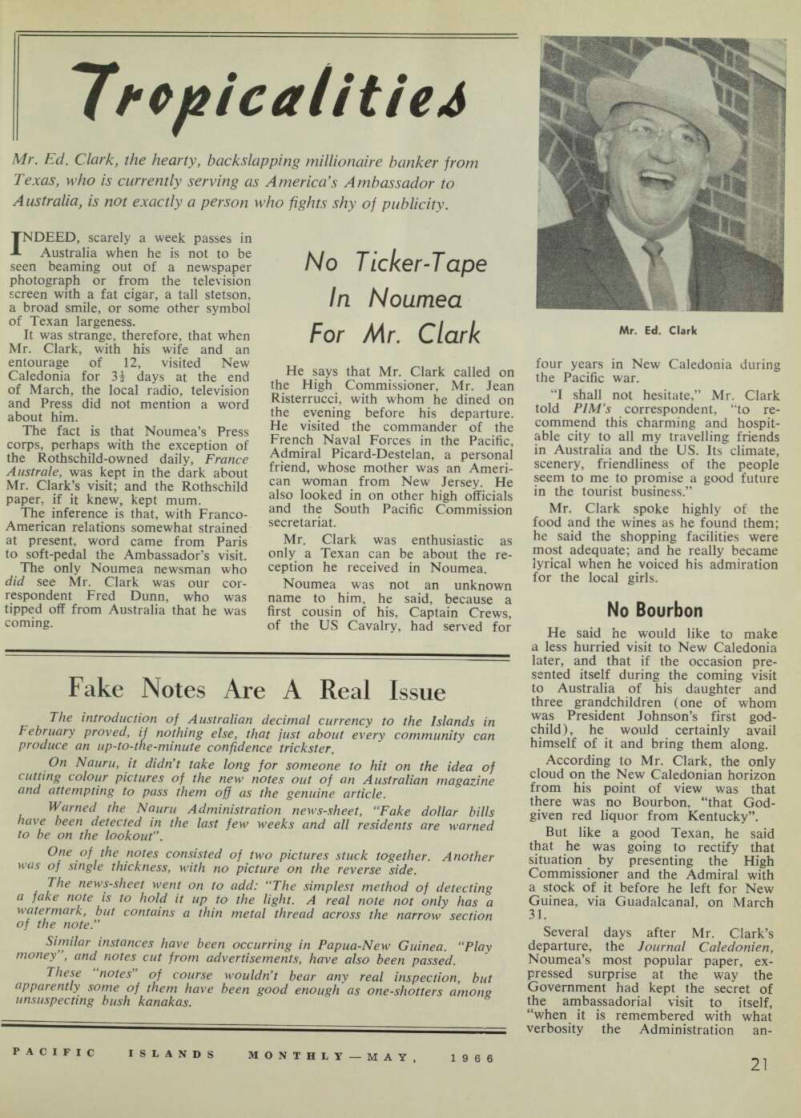
Mr. Ed. Clark, the hearty, backslapping millionaire banker from Texas, who is currently serving as America's Ambassador to Australia, is not exactly a person who fights shy of publicity.
INDEED, scarely a week passes in Australia when he is not to be seen beaming out of a newspaper photograph or from the television screen with a fat cigar, a tall stetson, a broad smile, or some other symbol of Texan largeness.
It was strange, therefore, that when Mr. Clark, with his wife and an entourage of 12, visited New Caledonia for 3i days at the end of March, the local radio, television and Press did not mention a word about him.
The fact is that Noumea’s Press corps, perhaps with the exception of the Rothschild-owned daily, France Australe, was kept in the dark about Mr. Clark’s visit; and the Rothschild paper, if it knew, kept mum.
The inference is that, with Franco- American relations somewhat strained at present, word came from Paris to soft-pedal the Ambassador’s visit.
The only Noumea newsman who did see Mr. Clark was our cor respondent Fred Dunn, who was tipped off from Australia that he was coming.
No Ticker-Tape
In. Noumea For Mr. Clark
He says that Mr. Clark called on the High Commissioner, Mr. Jean Risterrucci, with whom he dined on the evening before his departure.
He visited the commander of the French Naval Forces in the Pacific, Admiral Picard-Destelan, a personal friend, whose mother was an Ameri can woman from New Jersey, He also looked in on other high officials and the South Pacific Commission secretariat.
Mr. Clark was enthusiastic as only a Texan can be about the re ception he received in Noumea.
Noumea was not an unknown name to him, he said, because a first cousin of his, Captain Crews, of the US Cavalry, had served for
four years in New Caledonia during the Pacific war.
“I shall not hesitate,” Mr. Clark told PlM’s correspondent, “to re commend this charming and hospit able city to all my travelling friends in Australia and the US. Its climate, scenery, friendliness of the people seem to me to promise a good future in the tourist business.”
Mr. Clark spoke highly of the food and the wines as he found them; he said the shopping facilities were most adequate; and he really became lyrical when he voiced his admiration for the local girls.
No Bourbon
He said he would like to make a less hurried visit to New Caledonia later, and that if the occasion pre sented itself during the coming visit to Australia of his daughter and three grandchildren (one of whom was President Johnson’s first god child), he would certainly avail himself of it and bring them along.
According to Mr. Clark, the only cloud on the New Caledonian horizon from his point of view was that there was no Bourbon, “that God given red liquor from Kentucky”.
But like a go<xi Texan, he said that he was going to rectify that situation by presenting the High Commissioner and the Admiral with a stock of it before he left for New Guinea, via Guadalcanal, on March 31.
Several days after Mr. Clark’s departure, the Journal Caledonien, Noumea’s most popular paper, ex pressed surprise at the way the Government had kept the secret of the ambassadorial visit to itself, “when it is remembered with what verbosity the Administration an-
Mr. Ed. Clark
nounces the least movement of any public or Administration figure”.
The Journal Caledonien added: “We remember a time when the Americans were received here with all the honour and merit they deserved. It is true that at that moment they were badly needed”.
Following the Journal Caledonien’s outburst, PlM’s correspondent was left wondering whether Mr. Clark’s tongue had not been in his ambas sadorial cheek when he went into raptures about his Noumea reception.
Up And Over,
And Down Again
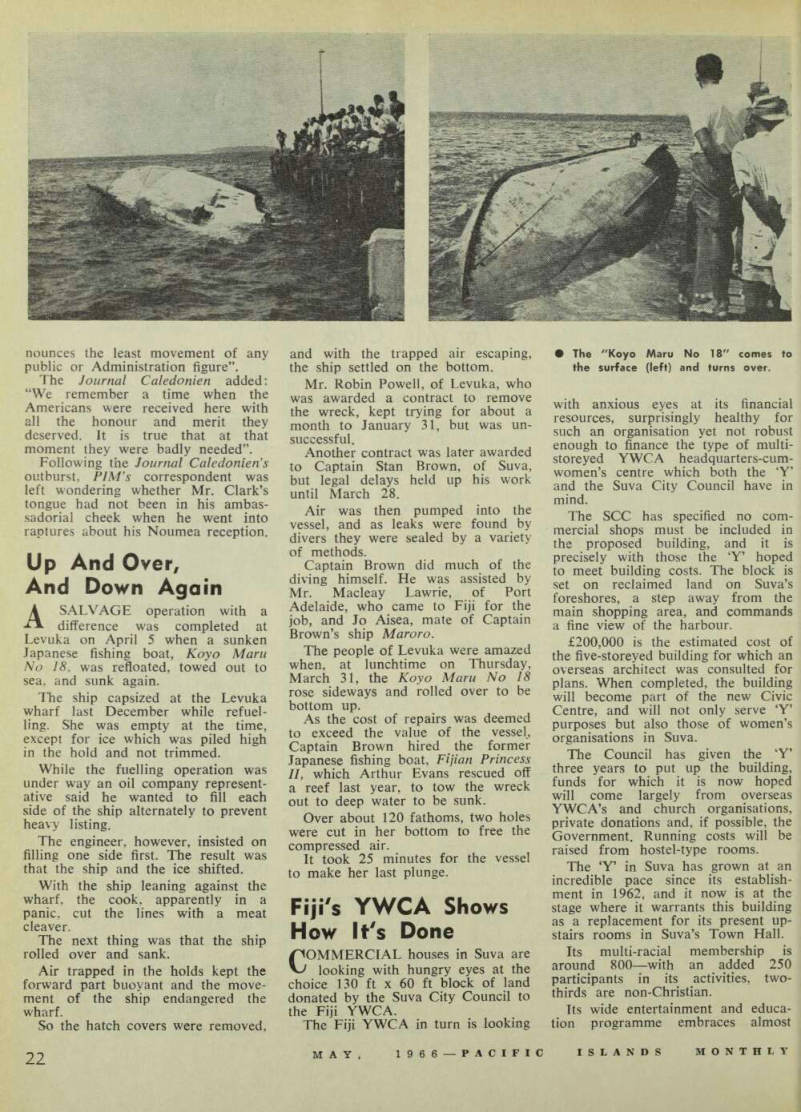
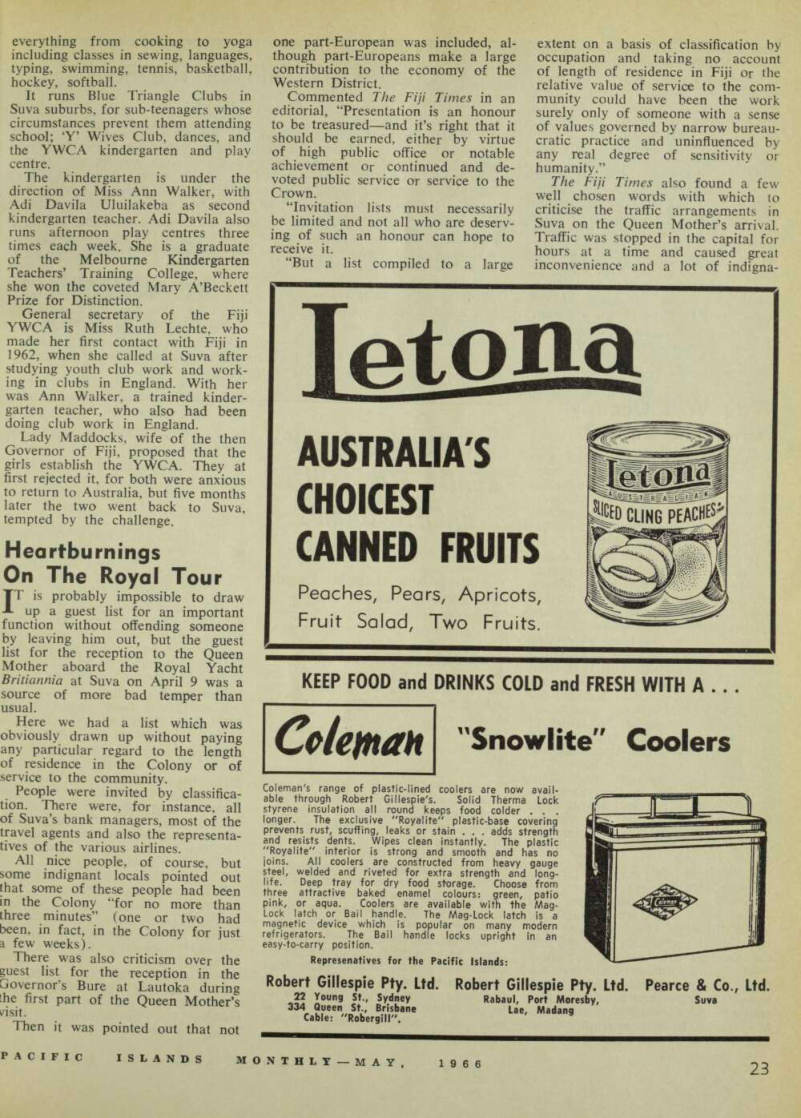
A SALVAGE operation with a difference was completed at Levuka on April 5 when a sunken Japanese fishing boat, Koyo Maru No 18, was refloated, towed out to sea, and sunk again.
The ship capsized at the Levuka wharf last December while refuel ling. She was empty at the time, except for ice which was piled high in the hold and not trimmed.
While the fuelling operation was under way an oil company represent ative said he wanted to fill each side of the ship alternately to prevent heavy listing.
The engineer, however, insisted on filling one side first. The result was that the ship and the ice shifted.
With the ship leaning against the wharf, the cook, apparently in a panic, cut the lines with a meat cleaver.
The next thing was that the ship rolled over and sank.
Air trapped in the holds kept the forward part buoyant and the move ment of the ship endangered the wharf.
So the hatch covers were removed,
and with the trapped air escaping, the ship settled on the bottom.
Mr, Robin Powell, of Levuka, who was awarded a contract to remove the wreck, kept trying for about a month to January 31, but was un successful.
Another contract was later awarded to Captain Stan Brown, of Suva, but legal delays held up his work until March 28.
Air was then pumped into the vessel, and as leaks were found by divers they were sealed by a variety of methods.
Captain Brown did much of the diving himself. He was assisted by Mr. Macleay Lawrie, of Port Adelaide, who came to Fiji for the job, and Jo Aisea, mate of Captain Brown’s ship Maroro.
The people of Levuka were amazed when, at lunchtime on Thursday, March 31, the Koyo Maru No 18 rose sideways and rolled over to be bottom up.
As the cost of repairs was deemed to exceed the value of the vessel,, Captain Brown hired the former Japanese fishing boat, Fijian Princess 11, which Arthur Evans rescued off a reef last year, to tow the wreck out to deep water to be sunk.
Over about 120 fathoms, two holes were cut in her bottom to free the compressed air.
It took 25 minutes for the vessel to make her last plunge.
Fiji's YWCA Shows
How It's Done
COMMERCIAL houses in Suva are looking with hungry eyes at the choice 130 ft x 60 ft block of land donated by the Suva City Council to the Fiji YWCA.
The Fiji YWCA in turn is looking
with anxious eyes at its financial resources, surprisingly healthy for such an organisation yet not robust enough to finance the type of multi storeyed YWCA headquarters-cum women’s centre which both the ‘Y’ and the Suva City Council have in mind.
The SCC has specified no com mercial shops must be included in the proposed building, and it is precisely with those the *Y* hoped to meet building costs. The block is set on reclaimed land on Suva’s foreshores, a step away from the main shopping area, and commands a fine view of the harbour. £200,000 is the estimated cost of the five-storeyed building for which an overseas architect was consulted for plans. When completed, the building will become part of the new Civic Centre, and will not only serve ‘Y* purposes but also those of women’s organisations in Suva.
The Council has given the ‘Y’ three years to put up the building, funds for which it is now hoped will come largely from overseas YWCA’s and church organisations, private donations and, if possible, the Government, Running costs will be raised from hostel-type rooms.
The ‘Y 5 in Suva has grown at an incredible pace since its establish ment in 1962, and it now is at the stage where it warrants this building as a replacement for its present up stairs rooms in Suva’s Town Hall.
Its multi-racial membership is around 800—with an added 250 participants in its activities, two thirds are non-Christian.
Its wide entertainment and educa tion programme embraces almost
• The "Koyo Maru No 18" comes to the surface (left) and turns over.
everything from cooking to yoga including classes in sewing, languages, typing, swimming, tennis, basketball, hockey, softball.
It runs Blue Triangle Clubs in Suva suburbs, for sub-teenagers whose circumstances prevent them attending school; ‘Y’ Wives Club, dances, and the YWCA kindergarten and play centre.
The kindergarten is under the direction of Miss Ann Walker, with Adi Davila Uluilakeba as second kindergarten teacher. Adi Davila also runs afternoon play centres three times each week. She is a graduate of the Melbourne Kindergarten Teachers’ Training College, where she won the coveted Mary A’Beckett Prize for Distinction.
General secretary of the Fiji YWCA is Miss Ruth Lechte, who made her first contact with Fiji in 1962, when she called at Suva after studying youth club work and work ing in clubs in England. With her was Ann Walker, a trained kinder garten teacher, who also had been doing club work in England.
Lady Maddocks, wife of the then Governor of Fiji, proposed that the girls establish the YWCA. They at first rejected it, for both were anxious to return to Australia, but five months later the two went back to Suva, tempted by the challenge.
Heartburnings
On The Royal Tour
TT is probably impossible to draw up a guest list for an important function without offending someone by leaving him out, but the guest list for the reception to the Queen Mother aboard the Royal Yacht Britiannia at Suva on April 9 was a source of more bad temper than usual.
Here we had a list which was obviously drawn up without paying any particular regard to the length of residence in the Colony or of service to the community.
People were invited by classifica tion. There were, for instance, all of Suva’s bank managers, most of the travel agents and also the representa tives of the various airlines.
All nice people, of course, but some indignant locals pointed out that some of these people had been in the Colony “for no more than three minutes” (one or two had been, in fact, in the Colony for just a few weeks).
There was also criticism over the guest list for the reception in the Governor’s Bure at Lautoka during the first part of the Queen Mother’s yisit.
Then it was pointed out that not
one part-European was included, al though part-Europeans make a large contribution to the economy of the Western District.
Commented The Fiji Times in an editorial, “Presentation is an honour to be treasured—and it’s right that it should be earned, either by virtue of high public office or notable achievement or continued and de voted public service or service to the Crown.
“Invitation lists must necessarily be limited and not all who are deserv ing of such an honour can hope to receive it.
“But a list compiled to a large
extent on a basis of classification by occupation and taking no account of length of residence in Fiji or the relative value of service to the com munity could have been the work surely only of someone with a sense of values governed by narrow bureau cratic practice and uninfluenced by any real degree of sensitivity or humanity.”
The Fiji Times also found a few well chosen words with which to criticise the traffic arrangements in Suva on the Queen Mother’s arrival.
Traffic was stopped in the capital for hours at a time and caused great inconvenience and a lot of indigna
tion. There was support for The Times' editorial, which said: “The result was seen at its most absurd on Sunday, when access through the city was denied and bus services disrupted for hours, though the total number of pedes trians and vehicles in the streets was negligible.
“If people had been able to get nearer to the route over which the Queen Mother travelled several times during the day—and there was no sensible '.ason why they should not have been able to get there by normal bus services, or by car to streets or park ing places just off the Royal route— more would no doubt have been delighted to take advantage of the opportunity to come to see her pass.
“The procedure in London for a Royal progress is simple and practical, and could have been applied at Suva with the utmost ease.”
Who Will Occupy
New Lae Camp?
THE announcement in April that a $7.5 million tender has been let for the building of an Australian Army camp at Lae, New Guinea, to house a battalion of troops has again led to conjecture as to what troops will be stationed there.
It has been officially stated that a battalion of the Pacific Islands Regiment, comprised of New Guinean troops, will be stationed at Lae, but some people who have seen the plans of the establishment believe that the camp could be used as a training base for Australian soldiers, including National Servicemen. This suggestion had been put forward previously but was refuted by the then Minister for the Army, Dr. Forbes, The Lae camp, to be built on 700 acres of land adjoining the Lutheran Mission boarding school at Bumayong, seven miles from Lae, between the Butibum and Busu Rivers, will be a self-contained establishment. Besides having full training facilities for an infantry group it will contain a complete set up for the training of corps person nel.
Lae is ideally situated for the building of an army camp, to cater for more than 1,000 men, and Bumayong is in an area suitable for jungle training. The camp site is a large kunai and timber tract of land cut through the centre by a road built by a timber company for logging purposes and which extends for several miles into heavily wooded country and through the mountains at the back. In close proximity is the fast flowing Busu River.