And Self-Government
p. 13 · Read in the full issue
P-Ng Assembly Will Quiz
Electors On Ministers
By a Staff Writer
Papua-New Guinea’s 14-member House of Assembly select committee on constitutional development visited Can berra for a week of top-level discussions in April, and returned home with most of its problems still in front of it. The mem bers had hoped they would take back a blueprint which would enable them to plan a timetable for political development.
YET in many ways the negative results of their talks gave them a positive picture, and certainly a positive determination to produce, by August, an interim committee report which would make its points more clearly than Canberra had.
Members in early May were ar ranging to tour the territory, pos sibly in two groups, to sound out the electors on a system of ministerial government, self-government and the method of attaining it.
Their August report will also out line the electors’ views on how elec torates should be altered for the 1968 elections, and whether the existing 10 special electorates (re served for European members) should be abolished.
Most members are aware that the problem of gaining the first part of this information is a real poser, because questions can be phrased in today’s territory to elicit any answer the questioner wants.
It is a problem also because there are no majority opinions in New Guinea just now, and perhaps even no real opinions at all. The people don’t know what they want—they know merely what they don’t want.
They don’t want Australia to start getting out now.
This present political vacuum is a real thing. But many committee members believe that if they go about their task carefully, and some how also overcome the committee’s own serious internal divisions, they could quickly develop some kind of political plan for the future.
The question of ministerial govern ment was one concrete matter raised at the Canberra talks. Australia is prepared to change the Papua-New Guinea Act to appoint a small number
af ministerial “representatives”, giving
them more authority than the present
Under-Secretaries have.
Both the Government and the com
mittee were aware at their talks that in the absence of party politics, and therefore safe seats, the “ministers” would still be tempted to neglect their ministerial duties for regular visits to their electorates to keep on side with the electors. How then to educate the electors? That, and the principles of a satisfactory ministerial system, will be up to the committee to decide in the next few months.
"The People Will Decide"
The committee learned in Can berra that the Government’s basic policy was self-determination for P-NG, but that it was up to the territory people to say when and how. If they wished to remain “in association” with Australia after self-determination this would require the agreement of the Australian Government of the day, and the present Government was not going to make any predictions.
The Government said also it was up to the territory people to decide how to solve any implications arising from the separate status of Papua as an Australian territory and of New Guinea as a trust territory.
The matter was of no practical importance now, said the Govern ment, and there were dangers for everybody in attempting to interfere with the UN Agreement, because it would bring too many other questions into prominence.
The Government’s apparent avoid ance of other main issues did indicate to most committee members that Australia was not hurrying with any policy of disengagement, and in this the committee felt reassured.
It was probably this point more than any other that made them feel that the Canberra deliberations were not a waste of time. The talks did indicate Government thinking.
They absorbed one important note of warning in Canberra. Australia
indicated that the territory could not expect to get increasingly large financial handouts and the limit was not far off.
On migration, Australia's Immi gration Minister Hubert Opperman made a fine impression with his frankness and his grasp of New Guinean attitudes.
He could not foresee a mass move ment of Territory people to Australia (and neither could the committee) but there would be no difficulty about New Guineans being allowed into Australia to obtain skills to be used for the benefit of the territory.
The recent liberalisation of Aus tralian policy, which allows non- Europeans to settle if they have specialised skills, would apply to New Guineans, and in fact, said Mr.
Opperman, New Guineans would get top priority when the time came.
In total, the talks were regarded as satisfactory, with some confusion left. As one member remarked, in terpreting what was said during the week was rather like interpreting the Bible: there were so many meanings.
One puzzle left unanswered was whether Australia would countenance P-NG becoming a seventh state. But the following week the P-NG Ad ministrator, Sir Donald Cleland in a statement in Port Moresby which was presumably inspired by Canberra, indicated that a seventh state was “not practicable.” • See "Seventh State Is Out" p. 12, and "Independence" p. 13.
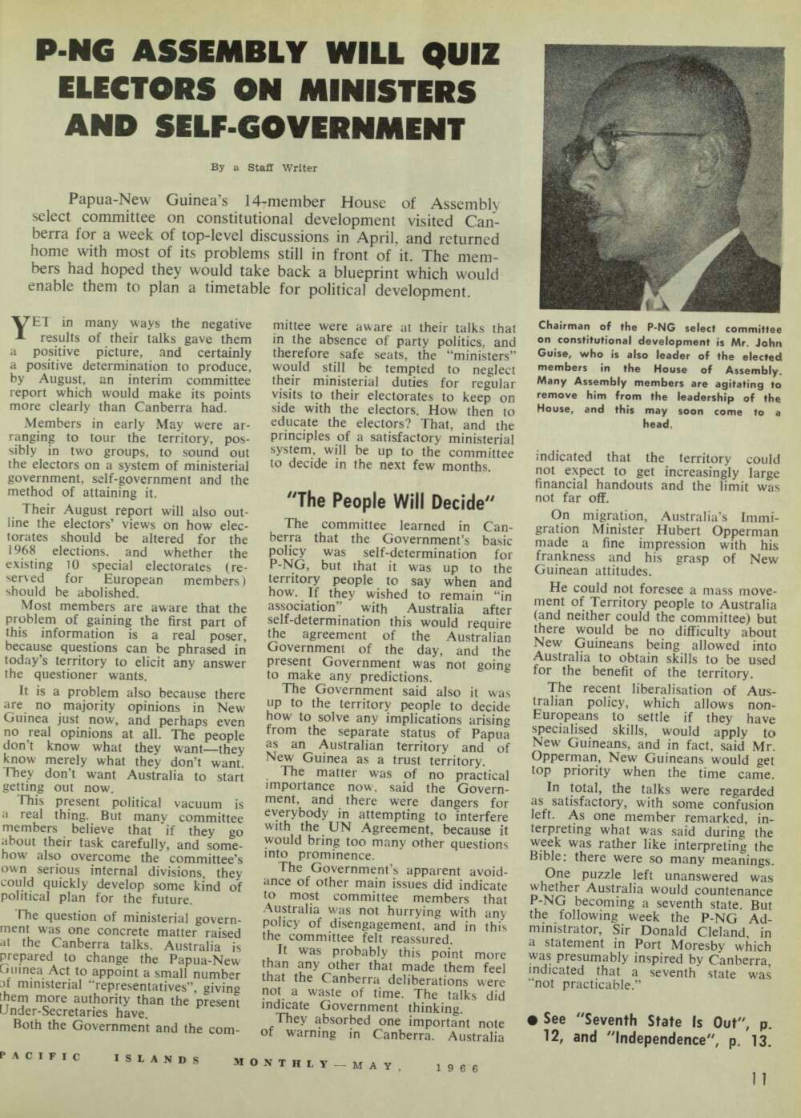
Chairman of the P-NG select committee on constitutional development is Mr. John Guise, who is also leader of the elected members in the House of Assembly.
Many Assembly members are agitating to remove him from the leadership of the House, and this may soon come to a head.