Deaths Of Islands People
p. 158 · Read in the full issue
Father P. Ladener The Rev. Father Peter Ladener, one of the longest resident mis sionaries in Papua-New Guinea, died in March at Madang, aged 81.
Born in Cologne, Germany, he went to the Territory in 1912. He spent most of his service at Halope, a mountain station near Madang.
During the Japanese occupation he was imprisoned on Manam Island, and was among 150 prisoners herded into a Japanese ship, which was strafed at sea by Allied aircraft.
Mr. G. Whiteside Mr. George Whiteside, a well known resident of Suva, died on March 1, aged 78.
He worked for Morris Hedstrom Ltd. for many years and was with the Posts and Telegraphs Department for seven years. For some years he was on the land in the Viti Levu Bay area.
He leaves a widow; a son, George, who is postmaster at Lautoka; and a daughter. Mrs. Betty Evans, who is in the office of the Fiji Govern ment representative in Sydney.
Mr. Tiri Trego A well-known resident of Raro tonga, Mr. Tiri Trego, died in Rarotonga on March 19 at the age of 55.
Mr. Trego, who was born on Mangaia, joined the Cook Islands Public Service as a clerk in 1945, and rose to become Mangaia’s Clerk-in-Charge. He was promoted to Clerk-in-Charge at Manihiki, then illness compelled him to spend some time in Rarotonga’s Sanitorium.
Following his discharge he became Senior Clerk at Mauke, then Acting Resident Agent for Mangaia, Mauke and Manihiki. As Acting RA, he was also Commissioner of the High Court.
In 1958, he became chief clerk in the Justice Department at Rarotonga.
He is survived by his widow, three sons and four daughters.
Mr. Glassie Strickland Mr. Glassie Strickland, a pro minent Cook Islander, died at Rarotonga Hospital on March 21, in his 72nd year. He had been in hospital for several weeks suffering from an infected leg which finally had to be amputated.
He was born in Aitutaki in 1894 and was educated at Rarotonga’s
Tereora College. For six years he was a steward on the London Missionary Society’s ship John Williams and travelled widely in the South Pacific. Later, he joined the Rarotonga Branch of the Union Steam Ship Company, and after that the local branch of Tagger and Harveys. There he worked for 38 years, rising to be manager.
In 1955, Mr. Strickland retired from the firm and opened a bakery in Avarua which he ran until shortly before his death. From 1945 he was local secretary of the LMS, since renamed the Cook Islands Christian Church. He was also assistant pastor of the church, and a member of the Legislative Assembly.
As an MLA he served on the standing committees on Finance and on Public Works. For some years he was president of a Rarotonga sports club.
In this year’s Honours List he was awarded the MBE for his work in church and government. He is survived by his wife, one daughter and one adopted son, both married.
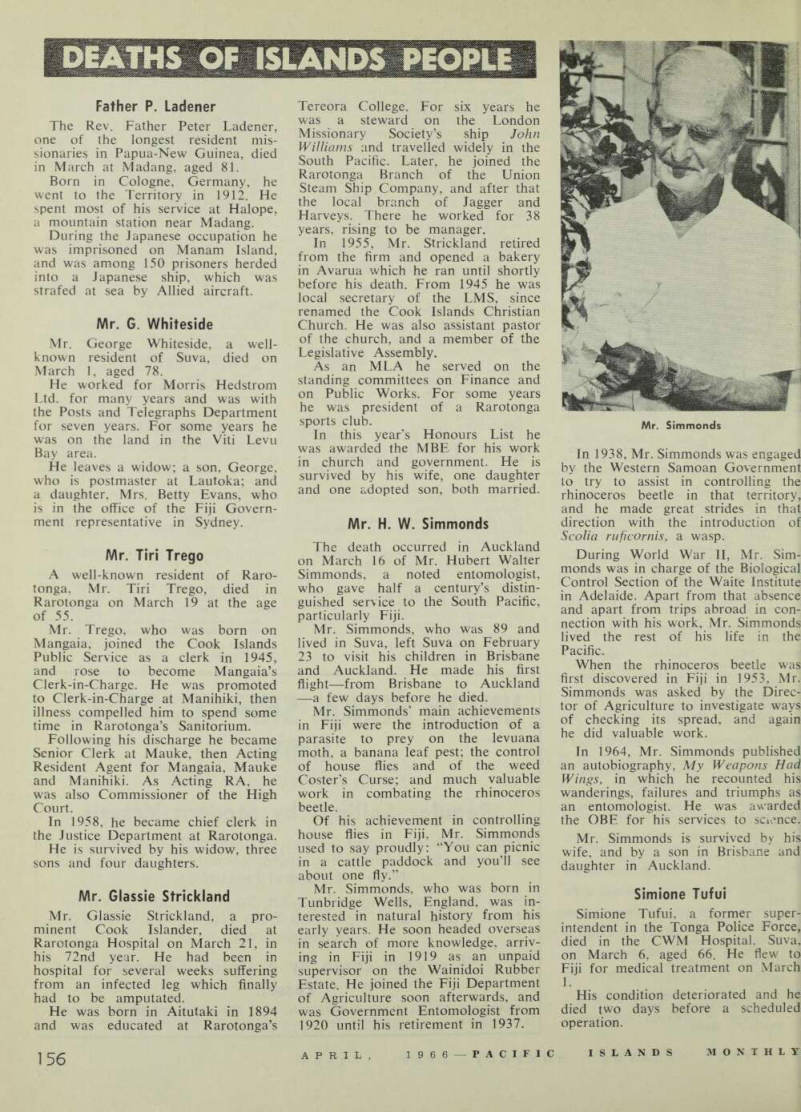
Mr. H. W. Simmonds The death occurred in Auckland on March 16 of Mr. Hubert Walter Simmonds, a noted entomologist, who gave half a century’s distin guished service to the South Pacific, particularly Fiji.
Mr. Simmonds, who was 89 and lived in Suva, left Suva on February 23 to visit his children in Brisbane and Auckland. He made his first flight—from Brisbane to Auckland —a few days before he died.
Mr. Simmonds’ main achievements in Fiji were the introduction of a parasite to prey on the levuana moth, a banana leaf pest; the control of house flies and of the weed Coster’s Curse; and much valuable work in combating the rhinoceros beetle.
Of his achievement in controlling house flies in Fiji, Mr. Simmonds used to say proudly; “You can picnic in a cattle paddock and you’ll see about one fly.”
Mr. Simmonds, who was born in Tunbridge Wells, England, was in terested in natural history from his early years. He soon headed overseas in search of more knowledge, arriv ing in Fiji in 1919 as_ an unpaid supervisor on the Wainidoi Rubber Estate. He joined the Fiji Department of Agriculture soon afterwards, and was Government Entomologist from 1920 until his retirement in 1937.
In 1938, Mr. Simmonds was engaged by the Western Samoan Government to try to assist in controlling the rhinoceros beetle in that territory, and he made great strides in that direction with the introduction of Scolia ruficornis, a wasp.
During World War 11, Mr. Sim monds was in charge of the Biological Control Section of the Waite Institute in Adelaide. Apart from that absence and apart from trips abroad in con nection with his work, Mr. Simmonds lived the rest of his life in the Pacific.
When the rhinoceros beetle was first discovered in Fiji in 1953, Mr.
Simmonds was asked by the Direc tor of Agriculture to investigate ways of checking its spread, and again he did valuable work.
In 1964, Mr. Simmonds published an autobiography, My Weapons Had Wings, in which he recounted his wanderings, failures and triumphs as an entomologist. He was awarded the OBE for his services to science.
Mr. Simmonds is survived by his wife, and by a son in Brisbane and daughter in Auckland.
Simione Tufui Simione Tufui, a former super intendent in the Tonga Police Force, died in the CWM Hospital. Suva, on March 6, aged 66. He flew to Fiji for medical treatment on March 1.
His condition deteriorated and he died two days before a scheduled operation.
Mr. Simmonds