travel
p. 141 · Read in the full issue
New Guinea Ponders Tourism And 'Personal Dignity'
From a Port Moresby Correspondent The value of tourism to Papua-New Guinea was debated at length in the House of Assembly in Port Moresby in March following introduction of a bill to establish a P-NG Tourist Board. The board, which will include representatives of the Government and commerce, will promote the industry in the same way as the Fiji Visitors Bureau does.
rHE Administration will contribute funds, and audit the accounts, ut the acting Assistant Administra m, Mr. F. Henderson, made it clear i his second reading speech that le effectiveness of the board would irgely depend on the financial con ibutions it received from private idustry, which stands to benefit from icreased tourism.
Mr. Henderson said the board ould seek to attract overseas mrists, encourage regional tourist svelopment through local organisa ons, stimulate the growth of in ustries associated with tourism and ave the power to inspect and grade □tels. Accommodation in most parts f P-NG at present “cannot be :garded as being of sufficient stan ard to meet the needs of inter ational tourism”, Mr. Henderson lid.
Credit Needed
He added that the Administration garded an international air link resumably through Port Moresby to e Far East] as “being of the utmost iportance in developing the tourist dustry in the Territory”, for without is New Guinea would lose many sitors unwilling to divert from main r routes.
Welcoming the establishment of the >ard, Mr. Graham Gilmore (who vns a hotel at Kainantu) said also eded was a method of extended edit finance to small businesses as dated with tourism. Credit was not adily available at the moment for e small man.
Mr. John Guise, leader of the jcted members, who is a part iropean representing the Milne Bay €n electorate, said a reservation he and about the bill was that the Terri ry’s overseas earnings might be in cased at the cost of the dignity of i New Guineans.
Pacific Islands such as Tahiti had ide money at the expense of local
travel
dignity, he said, and he therefore wanted a majority of the board to be New Guineans, “to safeguard the respect and dignity of our people”.
New Guineans were not to be con sidered as merely hotel waiters.
Although Mr. Guise soon came under attack from other members, he persisted in this proposal as the only way of safeguarding local dignity.
He also distributed copies of some American comics, which he said “projected an image” which indicated that the New Guinean people couldn’t think. He said that the House should protest about such comics, which were another example of loss of dignity.
Mr. Don Barrett (West Gazelle) said that while the dignity of New Guineans had to be preserved this couldn’t be done by insisting on a racial structure of a particular board.
“Travelling around the Pacific one of the things that does impress anybody is the natural dignity of the people, and I cannot believe that the New Guineans are going to lose their natural dignity,” Mr. Barrett said.
Fijians Have Dignity
“I have seen something of tourism in Fiji and surely one cannot say that such men as Ratu Edward and Ratu George Cakobau, who are among my friends in that country, have lost their dignity. Nor do I believe that the average Fijian has.”
Mr. Barrett said he had seen the men of Mt. Hagen and Wabag in their feathers, “performing” for tourists, and you could not wish to see more dignified, natural men, and he was confident that New Guinea could retain this natural dignity while still fostering a tourist industry.
On the question of comics, Mr.
Barrett added that children in New Guinea read another comic called “Li’l Abner”, which brought into ridicule a certain class of Americans, but nobody read it seriously and New Guineans should learn to accept this sort thing about themselves, and laugh at it.
Mr. Henderson in reply said the Administration appreciated the need for considerable investment if a worthwhile tourist industry were to grow. When the P-NG Development Bank was in operation [later in the year] proposals for the tourist in dustry would no doubt be given sympathetic consideration.
Benefits
Nor was the Administration un mindful of the points made by Mr.
Guise. There were real dangers in uncontrolled tourism, but the Admini stration was convinced that the benefits of a well run tourist industry far outweighed the disadvantages.
The Administration had looked at tourist industries in various parts of the Pacific. In Tahiti everything was concentrated on one point so that it became a completely artificial environment. But in Fiji the Govern ment had spread its tourists widely, and this is what New Guinea intended to do.
The Administration would not agree to a board on a racial basis, for it wanted the best men available of any race.
The bill was passed.
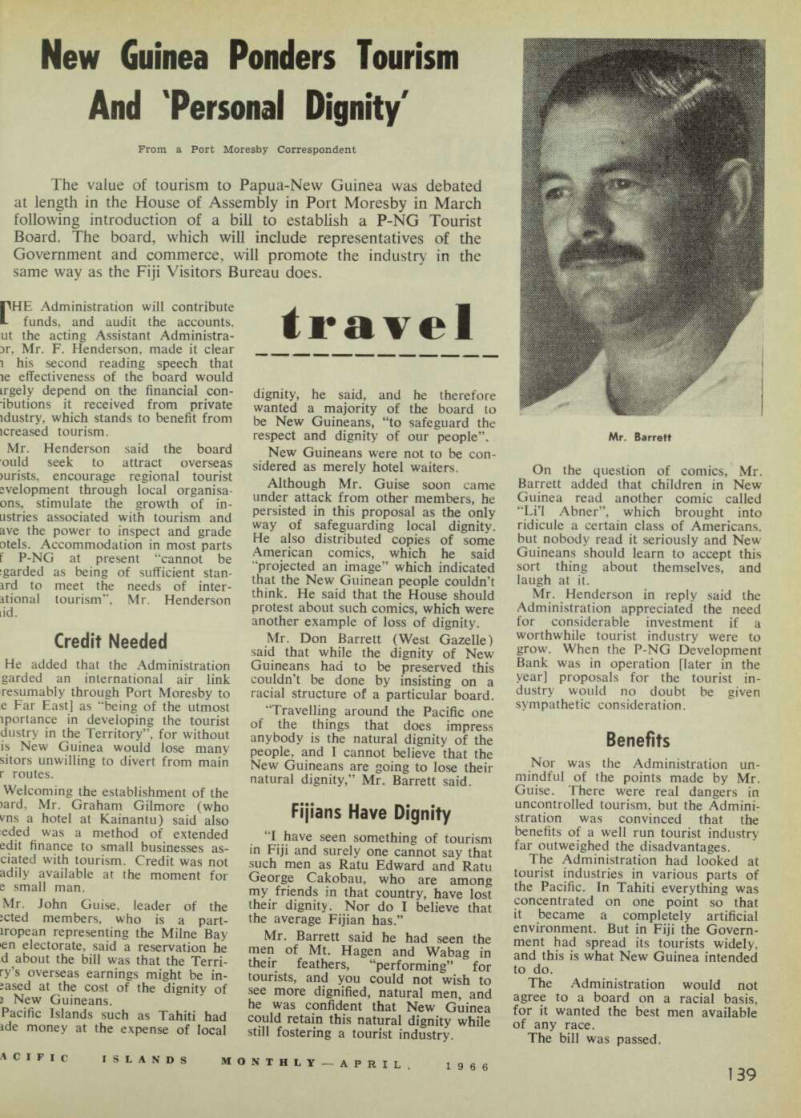
Mr. Barrett