travel
pp. 135-137 · Read in the full issue
[?]Ourist Hotel Open
[?]Oon At Tanna,
[?]Ew Hebrides
A new tourist hotel being
lilt at Tanna, New Hebrides,
expected to be able to accom odate its first visitors within a w months. hotel, Tanna’s first, is at Epul. near Lenakel, on the astern side of the island.
Tanna. 32 miles long by 15 miles ross,. is a fertile, attractive island th an equable climate about 130 iles south of Vila, the New ;brides capital.
It has a population of about 8,000 lives, and is noted for its con ntly active volcano, Mount Yasur, uch may be viewed from within short distance of the rim of the iter.
The new hotel, to be called the )tel Tanna, is a joint venture by . R. U. Paul, an Australian planter d businessman, of Lenakel, and -. Pierre Bourgeois, a prominent snch businessman, of Vila. It will ve a small intake of visitors dally, but this should increase as : buildings are extended.
An arrangement has already been ide with New Hebrides Airways enable passengers from the
travel
Messageries Maritimes vessel Poly nesie to fly from Vila and spend the day on Tanna.
New Hebrides Airways already maintains a thrice-weekly service between Vila and Lenakel.
HTHE Norfolk Island Council in A March decided to grant permis sive occupancy of one of the old Kingston buildings to the Norfolk Island Lions Club, to be used as club rooms and a seaside cottage for elderly people.
The building in question is a large wooden house near the King ston pier, and it is popularly believed to be the building in which W. C. Wentworth was born around 1790. However, local historian Merval Hoare, in her authoritative Rambler’s Guide to Norfolk Island , says there is no evidence to support popular belief. All buildings in the first settlement of Norfolk were deliberately destroyed when the settlement closed in 1814.
The building and land were excised from the Kingston Common in 1956 and the house itself has been unoccupied for some years.
A SEVEN-YEAR ban on the sale of bottled liquor between 3 p.m. on Saturdays and 9 a.m. on Mondays was lifted in New Caledonia at the end of February.
The ban had been aimed at
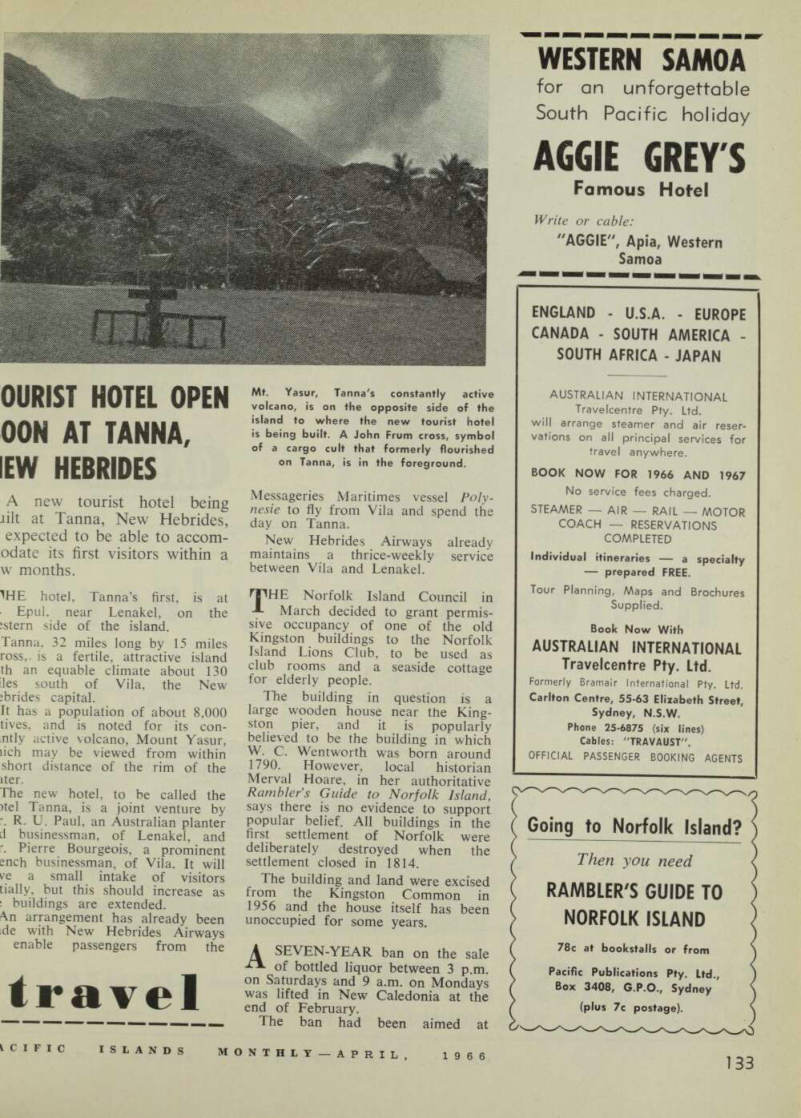
Mt. Yasur, Tanna's constantly active volcano, is on the opposite side of the island to where the new tourist hotel is being built. A John Frum cross, symbol of a cargo cult that formerly flourished on Tanna, is in the foreground.
curbing drinking particularly in public squares and on the beaches and highways, and particularly among the Melanesians.
However, its effect was to con centrate drinking (and drunken) parties in the local bars, where there was no prohibition on the sale of liquor—by the glass.
Europeans, especially, were pen alised by the ban, for if they were “caught short” with their home sup plies of liquor over the weekend, they either had to go thirsty or buy their liquor by the glass and empty it into a hidden bottle.
The lifting of the weekend ban on bottle sales means that liquor may now be bought and carried away every day from 6 a.m, to 9 p.m.
PAN American Airways is seeking approval for a service linking Australia and Japan via Guam.
Announcing this in Sydney in March, Pan Am’s Director for Australia, Mr. Rush S. Clark, said that the service would provide the shortest link in both distance and time between Australia and Tokyo and would tie Australia into Pan Am’s round the world services.
Travellers in Papua- New Guinea will look hard to locate good food properly served in the right atmosphere, for the big ter ritory still has much of the frontier attitude about it.
Thus it is all the more pleasant ;o find, hidden away in the industrial area of Mangola Street, Lae, near he native market, a restaurant called ‘Bobby’s Place”, where the visitor :an get a fine meal with an excellent selection of wines. It is open from 1 p.m. to 10 p.m. seven days a week, and the owner, Mrs. Bobby Smith, s hopeful of getting an extension )f hours from the Licensing Court.
Mrs. Smith has been 34 years in Guinea. She is best known as he former owner of Lae’s taxi fleet. ‘Bobby’s Place” is a new venture hat deserves to prosper as a pleasant alternative to a late meal at a Chinese cafe. rHE growing popularity of Norfolk Island as a tourist centre was Ilustrated recently by figures released >y the New South Wales Department >f Tourist Activities.
The figures show that about 5,500 ourists visited the island last year ompared with 602 in 1958, 642 in 960, 1,356 in 1961, 1,888 in 1962, 1,707 in 1963, and 3,557 in 1964.
B,OOO tourists are expected his year.