travel
pp. 123-125 · Read in the full issue
Away From It All In The Cook Is.
A Regular Rim Department
Reporting News Of South
Seas Tourism And Travel
From The Inside
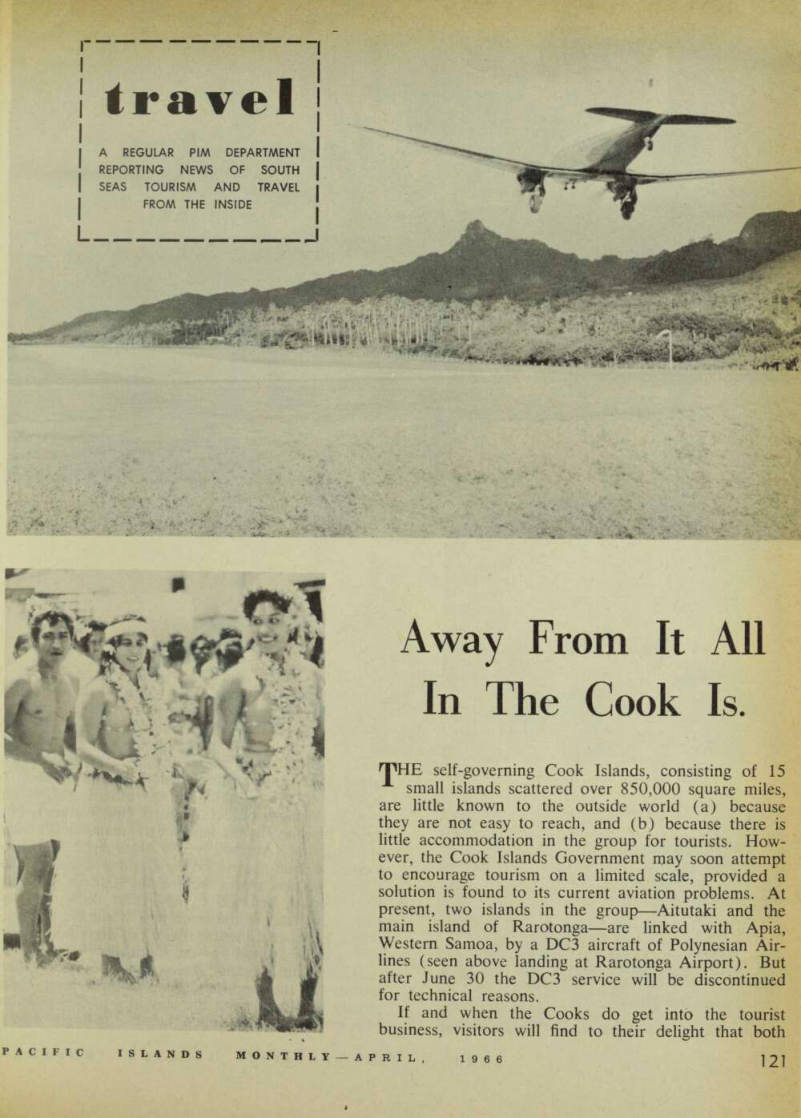
T'HE self-governing Cook Islands, consisting of 15 small islands scattered over 850,000 square miles, are little known to the outside world (a) because they are not easy to reach, and (b) because there is little accommodation in the group for tourists. How ever, the Cook Islands Government may soon attempt to encourage tourism on a limited scale, provided a solution is found to its current aviation problems. At present, two islands in the group—Aitutaki and the main island of Rarotonga—are linked with Apia, Western Samoa, by a DC3 aircraft of Polynesian Air lines (seen above landing at Rarotonga Airport). But after June 30 the DC3 service will be discontinued for technical reasons.
If and when the Cooks do get into the tourist business, visitors will find to their delight that both
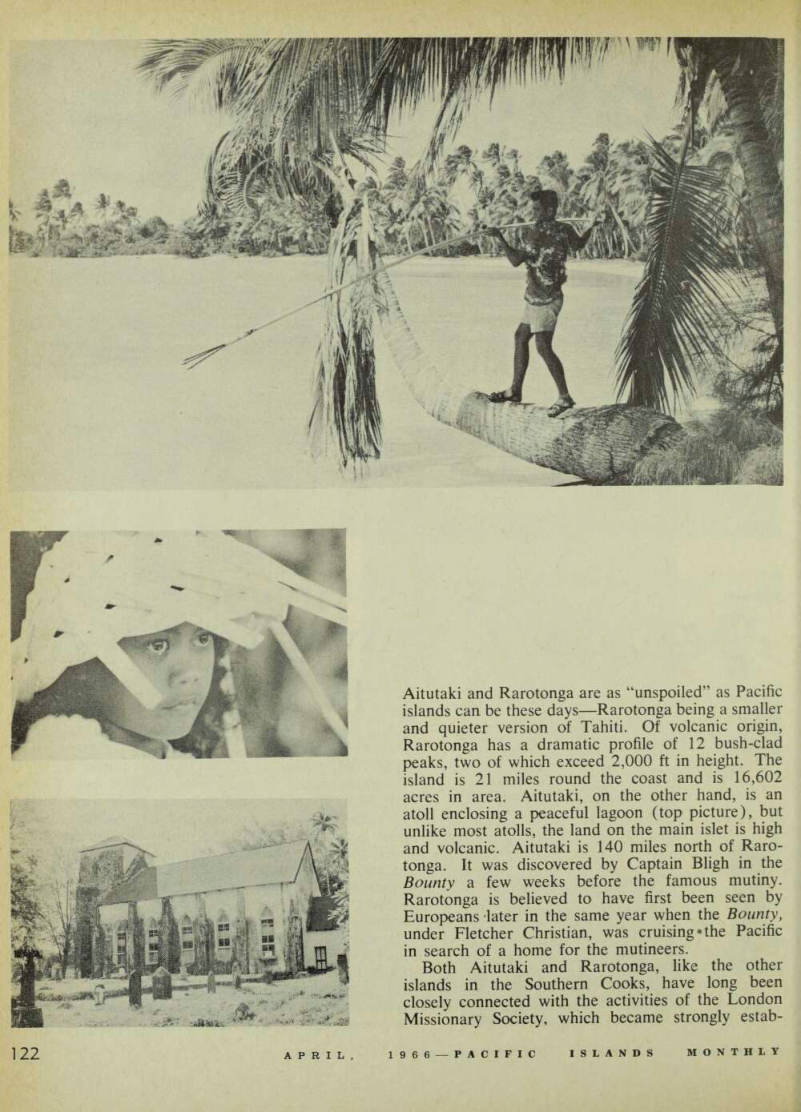
Aitutaki and Rarotonga are as “unspoiled” as Pacific islands can be these days—Rarotonga being a smaller and quieter version of Tahiti. Of volcanic origin, Rarotonga has a dramatic profile of 12 bush-clad peaks, two of which exceed 2,000 ft in height. The island is 21 miles round the coast and is 16,602 acres in area. Aitutaki, on the other hand, is an atoll enclosing a peaceful lagoon (top picture), but unlike most atolls, the land on the main islet is high and volcanic. Aitutaki is 140 miles north of Raro tonga. It was discovered by Captain Bligh in the Bounty a few weeks before the famous mutiny.
Rarotonga is believed to have first been seen by Europeans later in the same year when the Bounty, under Fletcher Christian, was cruising-the Pacific in search of a home for the mutineers.
Both Aitutaki and Rarotonga, like the other islands in the Southern Cooks, have long been closely connected with the activities of the London Missionary Society, which became strongly estab-
lished in Tahiti early in the 19th century. After gaining a foothold in Aitutaki, the Rev. John Williams took the first Polynesian missionaries to Rarotonga in 1823. Christianity quickly spread, and LMS churches are now a feature of the Rarotongan landscape. The LMS church at left is at Avarua, Rarotonga.
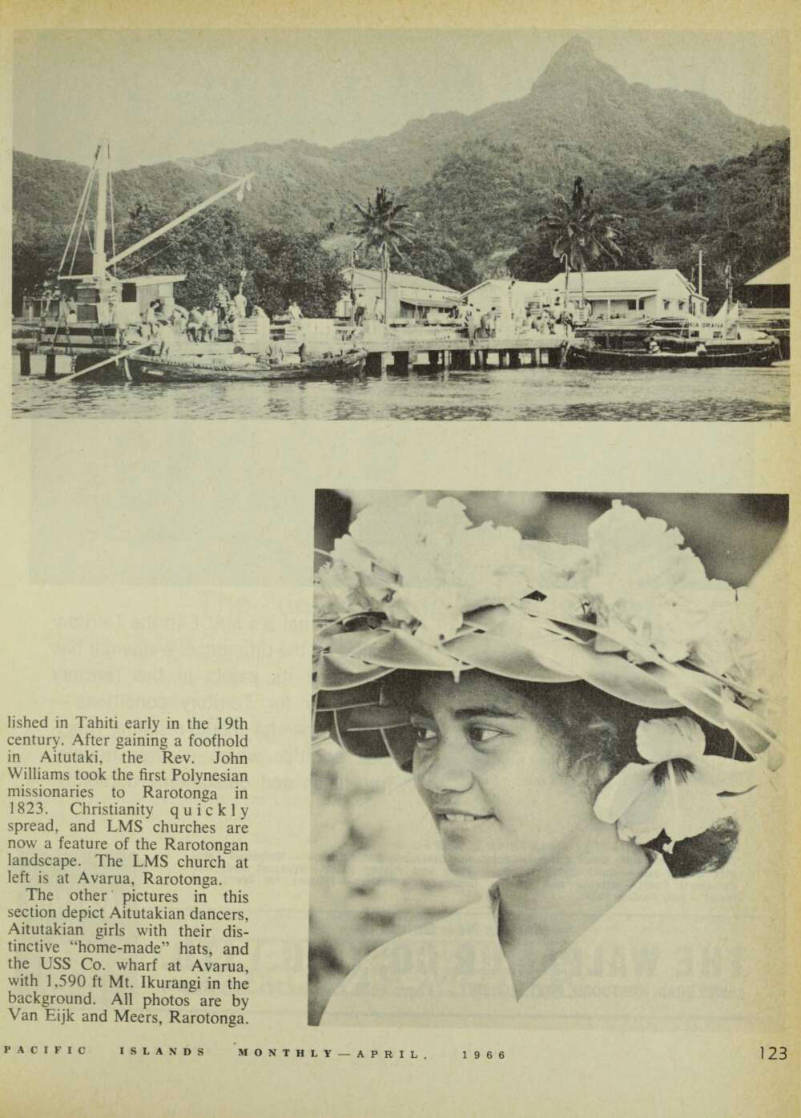
The other pictures in this section depict Aitutakian dancers, Aitutakian girls with their dis tinctive “home-made” hats, and the USS Co. wharf at Avarua, with 1,590 ft Mt. Ikurangi in the background. All photos are by Van Eijk and Meers, Rarotonga.