Cruising Yachts
pp. 103-113 · Read in the full issue
Pacific Shipping And Cruising Yachts
Deep-Water Wharves Opened At Two Islands Capitals
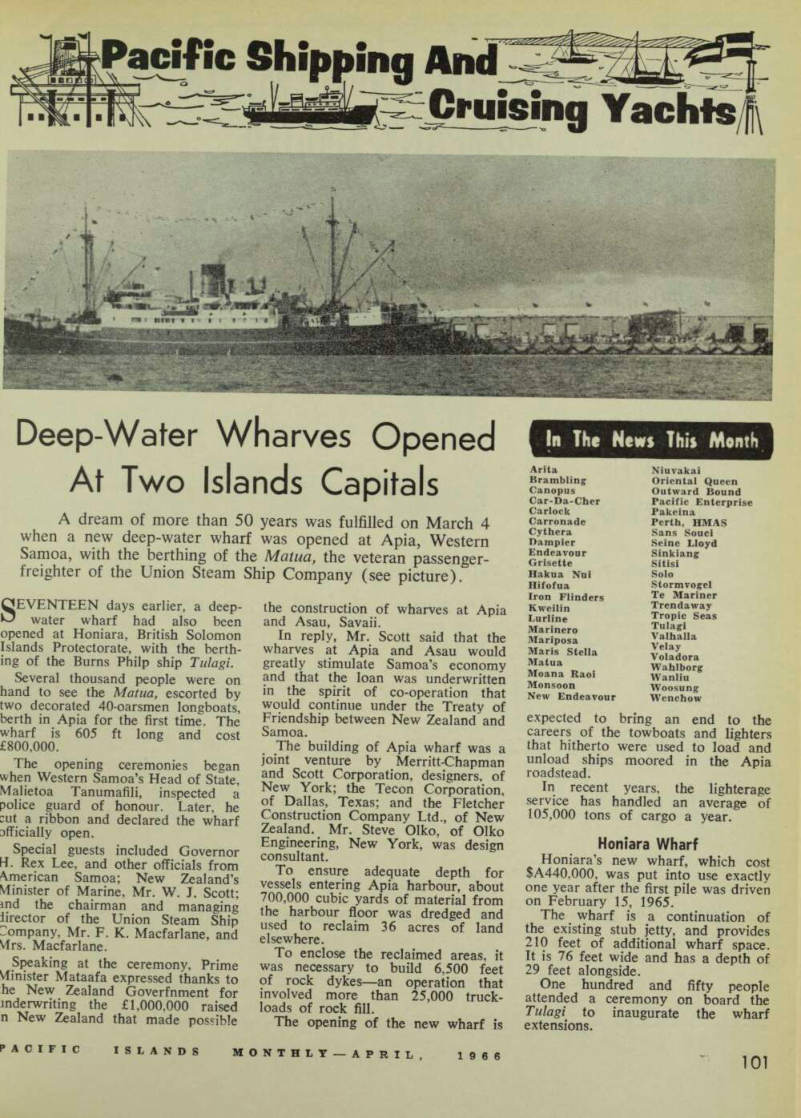
A dream of more than 50 years was fulfilled on March 4 when a new deep-water wharf was opened at Apia, Western Samoa, with the berthing of the Matua, the veteran passenger freighter of the Union Steam Ship Company (see picture).
SEVENTEEN days earlier, a deep water wharf had also been opened at Honiara, British Solomon Islands Protectorate, with the berth ing of the Burns Philp ship Tulagi.
Several thousand people were on hand to see the Matua, escorted by two decorated 40-oarsmen longboats, berth in Apia for the first time. The wharf is 605 ft long and cost
£Boo,Ooo.
The opening ceremonies began when Western Samoa’s Head of State, Malietoa Tanumafili, inspected a police guard of honour. Later, he :ut a ribbon and declared the wharf afficially open.
Special guests included Governor H, Rex Lee, and other officials from American Samoa; New Zealand’s Minister of Marine, Mr. W. J. Scott; md the chairman and managing Erector of the Union Steam Ship Company, Mr. F. K. Macfarlane, and Mrs. Macfarlane.
Speaking at the ceremony, Prime Minister Mataafa expressed thanks to he New Zealand Goverfnment for mderwriting the £1,000,000 raised n New Zealand that made possible
the construction of wharves at Apia and Asau, Savaii.
In reply, Mr. Scott said that the wharves at Apia and Asau would greatly stimulate Samoa’s economy and that the loan was underwritten in the spirit of co-operation that would continue under the Treaty of Friendship between New Zealand and Samoa.
The building of Apia wharf was a joint venture by Merritt-Chapman and Scott Corporation, designers, of New York; the Tecon Corporation, of Dallas, Texas; and the Fletcher Construction Company Ltd., of New Zealand. Mr. Steve Olko, of Olko Engineering, New York, was design consultant.
To ensure adequate depth for vessels entering Apia harbour, about 700,000 cubic yards of material from the harbour floor was dredged and used to reclaim 36 acres of land elsewhere.
To enclose the reclaimed areas, it was necessary to build 6,500 feet of rock dykes—an operation that involved more than 25,000 truck loads of rock fill.
The opening of the new wharf is
expected to bring an end to the careers of the towboats and lighters that hitherto were used to load and unload ships moored in the Apia roadstead.
In recent years, the lighterage service has handled an average of 105,000 tons of cargo a year.
Honiara Wharf Honiara’s new wharf, which cost $A440,000, was put into use exactly one year after the first pile was driven on February 15, 1965.
The wharf is a continuation of the existing stub jetty, and provides 210 feet of additional wharf space.
It is 76 feet wide and has a depth of 29 feet alongside.
One hundred and fifty people attended a ceremony on board the Tulagi to inaugurate the wharf extensions.
Keen Interest In Tongan
Ship's Voyage Under Sail
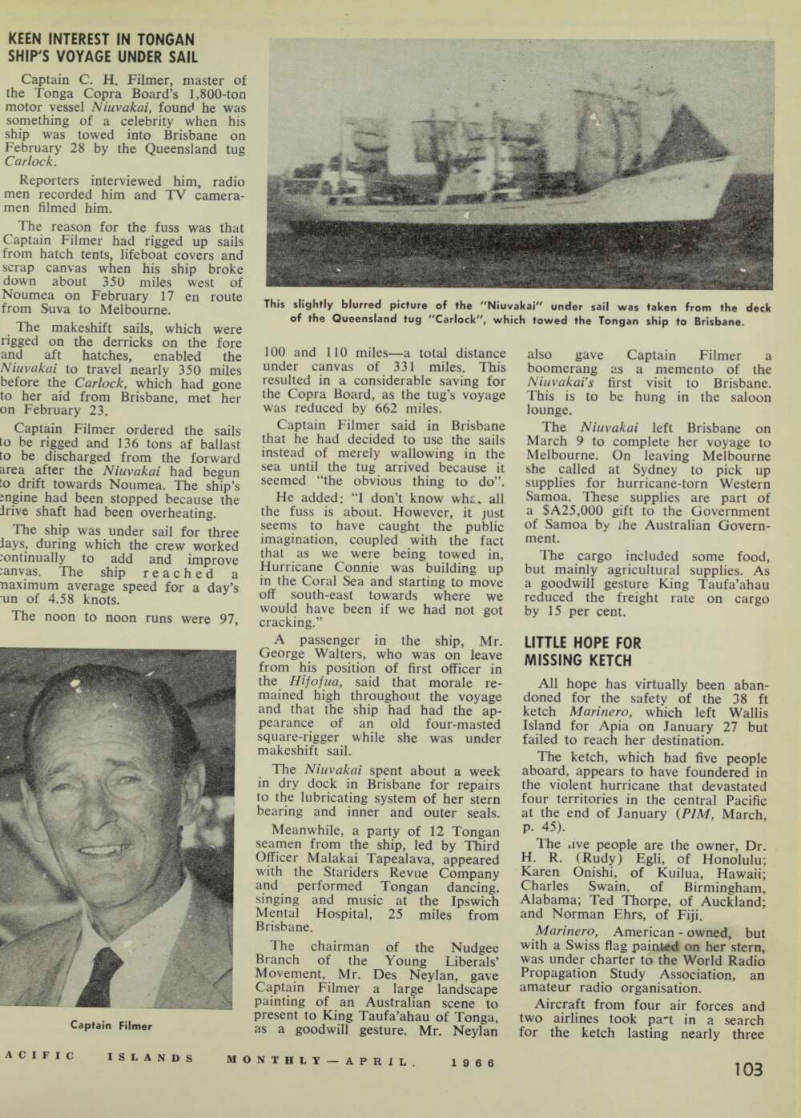
Captain C. H. Filmer, master of the Tonga Copra Board’s 1,800-ton motor vessel Niuvakai, found he was something of a celebrity when his ship was towed into Brisbane on February 28 by the Queensland tug Carlock.
Reporters interviewed him, radio men recorded him and TV camera men filmed him.
The reason for the fuss was that Captain Filmer had rigged up sails from hatch tents, lifeboat covers and scrap canvas when his ship broke down about 350 miles west of Noumea on February 17 en route from Suva to Melbourne.
The makeshift sails, which were rigged on the derricks on the fore and aft hatches, enabled the Niuvakai to travel nearly 350 miles before the Carlock, which had gone to her aid from Brisbane, met her on February 23.
Captain Filmer ordered the sails to be rigged and 136 tons af ballast to be discharged from the forward area after the Niuvakai had begun to drift towards Noumea. The ship’s engine had been stopped because the Irive shaft had been overheating.
The ship was under sail for three lays, during which the crew worked continually to add and improve canvas. The ship reached a naximum average speed for a day’s un of 4.58 knots.
The noon to noon runs were 97,
100 and 110 miles—a total distance under canvas of 331 miles. This resulted in a considerable saving for the Copra Board, as the tug’s voyage was reduced by 662 miles.
Captain Filmer said in Brisbane that he had decided to use the sails instead of merely wallowing in the sea until the tug arrived because it seemed “the obvious thing to do”.
He added; “I don’t know wha. all the fuss is about. However, it just seems to have caught the public imagination, coupled with the fact that as we were being towed in, Hurricane Connie was building up in the Coral Sea and starting to move off south-east towards where we would have been if we had not got cracking.”
A passenger in the ship, Mr.
George Walters, who was on leave from his position of first officer in the Hifofua, said that morale re mained high throughout the voyage and that the ship had had the ap pearance of an old four-masted square-rigger while she was under makeshift sail.
The Niuvakai spent about a week in dry dock in Brisbane for repairs to the lubricating system of her stern bearing and inner and outer seals.
Meanwhile, a party of 12 Tongan seamen from the ship, led by Third Officer Malakai Tapealava, appeared with the Stariders Revue Company and performed Tongan dancing, singing and music at the Ipswich Mental Hospital, 25 miles from Brisbane.
The chairman of the Nudgee Branch of the Young Liberals’
Movement, Mr. Des Neylan, gave Captain Filmer a large landscape painting of an Australian scene to present to King Taufa’ahau of Tonga, as a goodwill gesture. Mr. Neylan
also gave Captain Filmer a boomerang as a memento of the Niuvakai’s first visit to Brisbane.
This is to be hung in the saloon lounge.
The Niuvakai left Brisbane on March 9 to complete her voyage to Melbourne. On leaving Melbourne she called at Sydney to pick up supplies for hurricane-torn Western Samoa. These supplies are part of a $A25,000 gift to the Government of Samoa by the Australian Govern ment, The cargo included some food, but mainly agricultural supplies. As a goodwill gesture King Taufa’ahau reduced the freight rate on cargo by 15 per cent.
Little Hope For
Missing Ketch
All hope has virtually been aban doned for the safety of the 38 ft ketch Marinero, which left Wallis Island for Apia on January 27 but failed to reach her destination.
The ketch, which had five people aboard, appears to have foundered in the violent hurricane that devastated four territories in the central Pacific at the end of January (PIM, March, P- 45).
The uve people are the owner, Dr.
H. R. (Rudy) Egli, of Honolulu; Karen Onishi, of Kuilua, Hawaii; Charles Swain, of Birmingham, Alabama; Ted Thorpe, of Auckland; and Norman Ehrs, of Fiji.
Marinero, American - owned, but with a Swiss flag painted on her stern, was under charter to the World Radio Propagation Study Association, an amateur radio organisation.
Aircraft from four air forces and two airlines took pan in a search for the ketch lasting nearly three
Captain Filmer
This slightly blurred picture of the "Niuvakai" under sail was taken from the deck of the Queensland tug "Carlock", which towed the Tongan ship to Brisbane.
weeks, costing about £50,000, and covering about 170,000 square miles.
A New Zealand Civil Aviation Department spokesman said the RNZAF made 21 sorties totalling 167 hours, and USAF planes made 25 sorties totalling 111 hours.
In addition, French Air Force planes flying through the area had made two sorties totalling eight hours, and an RAF Belfast from Apia had made two sorties of 11 hours.
An American helicopter had searched for 12 hours.
“We are satisfied that we have done everything possible to find the ketch,” the spokesman said. “If she had been in the area searched she would almost certainly have been seen.”
New Captain For
Survey Ship
A new captain was due to join the Royal Naval survey ship, HMS Dampier at Suva on March 25. He is Commander P. G. N. Cardno, who is succeeding Commander M. J.
Baker.
HMS Dampier arrived in the South Pacific last year, after working in Asian waters for many years, to carry on work begun by HMS Cook.
Commander Baker has been her captain for 2i years. His next post will be at the Admiralty in London.
The Dampier is currently working in the New Hebrides, but calls at Suva every two weeks for fuel and stores.
In March she was surveying the coastal waters of Malekula where the sea bottom was greatly deformed by earthquakes last year.
Services To New Guinea
Fo Be Expanded
The China Navigation Co. plans 0 expand its services to New Guinea )orts soon. The expansion will in- Jude a new direct call at Lae as the :ompany feels that, with the comple lon of the Lae-Goroka road and the general prosperity of Lae, there is 1 demand for increased exports from Australia.
The first service will be by the Cweilin, from Melbourne, Sydney nd Brisbane, followed by the Wanliu Voosung and Wenchow. The present lonthly service to Rabaul will con mue.
The China Navigation Co. also has ortnightly sailings by the Shansi and oochow to Port Moresby and amarai from Sydney and Brisbane, nd monthly sailings to Port Moresby Ir 1 ,J he chan % s ha and Taiyuan from lelbourne, Sydney and Brisbane.
Lae will also be served by the
China Navigation Co. on a regular basis direct from Japan, starting this month, with the Chefoo and the Kweilin.
This service will be in addition to the monthly sailings from Japan and Hong Kong to Papua, New Guinea and South Pacific ports.
Yacht Skipper On Arms
Charge "Skips" Noumea
John Dean, owner-skipper of the 34 ft Auckland yawl Te Mariner , slipped out of Noumea “a la Anglaise” on the night of March 6-7 while a case was pending against him in a Noumea court for illegally im porting five rifles and a quantity of
ammunition. (In New Caledonia, the term “a la Anglaise” means to leave “without notice”).
Dean, who has spent quite a lot of time in New Caledonian waters in the last few years, arrived in Noumea from Auckland in February.
Customs officials later raided his yacht, and on finding the firearms and ammunition, Dean was arrested.
Charged in a Noumea court with having the material in his possession, Dean said he did not know of a local law which made it necessary for the master of any vessel under 100 tons to declare any firearms aboard when entering New Caledonia.
He added that he had had the
firearms aboard his yacht because he intended to go crocodile-hunting in :he Solomons.
After this evidence had been given.
Dean’s case was adjourned for eight lays. Later, after Dean had been >ermitted to take care of his yacht, vhich had been sealed by the luthorities, he slipped out of harbour inobserved.
In mid-March, PlM’s Noumea :orrespondent reported: “On the vidence, it seems that Dean was inxious to place Te Mariner out of each of seizure by the local authori ies. If he had been fined, his vessel rould probably have been seized and old to pay his fine, which probably /ould have been about 5A600.
“Although Te Mariner is worth at ;ast $A 10,000, it would not have rought one-third of that sum in Joumea.”
Our correspondent added that eople in Noumea were awaiting the jsumption of the Dean case with ecn interest, and that Dean’s flight ad “seriously aggravated his osition”.
Dean arrived in Sydney on March 7, and claimed in an interview in le Daily Mirror that day that he ad been persecuted and “framed on gun-running charge” in Noumea.
Apology
To save his yacht from falling into le hands of the New Caledonian overnment, he said he had slipped vay at night.
Mr. Dean blamed an Australian Noumea for the trouble. He id he had had five .303 rifles ith him, which he intended to use i a crocodile-shooting expedition in e Solomons.
“This man’s allegations were lough to get me arrested and tried :fore a special tribunal on a charge importing firearms without having idared them to the Customs ricials,” Mr. Dean told the Daily irror. “The judge threw the case it and blasted the Customs men for ivmg brought the matter to court.”
Despite his acquittal, Mr. Dean id the Customs imposed a $2,500 ie for having the rifles in his ►ssession.
While my solicitor was wrangling th them, I hoisted sail one night d lit out for Sydney,” he said. “I J a tin of beef a day until it ran dney'” 0 dayS before reaching Mr. Dean told the Daily Mirror at he was broke, and that he hoped get a job in Sydney doing charter irk on his yacht.
Interviewed by PIM, Mr. Dean d he was willing to go back to
New Caledonia to face the charge against him now that his yacht was safe.
He added that as he has been attempting to build up a tourist business in New Caledonia during the past two years, he hoped to be allowed to return there without prejudice to continue this business.
Islands Freighter In
Sydney Collision
The 7,500-ton Messageries Mari times freighter Velay, was involved in a collision with the freighter Iron Flinders, of 14,000 tons, in Sydney Harbour about 10.30 p.m. on March 8.
The bow of the Iron Flinders hit the Velay amidships on the starboard side and cut open three decks.
It spread open iron companion
ways on three decks, from the hull top to the boat deck, A lowered gangway was smashed.
The Velay, with a pilot on board, was entering the harbour. Tugs later towed her to a wharf.
The Velay, which had just arrived from Newcastle, trades between Europe and Australia, taking in Tahiti, the New Hebrides and New Caledonia.
Broken Hill Pty. Ltd., owners of the Iron Flinders, about the middle of March, filed a writ in admiralty in the NSW Supreme Court for 5500,000, claiming damages against Messageries Maritimes, owners of the Velay.
New Fishing Ship
For Tonga
The Pakeina, Tonga’s new fishing ship, arrived at Nukualofa on
■ebruary 27 as deck cargo in the )utch ship Seine Lloyd.
The Pakeina, built in England for *opical conditions, has a capacity f 1,950 cubic feet, and is capable f deep freezing 25 tons of fish, he is powered by a Lister Black ;one diesel main engine developing 65 hp.
The ship was named by Queen alote at a Privy Council in August, 964.
The name refers to the ancient ongan fishing lure made of mother f-pearl shell, commonly known as i. If a pa was particularly suc ;ssful, it was keina.
Lady Luke, wife of the senior rown Agent, London, launched the ikeina at Berwick-on-Tweed on ugust 26, 1965.
!\St New Boat For
3Rd Howe Island
Mr. Carl Dignam and Mr. Ron iyten, of Lord Howe Island, were take delivery in March of a 40 ft hing boat, which they plan to >erate in the waters around Lord owe.
The vessel, Car-Da-Cher, is •wered by a 200 horsepower diesel id has a top speed of about 20 lots —almost twice as fast as any her Lord Howe Island boat. She also fitted with a radio transmitter, ho sounder and automatic pilot.
It is expected that the vessel will licensed to carry 28 people within ree miles of Lord Howe and 18 ople to Balls Pyramid.
Iree Shipping
Spectors Appointed
Shipping inspectors have been ap inted to three main ports in Papua :w Guinea. They are Captains A. Janoulis (Port Moresby), C. B. ueman (Rabaul) and A. L. Lewis ladang).
Captain G. A. Hawley, Super endent of the Marine Division of Department of Trade and lustry, said in March that the new Dointees would carry out normal PPing inspections and would assist harbourmasters in surveys and Jtage.
Ws From The
Chting Caldwells
Pexan yachtsman John Caldwell, o sailed through the yachting umns of PIM in the 1950’5, first the 36 ft ketch Tropic Seas and :r in the 45 ft ketch Outward und, recently sent us word from West Indies that he and his V ly ,™ ere P lannin S to “swallow the hor” and move ashore on their
own island in the British Grenadines.
The Grenadines lie between St.
Vincent and Grenada in the Windward Islands.
The Caldwells, who still have Out ward Bound, have been doing charter work for the past four years or so, specialising in taking tourists on twoweek cruises from Antigua to Mar- Unique, or Martinique to Grenada.
Meanwhile, John has been planting coconut palms and tropical trees on the treeless beaches of the Windwards to beautify them—and attract more tourists.
One of the islands he planted in this way was uninhabited Prune Island in the Grenadines. But
herds of goats destroyed his plants, and when he negotiated with the St.
Vincent Government to get rid of them, the government gave him a 99-year lease of the island so long as he agreed to develop it for the tourist industry.
The island lies in the centre of the Grenadines, is half a mile long and nearly as wide, has four good beaches, and contains 150 acres of level land.
The Caldwells are now planning to construct a 20-room South Sea style cottage resort, a grass airstrip capable of landing a six-seater plane, and a six-hole golf course. To finance the project, they will subdivide the island
accommodate at least 50 beach jmesites, of which they have now Id subleases to 14.
Son Johnny, who is now 18, will ke over Outward Bound as skipper ith his mother, while Dad moves hore to direct the island’s develop ed.
The yacht will be kept attached to e resort and will be part of a new [vice in which tourists can spend week on the yacht and a week the resort for an all inclusive fee, le resort will be called the isuarina Beach Club.
Thirteen-year-old Roger Caldwell, 10 was born during the voyage of 5 Tropic Seas, and is now at board l school in Barbados, hopes to join ; family hotel-charter business later
Iw Oil Protects Yachts
Motor Boats
A petroleum-based rust preventive id and protective oil that should ave of great value to yachtsmen d owners of other pleasure boats s recently come on the market in istralia and other countries.
The Petroleum Information Bureau Australia) says that the fluid dis ices water from metal surfaces d covers them with a soft greasy n.
This film, which can be wiped off th a cloth dipped in kerosene, >tects the surfaces from rust for •m six to 12 months. It comes in aerosol pack.
Wire rigging, brass, copper.
chromium and other metals may all be protected with the fluid, which can also be sprayed on to plug leads, magnetos and other electrical com ponents of inboard and outboard motors.
Even tools left on board for the winter can be protected in this way.
Those parts of boat trailers that enter the water when boats are being launched from them will also benefit from similar treatment.
Workshop tools and garden im plements, too, can be kept in good condition by being sprayed with the fluid as often as necessary.
Results obtained by use of the new fluid provide adequate proof of the old adage that prevention is better than cure.
Nsw Government Support
For 'Endeavour 7 Voyage
The New South Wales Government recently gave $A20,000 to aid a plan to sail a replica of Captain James Cook’s Endeavour from England to Australia in 1969-70.
The new Endeavour will be sailed under the command of a veteran Aus tralian shellback, Captain Alan Villiers.
The object of the voyage is to com memorate the 200th anniversary of Cook’s discovery of Australia’s eastern coast.
The new Endeavour will sail round the Horn and will call at Tahiti, New Zealand and possibly Hawaii before reaching Sydney,