Interest Snowballs
pp. 69-71 · Read in the full issue

In Duke's Award
Scheme In Fiji
From Beryl Cates in Suva.
After 12 months or so of
promising development in Fiji,
the Duke of Edinburgh Award Scheme, which has so far been confined to boys, is to be ex
panded to include girls.
THE plan to include gids follows the arrival in Fiji from Britain of two young women who hold the Duke’s Gold Award, They are Miss Penelope Louden, who is working with the Young Women’s Christian Association, and Miss Rosemary Wilkinson, who works with the Social Services Department.
The Duke of Edinburgh Award Scheme, which is aimed at develop ing perseverance and initiative in the fields of community service, ex peditions, pursuits and interests, and physical fitness, is now operating in almost every Commonwealth country.
The initiator of the scheme in Fiji, District Officer J. R. Deverell, originally had first-hand experience with its workings in Kenya.
When transferred to Fiji in 1963, he brought with him ideas for its introduction into the Pacific—his intention carrying with it the bles sing of a friend and erstwhile neighbour in England, Sir John Hunt, the scheme’s director.
Mr. Deverell worked on pre liminary plans for setting up the scheme until early last year when it was launched with the Governor, Sir Derek Jakeway, as its patron, and with community leaders and representatives of youth organisa tions, sports clubs, churches, Rotary, the Army, the RNZAF, etc., on its executive committee. Mr. Deverell was elected secretary.
Perseverance, Initiative
Early sceptics shook their heads over what they imagined to be yet another youth organisation in the Colony. Perseverance and initiative being the keynotes of the scheme, the doubters wondered also if the locals—sprinters rather than stayers— could adapt themselves to the neces sary requirements.
The scheme soon showed itself to be neither a new organisation offer ing leisure time activities, nor one
with standards beyond average abilities. For success, endurance is vital, but under careful guidance participants test and toughen their own characters as they progress.
What is more, each can adjust the pace of his progress according to his ability and temperament.
The scheme works through exist ing organisations and authorities concerned with education or the training of young people—schools, scouts, sports clubs, etc.
A candidate enters the scheme between his 14th and 19th birthday, buys a record book for a couple of shillings and then decides what activities he would like to go in for.
In Britain and elsewhere the choice is freer than in Fiji, but never theless the scope here is wide enough to include a wide variety of activities from stamp collecting to the build ing of a kayak. (Award candidates living at Lomaivuna Settlement
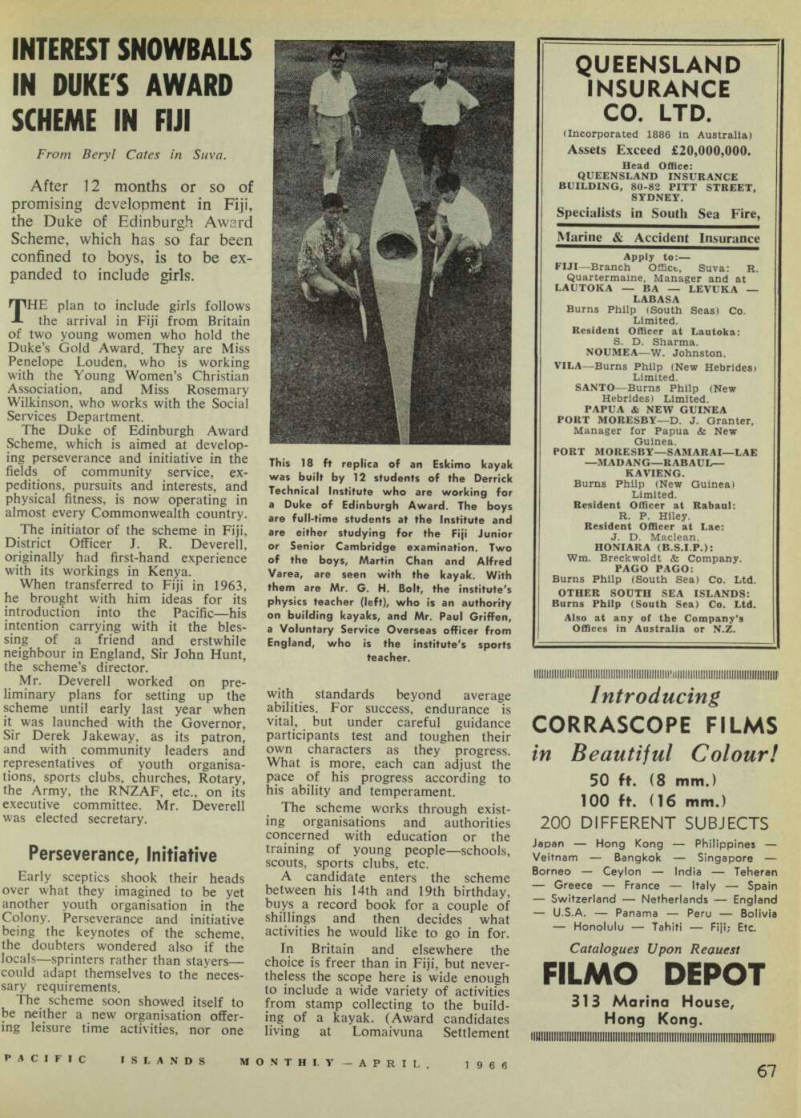
This 18 ft replica of an Eskimo kayak was built by 12 students of the Derrick Technical Institute who are working for a Duke of Edinburgh Award. The boys are full-time students at the Institute and are either studying for the Fiji Junior or Senior Cambridge examination. Two of the boys, Martin Chan and Alfred Varea, are seen with the kayak. With them are Mr. G. H. Bolt, the institute's physics teacher (left), who is an authority on building kayaks, and Mr. Paul Griffen, a Voluntary Service Overseas officer from England, who is the institute's sports teacher.
School are making the scientifically run banana plantation their leisure time study).
Through the school or organisation to which he belongs, the candidate is coached by available authorities on the activity chosen, and his studies lead up to awards in three stages— bronze, silver and gold.
Personal Interest
In Britain the Duke of Edinburgh, himself, presents gold medallists with their awards—thus showing his con tinuing personal interest in the scheme he instigated.
Requirements for the bronze and silver medals have to be fulfilled in each of the four sections of service, expeditions, pursuits and interests, and physical fitness. There are certain other requirements for the gold award.
In the service section, candidates have to reach set standards in a form of community service such as first aid, lifesaving, etc.
For bronze awards in expeditions, candidates have to undertake a 15mile expedition on foot camping out for one night; for silver awards the expedition is extended to 30 miles on foot (with two nights camping out), or a comparable journey must be made by bicycle, canoe, sail or horseback. For gold awards the ex pedition is extended to 50 miles in wild country (three nights camping out), or a comparable journey by bicycle, canoe, sail or horseback.
For pursuits and interests (hob bies), candidates have to follow the one pursuit for six months and qualify as to knowledge and/or ability. After qualifying for a bronze award, a further six months’ study on the same subject is necessary for a silver award, and yet another six months for a gold.
Initial Course
Physical fitness awards are given for set standards of fitness. Bronze awards candidates must be able to run 100 yds. in 13 sec.; silver, 100 yds. in 12.2 sec.; gold 100 yds. in 11.8 sec.
After an initial course for leaders at the Queen Victoria School early last year, award schemes were begun at Lelean Memorial School, Fulton Missionary College, Derrick Tech nical Institute, Central Fijian Second ary School, Naivucini District School, Lomaivuna Settlement School and Ratu Sukuna School.
Last September much of the Pioneering work shifted to the ihoulders of a young English univer >ity graduate, Tom Sage, who arrived
in the Colony as a VSO. Originally Tom planned several types of youth work during his 12 months of voluntary service, but within weeks he found his main attention being given to the award scheme, and it has been that way ever since.
He has recently helped set up a divisional council at Lautoka, fol lowing the executive council’s policy of decentralising the scheme, and on that side of Viti Levu there are now branches at Natabua High School, Til ah High School and the Muslim High School.
In Suva the scheme will shortly begin operating within the St. John’s
Ambulance Brigade and the Suva Youth Centre, and, it is hoped, Suva Grammar School and the Marist Brothers’ High School.
About 250 boys are now endeavour ing to qualify for awards, and many are almost at bronze award standard.
Warwick Williams, a part-European who attended the Queen Victoria School leadership course, has almost reached gold medal standard.
Recently inquiries were received from the Women’s Interests Officer in the Gilbert and Ellice Islands and it is hoped that sufficient interest will be shown there for the scheme to be introduced.