Australia's South Seas
pp. 63-67 · Read in the full issue


"Colombo Plan" Gets
Off To A Good Start
By a Staff Writer
Australia’s South Pacific “Colombo Plan”, officially an nounced only last November, appears to have got off to a good, firm start. In Canberra they are confident it will eventually have significant effect on South Pacific planning.
THE plan, officially known by the unmelodious title of ASPTAP— for Australian South Pacific Technical Assistance Plan—was launched with little publicity following a number of requests from the South Seas for financial aid.
Fiji’s Governor, Sir Derek Jakeway, visited Australia early last year in the hope of obtaining such aid, but found that there was no machinery for Colombo-type aid to be given to South Pacific territories.
At the Sixth South Pacific Confer ence in Lae, New Guinea, last July, Ratu K. K. T. Mara, of Fiji, com plained that the South Seas could not avail itself of Australian educational institutions and similar help in the same way as Asian countries could under the Colombo Plan.
PIM editor Stuart Inder said in a national ABC broadcast at the same time, “If we are always going to send our friends away empty-handed, then it’s time we got some machinery going.
A Colombo Plan for the South Seas is certainly needed.”
ASPTAP is not a full Colombo Plan, but it’s a start.
Supplementary
The plan is designed to supplement present aid without cutting across national responsibilities.
The programme applies to Western Samoa, Tonga and British territories in the South Pacific. It is not avail able to French, New Zealand or American territories.
Western Samoa is an independent state, and Tonga is an independent kingdom with close ties with Britain.
The British territories eligible are the Colony of Fiji, the Gilbert and Ellice Islands Colony, the British Solomon Islands Protectorate and the British side of the Anglo-French Condo minium of the New Hebrides.
These territories are already among those which benefit from Australian aid under the South Pacific Com mission, the Australian International Awards Scheme and the Common wealth Co-operation in Education.
Under ASPTAP they will receive, in the words of Australia’s Minister for External Affairs, Mr. Paul Hasluck, “technical assistance similar to that offered South-East Asian countries under the Colombo Plan.
The Australian Government will pro vide specialised training in Australia, the services of Australian experts and, as well, technical equipment for trade training, agricultural projects and re search. Particular emphasis will be given to technical education, a field in which experience under the Colombo Plan has shown Australia to be well qualified to give assistance.”
Merely A Starter
Mr. Hasluck announced that the sum provided for the first year’s operation of ASPTAP was $lOO,OOO.
What his statement didn’t make clear was that this small sum, which is available for the 12 months ending this June, was merely a starter—a figure selected so that the principle of technical aid to the South Seas could be established.
This first 12 months is an experi-
ment aimed at finding out what help the South Pacific territories need. On its result will depend the size of the grant for 1966-67, and Canberra officials are currently reviewing the information they have.
“As with the Colombo Plan, the re cipients will suggest the schemes they would like us to help them with,” an External Affairs officer told PIM in Canberra. “You can’t build this sort of thing in a day. Money can’t be spent without planning.”
In Suva, the Australian Com missioner in Fiji, Mr. R. N. Hamilton, who is Australia’s permanent man in the field in the South Seas, and responsible for the practical co-ordin ation of ASPTAP, told PIM he hoped that next year the amount would be doubled. He expected it would be increased each year thereafter.
The figure will obviously depend on Treasury’s commitments on inter national aid, and the various pressures on the Commonwealth Budget. But clearly Australia’s intention at the moment is to give the South Seas financial help of some significance.
PlM’s information is that the scheme probably will first concentrate on a few projects which make a worth while impact, and expand from there.
How It Works
What will ASPTAP do?
ASPTAP aid will not cover economic development, but will help supply the means under which a terri tory can develop.
Thus funds will not be offered to build a road or a wharf or erect a building, but technical advice on the spot, or training in Australia, might be provided to help the territory build the road itself, A technical school, once built, could be equipped with machinery under
Mr. Hamilton.
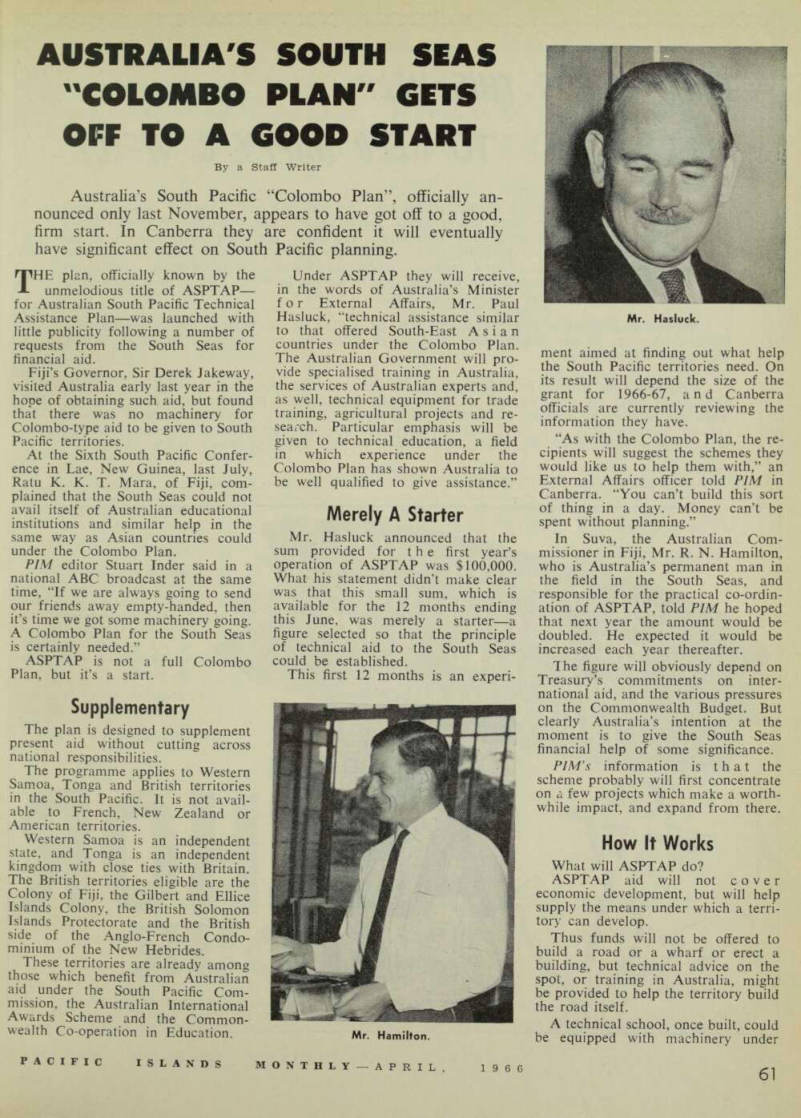
Mr. Hasluck.
ASPTAP aid. Australia might supply science teachers for it.
ASPTAP would not supply or erect an electricity undertaking, but might make available experts to survey elec tricity needs, or train local men for this task, ASPTAP will not duplicate aid already being given to recipient terri tories by other countries, nor will a territory which has already had a specific request for aid rejected by some other country be able to persuade Australia to supply it.
Australia apparently is being careful not to introduce ASPTAP as a political football in any game of power politics.
What has been done so far?
In the short time the scheme has been in operation various territories have asked Australia for technical school instructors and secondary school teachers, and for the right to train their own technical instructors in Australia.
Mr. Hamilton said in Suva: “We have also been asked for textbooks and other reading matter for schools and libraries, and for experts to man age various development or research projects.
“Probably the best thing done re cently has been the help provided by Mr. W. H. Smith, of the NSW De partment of Agriculture, in the eradication of bunchy top disease in the Western Samoan banana industry.”
A stroke of fate in the shape of the late January hurricane, which flattened most Samoan banana plant ings, unfortunately has destroyed the value of some of Mr. Smith’s work.
Course In Administration
Among the other things provided under the initial $lOO,OOO have been a course in public administration in Australia for a group of Fijians and a course in decimal currency for officials in the Solomons, Western Samoa and Tonga—who were able to witness Australia’s decimal currency changeover in February.
Other courses already established m Australia under the Colombo Plan will be available to the South Seas terridories, in addition to new ones designed especially for them under
Asptap.
Mr. R. Carswell, Assistant Director of the NSW Department of Technical Education, visited South Seas terri tories recently to investigate at first hand the best way of meeting their needs for technical education.
Wide interest has been aroused by suggestions that under ASPTAP Aus tralia could train Islands agricultural extension officers in New Guinea.
Talks are now going on with the
Western Pacific High Commission, in Honiara, for staffing and equipping of technical schools in the British Western Pacific area. This would be additional to the training of Mel anesian artisans, and business, agri cultural and forestry students in Papua-New Guinea under a separate arrangement with that Territory.
The British High Commissioner, Sir Robert Foster, told PIM in Honiara that the new ASPTAP scheme was “extremely welcome and useful” and had created a lot of in terest among administrative officers in the Western Pacific, “It is surprising it has not had more outside publicity,” he said.
Australian Commitment
Australia’s newest aid programme brings the total amount paid out by Australia in all forms of overseas aid in 1965-66 to more than $ll3 million.
The figure does not include Aus tralia’s South Pacific Commission con tributions, but does include more than $72 million for Papua-New Guinea— which is equally regarded as aid to an under-developed territory. (Britain and France give more than 90 per cent, of their aid funds to their present or former colonies).
The Colombo Plan for 1965-66 is taking $l2 million of Australian aid money, and the remainder is dis tributed from Afghanistan to Korea through international financial institu tions, United Nations funds and pro grammes, economic assistance under SEATO and SCAAP, defence aid, disaster relief and special help such as wheat for India, and the Common wealth Co-operation in Education, The aid figure rises each year, in some departments dramatically.
Total foreign aid in 1963-64 was
$9O million, in 1964-65 it rose to almost $99 million, and in the current year it is $113.5 million.
Defence aid to Malaysia rose from more than $3 million in 1964-65 to more than $ll million in the current y ear - Colombo Plan aid has increased from more than $9 million in 1962-63, to $lO million in 1963-64, $10.6 million in 1964-65, to the current year’s $l2 million.
Such payments as the Indus Basin Development Fund and the Laos Stabilisation Fund continue to show increases.
Foreign aid expressed as a percent-
age of the gross national income con tinues to rise, but the Australian figure has not yet reached the 1 per cent, of national income which the United Nations considers should be the minimum aid given by economic ally advanced countries to developing ones, The Australian figure on the last available figures is on a par with the UK and Germany, but behind that of France, the US and some smaller countries such as Belgium.
The foreign aid figure for Aus tralia has yet begun to hurt the population and therefore the overall sum has provoked little public interest.