Prosperity For
p. 31 · Read in the full issue
" Unprecedented”
Norfolk Island
From Merval Hoare, on Norfolk Island Norfolk Island’s politics, which sometimes can get very warm, are in a quiet era.
Although the next council elec tions will take place in July there has not been as yet any great show of interest. r could be the result of the recent shift in population on the island, Tom a predominance of islanders :o a predominance of “mainlanders” —people who come from either \ustralia or New Zealand. But it :ould also be due to the fact that he island is enjoying unprecedented )rosperity and the people are in a :ontented frame of mind.
Publicity the island has received werseas during the last couple of ears has resulted in an influx of tew settlers, young and old. The hange in population was clearly hown in the half-yearly Public Vorks Call of October 1965, when, J the 216 adult males listed to erform public works, only 70 were Norfolk Islanders.
Full Employment
There is full employment, a boom i building and increasing activity i the business life of the island, /ages are high and so is the standard f living. At times like the present lere is little unrest and consequently, olitical feelings generally do not m high.
The Norfolk Island Council con sts of eight elected members, with le Administrator as chairman; but, present, there are only seven mncillors on the island, Councillor on Nobbs having left early this -ar to take up a position on the lainland.
It is unlikely that the vacancy msed by his departure will be led before the elections in July.
Council meetings acquired fresh terest when the Administrator be ime chairman of the council with e passing of legislation in 1963.
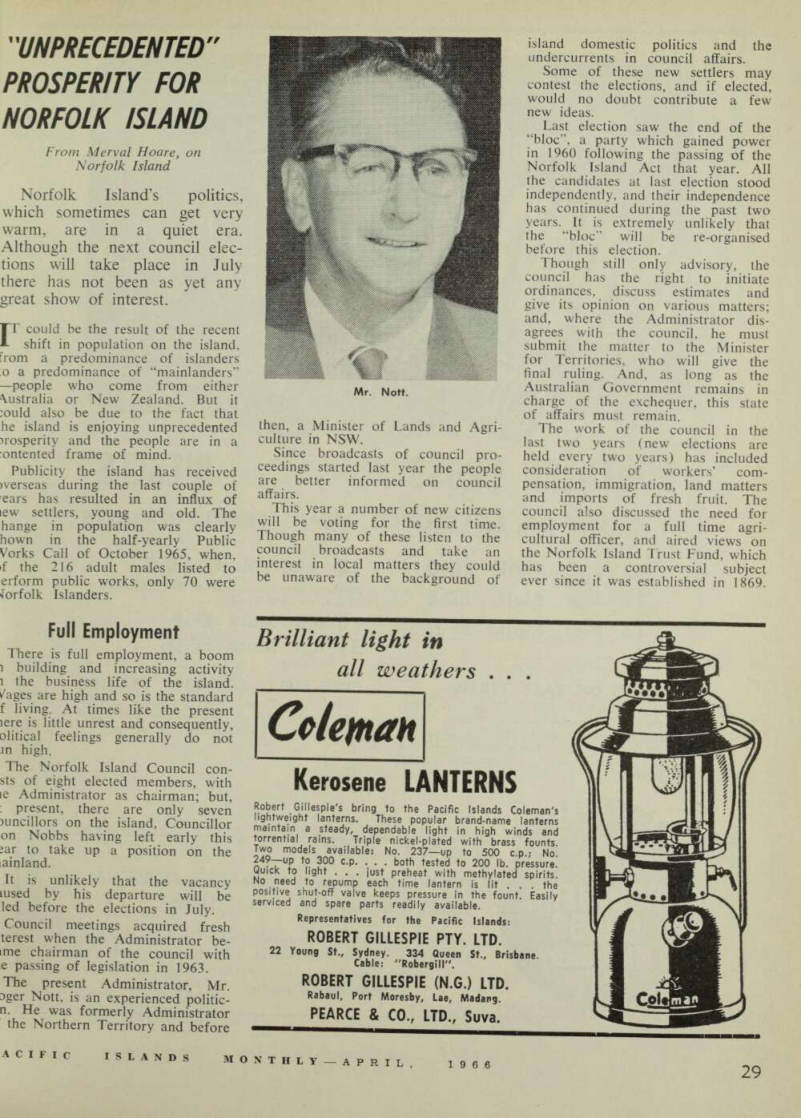
The present Administrator, Mr. 3ger Nott, is an experienced politic n. He was formerly Administrator the Northern Territory and before
then, a Minister of Lands and Agri culture in NSW.
Since broadcasts of council pro ceedings started last year the people are better informed on council affairs.
This year a number of new citizens will be voting for the first time.
Though many of these listen to the council broadcasts and take an interest in local matters they could be unaware of the background of
island domestic politics and the undercurrents in council affairs.
Some of these new settlers may contest the elections, and if elected, would no doubt contribute a few new ideas.
Last election saw the end of the ‘‘bloc”, a party which gained power in 1960 following the passing of the Norfolk Island Act that year. All the candidates at last election stood independently, and their independence has continued during the past two years. It is extremely unlikely that the “bloc” will be re-organised before this election.
Though still only advisory, the council has the right to initiate ordinances, discuss estimates and give its opinion on various matters; and, where the Administrator dis agrees with the council, he must submit the matter to the Minister for Territories, who will give the final ruling. And, as long as the Australian Government remains in charge of the exchequer, this state of affairs must remain.
The work of the council in the last two years (new elections are held every two years) has included consideration of workers’ com pensation, immigration, land matters and imports of fresh fruit. The council also discussed the need for employment for a full time agri cultural officer, and aired views on the Norfolk Island Trust Fund, which has been a controversial subject ever since it was established in 1869.
Mr. Nott.