Link With Somerset Maugham
p. 25 · Read in the full issue
By a Staff Writer
JJ/RITING of the death of English novelist W. Somerset Maugham in our January issue (p. 15), we said that although nearly 50 years had passed since Maugham visited the South Pacific, there was still at least one memento of the novelist for tourists to see in the Pacific— the Sadie Thompson Inn in Pago Pago.
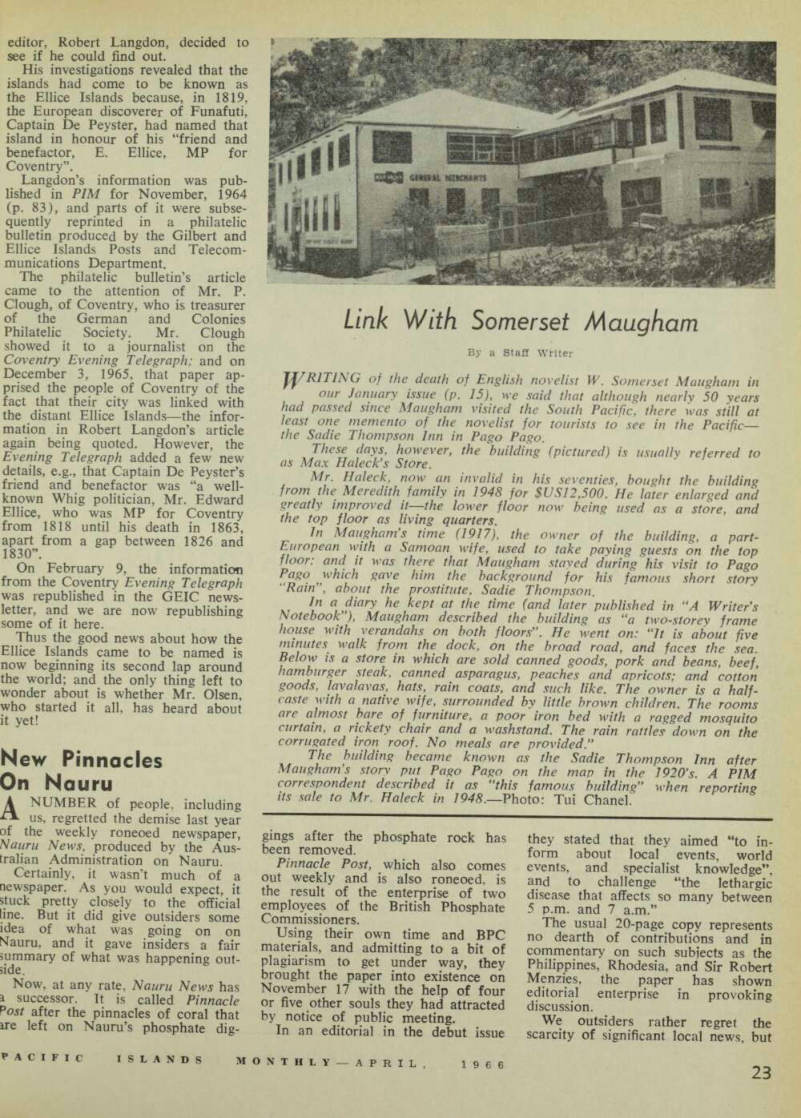
These days, however, the building (pictured) is usually referred to as Max Haleck’s Store.
Mr. Haleck, now an invalid in his seventies, bought the building from the Meredith family in 1948 for $U512,500. He later enlarged and greatly improved it—the lower floor now being used as a store, and the top floor as living quarters.
In Maugham’s time (1917), the owner of the building, a part- European with a Samoan wife, used to take paying guests on the top floor: and it was there that Maugham stayed during his visit to Pago Pago ' which gave him the background for his famous short story “ Rain”, about the prostitute, Sadie Thompson.
In a diary he kept at the time (and later published in “A Writer’s Notebook”), Maugham described the building as “a two-storey frame house with verandahs on both floors”. He went on: “It is about five minutes walk from the dock, on the broad road, and faces the sea.
Below is a store in which are sold canned goods, pork and beans, beef, hamburger steak, canned asparagus, peaches and apricots; and cotton goods, lavalavas, hats, rain coats, and such like. The owner is a half caste with a native wife, surrounded by little brown children. The rooms are almost bare of furniture, a poor iron bed with a ragged mosquito curtain, a rickety chair and a washstand. The rain rattles down on the corrugated iron roof. No meals are provided.”
The building became known as the Sadie Thompson Inn after Maugham’s story put Pago Pago on the map in the 1920’5. A PIM correspondent described it as “this famous building” when reporting its sale to Mr. Haleck in 1948.— Photo: Tui Chanel