Tropicalities
pp. 24-29 · Read in the full issue
Probably the most forthright and important statement made by representative and responsible New Hebrideans since the establish ment of the Anglo-French Condominium in the New Hebrides 60 years ago has passed unrecorded in the official newsletters published by the British and French Residencies in Vila.
THE statement, which was made at the December meeting of the New Hebrides Advisory Council, called for an end to the farcical situation under which New Hebri deans have no civil status; and it suggested that everyone in the New Hebrides should be subject to the same laws, rather than to British, French or Condominium laws, ac cording to whether they are British, French or New Hebrideans.
The statement, in effect, called for a major revision of the Anglo-French Protocol under which the New Hebrides is governed, although it sought the continuance of the dual rule system.
In the statement, the New Hebri deans said that they saw the need for overseas capital for the develop ment of the group and because the population was increasing rapidly.
To attract outside capital it was essential that the political future of the group be assured, they said.
The New Hebrideans wished, there fore, that the Condominium should continue, but that an increasing share in the affairs of the country should be given to New Hebrideans.
“As lack of citizenship has caused embarrassment to some of us who have travelled overseas,” their state ment went on, “and as we are, as far as we know, the only people in the world without definite civil status, we wish a New Hebridean citizenship to be established.
“To our mind, this would involve one common law for every person residing in the New Hebrides.”
The New Hebrideans’ statement was reported by Archdeacon D. A.
Rawncliffe, a British member of the Advisory Council, in the March issue of the Southern Cross Log, the quar terly journal of the Melanesian Mission which is strongly represented in the New Hebrides.
The statement followed a series of developments in the New Hebrides which indicate that, as elsewhere in
Winds Of Change
Astir In The
New Hebrides
the South Seas, the winds of change are beginning to blow with increas ing force in that group.
At the September meeting of the Advisory Council, a British member, Mr. S. J. Breusch, moved a motion asking the British and French Governments to make a statement on their policy on the future of the Condominium ( PIM, Nov., p. 55).
Mr. Breusch said that fiscal and social stability were needed if the country was to be developed, and that he, in company with many other people, believed it was essential to have a statement from the two Governments on the territory’s political future.
At the December meeting of the council, the British Resident Com missioner, Mr. A. M. Wilkie, told a New Hebridean member that no reply had been received from the Metropolitan Governments on Mr.
Breusch’s motion.
But both Mr. Wilkie and the French Resident Commissioner, Mr.
Jacques Mouradian, defended the dual-rule system in a joint speech opening the Advisory Council meet ing.
“We would not deny,” they said, “that there are complications in the system of administration of the New Hebrides, but from the different con tributions in outlook which the liberal traditions of our two countries can provide, allied to the solid common sense of the New Hebrideans, com promise solutions are reached which are sometimes original and which perhaps provide the best safeguard for the interests of those whom we govern.
“Thus there is little danger of hasty or rash decisions and problems can be dealt with after being fully and properly examined . .
Since then, France’s Minister for Overseas Territories, General Pierre Billotte, has been in the New Hebrides to look things over.
He said on his return to Paris early in March that an Anglo-French con ference would be held in London in late March “to smooth out differences arising between the two countries” on how the New Hebrides should be run.
We do not yet know the results of this conference, but everything points to some major changes in the New Hebrides before long.
Spreading The Ellice
Islands News
ONE day in 1964, Mr. K. F. Olsen, headmaster of Maunu School, Whangarei, New Zealand, wrote to the Administration in the Gilbert and Ellice Islands Colony in Tarawa ask ing if anyone could tell him why the Ellice Islands were so named.
Mr. Olsen’s inquiry was published in the Administration newsletter, Colony Information Notes, and when, after several weeks, it produced no enlightening reply, PlM’s assistant
editor, Robert Langdon, decided to see if he could find out.
His investigations revealed that the islands had come to be known as the Ellice Islands because, in 1819, the European discoverer of Funafuti, Captain De Peyster, had named that island in honour of his “friend and benefactor, E. Ellice, MP for Coventry”.
Langdon’s information was pub lished in PIM for November, 1964 (p. 83), and parts of it were subse quently reprinted in a philatelic bulletin produced by the Gilbert and Ellice Islands Posts and Telecom munications Department.
The philatelic bulletin’s article came to the attention of Mr. P.
Clough, of Coventry, who is treasurer of the German and Colonies Philatelic Society. Mr. Clough showed it to a journalist on the Coventry Evening Telegraph; and on December 3, 1965, that paper ap prised the people of Coventry of the fact that their city was linked with the distant Ellice Islands—the infor mation in Robert Langdon’s article again being quoted. However, the Evening Telegraph added a few new details, e.g., that Captain De Peyster’s friend and benefactor was “a well known Whig politician, Mr. Edward Ellice, who was MP for Coventry from 1818 until his death in 1863, apart from a gap between 1826 and 1830”.
On February 9, the information from the Coventry Evening Telegraph was republished in the GEIC news letter, and we are now republishing some of it here.
Thus the good news about how the Ellice Islands came to be named is now beginning its second lap around the world; and the only thing left to wonder about is whether Mr. Olsen, who started it all, has heard about it yet!
New Pinnacles
On Nauru
A NUMBER of people, including ** us, regretted the demise last year of the weekly roneoed newspaper, Nauru News, produced by the Aus tralian Administration on Nauru.
Certainly, it wasn’t much of a newspaper. As you would expect, it stuck pretty closely to the official line. But it did give outsiders some idea of what was going on on Nauru, and it gave insiders a fair summary of what was happening out side.
Now, at any rate, Nauru News has a successor. It is called Pinnacle Post after the pinnacles of coral that are left on Nauru’s phosphate dig
gings after the phosphate rock has been removed.
Pinnacle Post, which also comes out weekly and is also roneoed. is the result of the enterprise of two employees of the British Phosphate Commissioners.
Using their own time and BPC materials, and admitting to a bit of plagiarism to get under way, they brought the paper into existence on November 17 with the help of four or five other souls they had attracted by notice of public meeting.
In an editorial in the debut issue
they stated that they aimed “to in form about local events, world events, and specialist knowledge” and to challenge “the lethargic disease that affects so many between 5 p.m. and 7 a.m.”
The usual 20-page copy represents no dearth of contributions and in commentary on such subjects as the Philippines, Rhodesia, and Sir Robert Menzies, the paper has shown editorial enterprise in provoking discussion.
We outsiders rather regret the scarcity of significant local news but
in its efforts to bring the outside world to Nauru we acknowledge it a commendable effort of the founders —Dr. Michael Denny (BPC medical officer) and Mr. Terry O’Connor (BPC accountant) and their editorial staff.
Present circulation is 300 copies.
They are distributed free, and are much sought after on Nauru.
The paper was used in the secondary school last year, and this year in the Gilbertese, Ellice, and Chinese schools for the teaching of English and current affairs.
Peace And Quiet
It Was
DESPITE the ballyhoo that sur rounded them, and the an nounced desire that they were seek ing peace and quiet, the top British pop group The Rolling Stones must have been disappointed at the reception they received in Fiji early in March when they visited the colony at the end of a hectic tour of Australia and New Zealand.
In both countries they left a trail of hysterical teenagers, debris-strewn aisles and harassed concert hall managers, after a tour that had crammed a fair amount of loot into their coffers.
In a four-day spell of rest before setting off for battlefields in the United States, the shaggy-haired group bailed up at a Nadi hotel for most of their stay, venturing furtively, on occasions, out into the great wide world.
But it was all unnecessary.
The indigenous Fijians couldn’t have cared less about the mob, and were only too willing to allow them their peace and quiet. And after all, what’s a bushy-haired haircut any way? The Fijians know all about such things.
Memories Of
Yamamoto
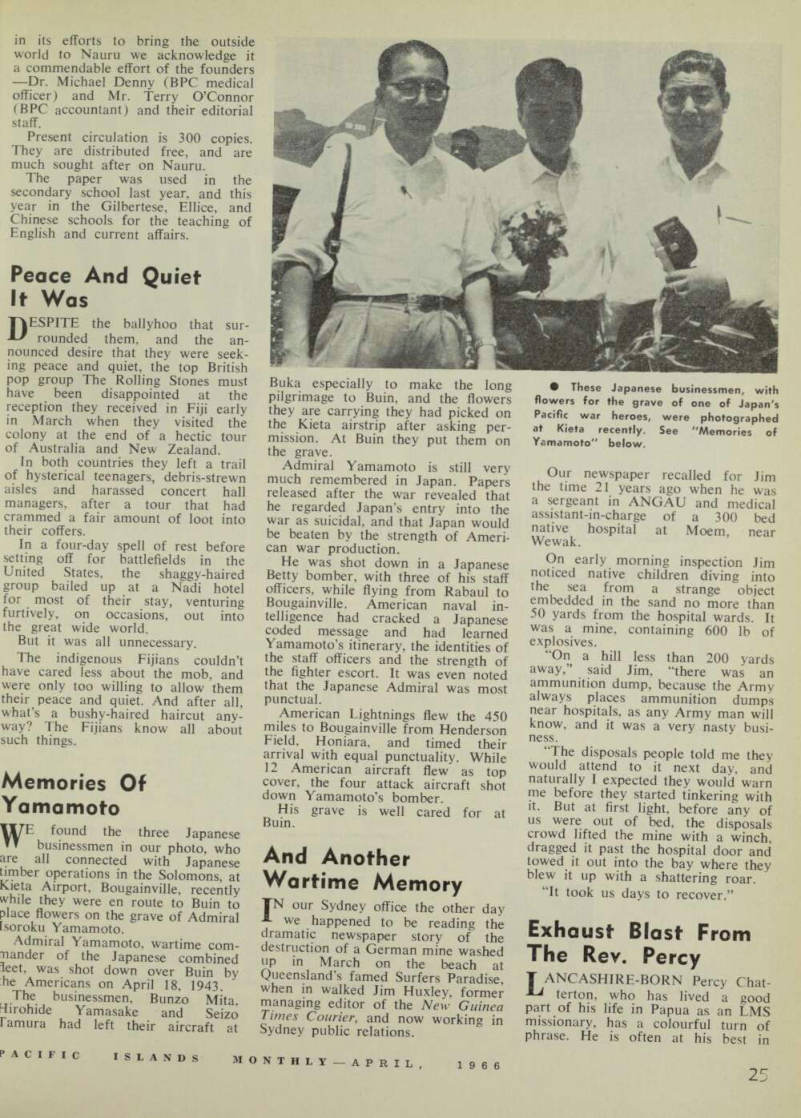
found the three Japanese ** businessmen in our photo, who are all connected with Japanese timber operations in the Solomons, at Kieta Airport, Bougainville, recently while they were en route to Buin to place flowers on the grave of Admiral Isoroku Yamamoto.
Admiral Yamamoto, wartime com pander of the Japanese combined leet, was shot down over Buin by he Americans on April 18, 1943.
The businessmen, Bunzo Mita, Tirohide Yamasake and Seizo Famura had left their aircraft at
Buka especially to make the long pilgrimage to Buin, and the flowers they are carrying they had picked on the Kieta airstrip after asking per mission. At Buin they put them on the grave.
Admiral Yamamoto is still very much remembered in Japan, Papers released after the war revealed that he regarded Japan’s entry into the war as suicidal, and that Japan would be beaten by the strength of Ameri can war production.
He was shot down in a Japanese Betty bomber, with three of his staff officers, while flying from Rabaul to Bougainville. American naval in telligence had cracked a Japanese coded message and had learned Yamamoto’s itinerary, the identities of the staff officers and the strength of the fighter escort. It was even noted that the Japanese Admiral was most punctual.
American Lightnings flew the 450 miles to Bougainville from Henderson Field, Honiara, and timed their arrival with equal punctuality. While 12 American aircraft flew as top cover, the four attack aircraft shot down Yamamoto’s bomber.
His grave is well cared for at Buin.
And Another
Wartime Memory
TN our Sydney office the other day , we happened to be reading the dramatic newspaper story of the destruction of a German mine washed up in March on the beach at Queensland’s famed Surfers Paradise, when in walked Jim Huxley, former managing editor of the New Guinea Times Courier, and now working in Sydney public relations.
Our newspaper recalled for Jim the time 21 years ago when he was a sergeant in ANGAU and medical assistant-in-charge of a 300 bed native hospital at Moem, near Wewak.
On early morning inspection Jim noticed native children diving into the sea from a strange object embedded in the sand no more than 50 yards from the hospital wards. It was a mine, containing 600 lb of explosives.
“On a hill less than 200 yards away,” said Jim, “there was an ammunition dump, because the Army always places ammunition dumps near hospitals, as any Army man will know, and it was a very nasty busi ness.
“The disposals people told me they would attend to it next day, and naturally I expected they would warn me before they started tinkering with it. But at first light, before any of us were out of bed, the disposals crowd lifted the mine with a winch, dragged it past the hospital door and towed it out into the bay where they blew it up with a shattering roar.
“It took us days to recover.”
Exhaust 1 Blast From
The Rev. Percy
I ANCASHIRE-BORN Percy Chat " terton, who has lived a good part of his life in Papua as an LMS missionary, has a colourful turn of phrase. He is often at his best in
These Japanese businessmen, with flowers for the grave of one of Japan's Pacific war heroes, were photographed at Kieta recently. See "Memories of Yamamoto" below.
the P-NG House of Assembly (where he represents the area around Port Moresby) when drawing at tention to some local anomaly.
In the March meeting of the House he was in full cry on the vexed question of Port Moresby bus services. These are mostly used by the local people, for most Europeans own cars, which they use to create traffic hazards at knock-off time when everything with wheels pours on to Port Moresby roads.
“I have been shaken,” he told the House in what still is un mistakably a Lancashire accent, “by the fact that the board which con trols public transport consists entirely of non-indigenous people who are the owners of private motor cars.
“These gentlemen—for each of whom I have the very highest regard — have looked out over the steering wheels of their Mercedes Benz cars and have decided there is nothing wrong with the bus service in Port Moresby. Now, I want to say on behalf of very many indigenous :onstituents, that there is a lot wrong with the bus service in Port Moresby.
“I think that the bus company is loing its best, but what is it doing ts best with? It is doing its best with a fleet of buses which is pro bably one of the finest collections of )ombs in the Southern Hemisphere, md when I talk about bombs I know vhat I am talking about.
“The buses going around Port Moresby remind me of the noises vhkh my 1916 Buick made in 1930. md the exhaust smells were pretty nuch the same. These poor old hings are breaking down all over he place and how can you have a
proper bus service under these con ditions?”
He then gave a wracking, sorrow ful description of the plight of Port Moresby’s bus passengers before finally suggesting that the transport board should include at least some of the people who habitually use public transport, and that a thorough investigation should be made into the Port Moresby transport situation.
Where Hurricanes
'Hardly' Ever Happen
JANUARY’S hurricane in the Central Pacific has naturally resulted in quite a lot of talk on the subject of hurricanes generally in the five territories affected.
The Samoa Times of Pago Pago, for example, recently published an article headed “Samoa Has Often Been Struck By Hurricanes”, which gave the lie to the oft-made statement that Samoa is out of the hurricane belt.
The Samoa Times said that hur ricanes had damaged parts of American Samoa in February, 1903.
April, 1913, January, 1915, January, 1926, March, 1926, January, 1931, early 1936, January, 1939 and February, 1959.
In the 1903 hurricane damage to crops caused a food shortage lasting four months; in 1915, when the Manu’a Islands were badly hit, there were three deaths; and in January, 1939, storms brought 58 inches of rain for the month causing many landslides. In the 1959 hur ricane, more than 400 houses on Manu’a were demolished by 100 mph winds and food was rationed for several months.
The Rev. Percy Chatterton