New Guinea Aghast At The
pp. 19-23 · Read in the full issue

Cost Of Educational Tv
Papua-New Guinea seems to have suffered from more than its fair share of experts, advisers and commissions of inquiry. But the latest report, on “the usefulness, technical feasibility and costs of television in the Territory of Papua and New Guinea”, must surely be one of the most surprising pre scriptions ever written for the deficiencies of an emerging nation.
[TS authors, Professor Derek Broadbent and Douglas Brooke, *O5l Office engineer, have proposed inverting the Highlands of New Guinea into a giant electronic class oom, at a cost of s2i million, with unning costs of Si million a year.
They envisage this merely as a pilot scheme”. Their ultimate ideal » an educational television broadcast ystem, spread over five separate egions. This would cost almost $8 lillion to establish, and another sli lillion a year to keep running.
Such proposals could hardly have een anticipated when Administrator ir Donald Cleland agreed to appoint commission, following political ressure from the House of Assembly, )r an investigation into television for le Territory.
Prejudices
As Director of Post-Graduate and xternal Studies for the University : NSW, Professor Broadbent helped 1 pioneer educational broadcasting in ustralia, first with radio lessons from e university’s own station and later it h its closed-circuit television stem. It was only to be expected at he would bring some of his lucational prejudices with him to the sk of reporting on TV for New uinea.
Largely because of this, the Admin istrator specially required, in the terms of reference, a report on tele vision, “not only as an educational medium, but as a medium for mass communication and entertainment.”
The commission’s report made no attempt to satisfy these requirements, It summarily dismissed mass com municat.ion and entertainment with the remark that “it requires little con sideration before the conclusion is reached that the expense of television in the Territory cannot be justified on grounds other than its potential for education.”
The report, untidily presented over 142 pages, recommended: • TV for the Territory should be confined to instructional purposes, and “enrichment”—educational jargon for improving the mind. * There should be no news, current events programmes or feature films, but 20 minutes a week could be devoted to religious programmes. a There should be no live tele casts - AII programmes would be pro duced in advance, and recorded on videotape for later replay, a A production centre should be established in Port Moresby to turn out these programmes. It would need f ° Ur st V dios ’ and all four w °uld have to work 10 hours a day, six days a
week to produce the programmes needed. • Most of the programmes should be written, and presented on camera, by teachers in their spare time, and they would be paid $2O per pro gramme. However, some research teachers would be employed, and they would have to produce five pro grammes each per week. • Because of the high concentra tion of population, TV should be in troduced first in the Highlands. A main transmitter at Mount Hagen, and a series of 12 relay stations (“trans lators” in the jargon) could serve 830,000 people. With a crash pro gramme, this network could be on the air within 18 months, • The relay stations should be perched on mountain tops, run on solar cell batteries, and serviced by helicopter. They should be installed and maintained by the P-NG Depart ment of Posts and Telegraphs, which could also train all the technicians needed to operate the whole service. • The service should have two channels, broadcasting simultaneously, and providing programmes for three grades in primary schools, and two in secondary schools, as well as pro grammes on health, agriculture.
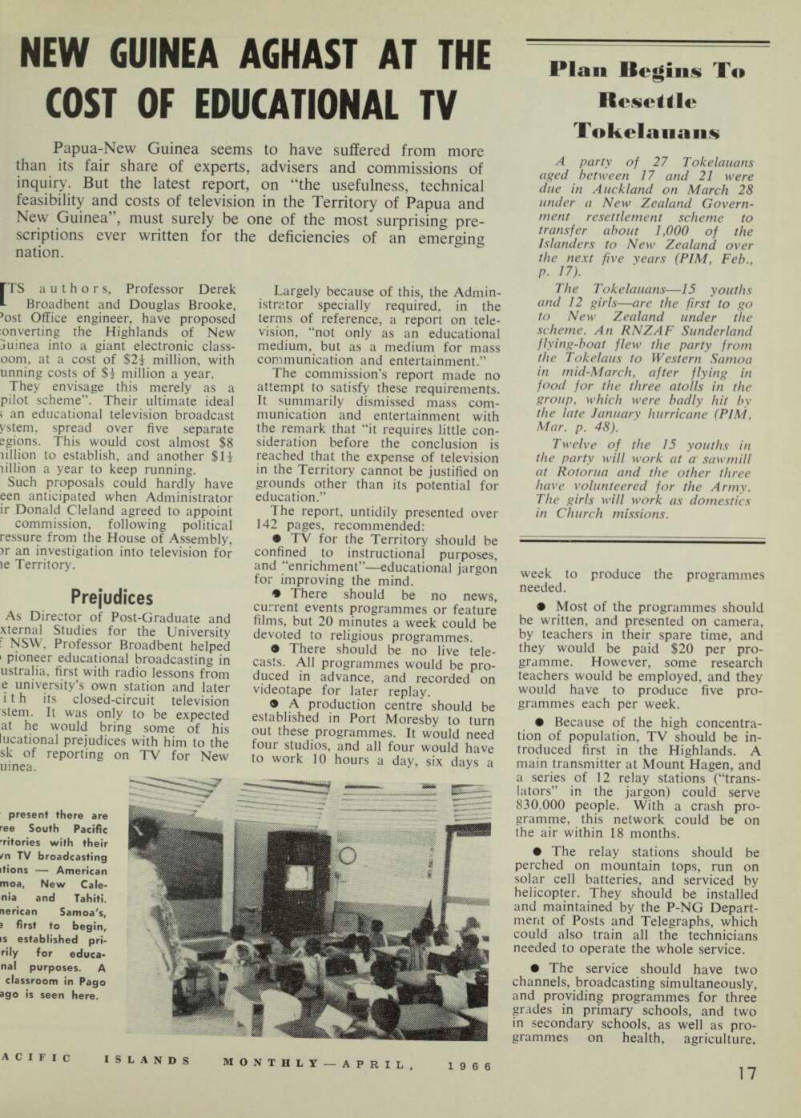
present there are [?]ee South Pacific [?]ritories with their [?]n TV broadcasting [?]tion-American [?]moa, New Cale [?]nia and Tahiti, [?]nerican Samoa's, [?]e first to begin, [?]s established pri [?]rily for educa [?]nal purposes. A classroom in Pago [?]ago is seen here.
politics, spoken English, village car pentry and child care. • Later, when (not if) this service proved successful, similar independent networks based on Madang, Port Moresby, Lae and Rabaul should be established. The five schemes would cover about 1.3 million people. • The Government should buy all the TV receivers needed, and install them in Administration schools, hos pitals, aid posts and welfare centres.
In most places, because of the lack of mains electricity, petrol-driven generators or solar cell batteries would have to be supplied also. The cost of receivers in the Highlands area alone is estimated at $1,255,000 — more than the total cost of setting up transmitters and production studios.
The cost of putting receiving sets in all five areas, i.e., Highlands, Madang- Sepik, Morobe, Papuan coast and New Britain-New Ireland, is reckoned to be $4,671,000.
The commission dashed some hopes by reporting that relay satellites were not the answer to the problem of getting pictures over the mountains and into deep valleys. There were legal difficulties, and costs were astronomical.
It said that an airborne system, using a circling aircraft equipped as a flying TV transmitter, was not as
good as a system of ground stations, mainly because it was much dearer to run.
The report has revealed that the major, indeed fatal weakness of the commission was its lack of an experi enced broadcaster. This lack is obvious in even the most cursory reading of the report.
Professor Broadbent has failed to perceive the difference between pro gramming for the captive (and pay ing) audiences in his university and for a diverse and demanding public.
He takes no account of the effect that public opinion will have on the type of service provided, or its pro grammes.
Exciting Potential
As a result of this lack of broad casting experience, the commission has apparently fallen heavily under the in fluence of the P-NG Department of Information and Extension Services, and its schoolmaster-Director, Lisle Newby, in formulating a plan for broadcast coverage.
Its proposal for a series of in dependent district stations, supplied with packaged programme material from a central production centre in Port Moresby, duplicates the general organisational plan of the Adminis tration’s existing radio broadcast system.
The commission has thus rejected, or failed to consider, the possibility of network TV for the Territory, with its exciting potential for im mediacy, and its advantages in lower programme costs and appeal to national unity. This is the great defect in the report.
As a result, Mr. Brooke, as tech
nical adviser, has apparently been re stricted to the task of plotting relay paths radiating from the district trans mitting centres.
His abilities could far more profit ably have been directed towards de signing a central micro-wave chain down the mainland and through the islands, giving all areas equal access to a national programme.
In the commission’s mind, the value of television to primary and secondary education is the chief justification for the project. It claims that over the next three years, TV could save 51.6 million in secondary education alone, by enabling the Administration to use native teachers in place of their more expensive Australian counterparts.
This makes it all the more difficult to understand why a regional, rather than a national TV system, was pre ferred.
The commission also stresses the need for vernacular broadcasts to the villager to teach hygiene, better farm ing, crafts and infant care. But it does not say which vernacular would best suit, for example, the 800,000 Highlanders living between Kainantu and Lake Kutubu. The vernacular of one region will certainly alienate the viewers in any of the 10 or 12 other major language groups in the area.
Residents of Papua-New Guinea may smile at the confidence of the commission in the ability of the De partment of Posts and Telegraphs to provide technical support for a tele vision service.
So far, the department has not been able to provide reliable radio-tele phone circuits between any two towns in the Territory on a 24-hour basis. (Over)
VISITOR: Recently in Rabaul was former [?]ethodist missionary, Mrs. Gertrude [?]enzel. She first went to the Territory [?]rom Germany in 1914 to marry her [?]ance, the Rev. Albert Wenzel. After a [?]hile spent in the Duke of Yorks, they [?]ent to New Ireland, and were at Nama [?]nai when the Australians captured [?]abaul. In 1920 they returned to Ger [?]any. Since her husband died three years go, Mrs. Wenzel has travelled widely, cturing to church groups, etc. She sur rised local Tolais by still being fluent in
[?]e Tolai language.
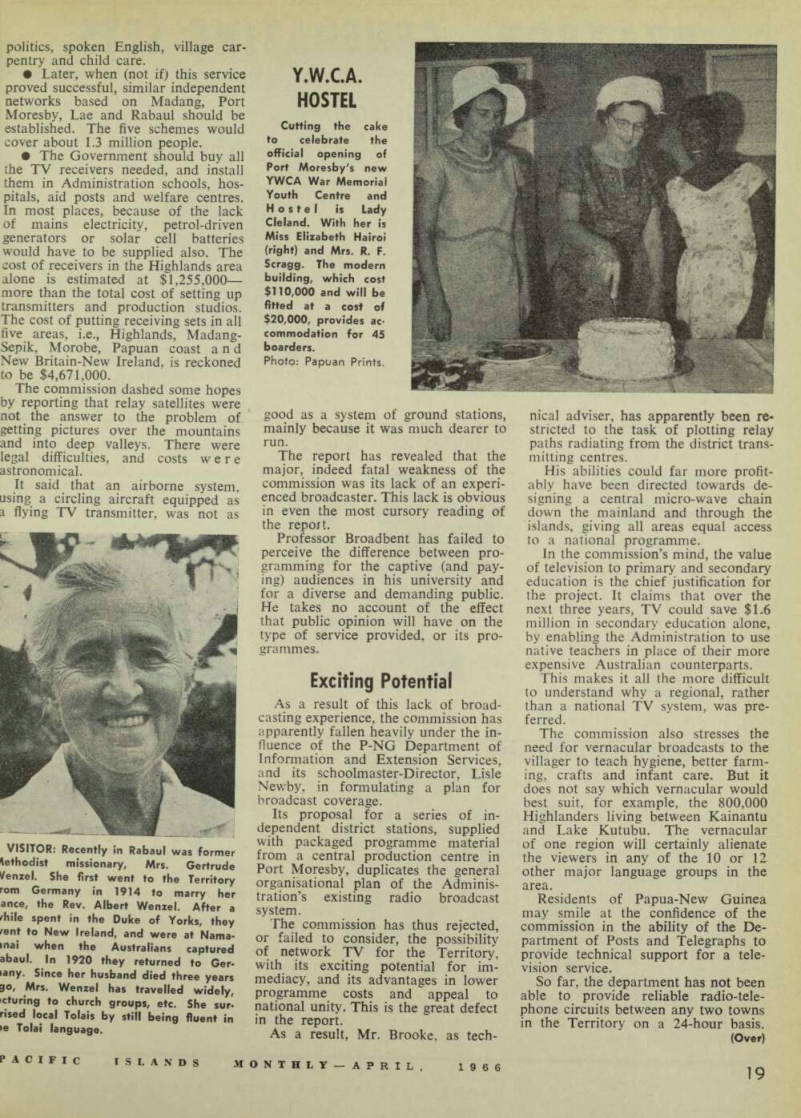
Y.W.C.A.
Hostel
Cutting the cake to celebrate the official opening of Port Moresby's new YWCA War Memorial Youth Centre and Hostel is Lady Cleland. With her is Miss Elizabeth Hairoi (right) and Mrs. R. F.
Scragg. The modern building, which cost $110,000 and will be fitted at a cost of $20,000, provides ac commodation for 45 boarders.
Photo: Papuan Prints.
It has pitifully few technicians. Its tiny training college has produced only a handful or graduates, and then only with special coaching and lowered examination standards.
In any type of broadcasting, con tinuity is important, but Territory TV as envisaged by the commission would apparently be a jerky series of unrelated programmes, each aimed at a different school class, or seg ment of the community. No provision is made at the district transmitters for a vision studio from which an announcer could present and link the programme segments.
The report refers to the need for the television station to identify it self with the people, but implies that this can be achieved by repeating “television bilong yumi” in station breaks. It says nothing about the need to build audiences, or provide balance.
It stresses the need for economy in production, but ignores the universal lesson that the medium quickly loses appeal if programmes are dull. It avoids altogether the problem of training teachers to use television as a teaching aid. It fails to take into calculation the likelihood of popular demand for general entertainment.
The commission apparently did not consider the relationship and inter action of television and existing radio programmes in the Territory.
Shock
Few people, except perhaps those politicians who urged the purchase of package transmitters, broadcasting imported programmes for commercial profit, imagined that TV for Papua- New Guinea would be cheap.
However, something more imagin ative and dynamic than a decentralised educational service might have been expected for the expenditure outlined by the commission. The bill has come as a shock to the P-NG Administra tion.
Those who would disagree with the recommendations in the report might take some comfort from the chill words of the Administrator in his message forwarding the report to the House of Assembly: *'• • • • the large demands on money and other resources that would be involved in implementa tion of the proposals raise import ant questions of priority as against other urgent claims on those re sources ... there must there fore be doubts whether, if the com mission’s views are accepted in full, the proposals of the report could be implemented for some time to come.
It appears likely that the report will be shelved.