"Unpleasant Measures " Ahead
pp. 17-161 · Read in the full issue
For Western Samoa
Some unpleasant economic prospects were held out for the rest of the year by Head of State Maleitoa Tanumafili when he opened the 1966 session of Western Samoa’s Parliament on March 8.
HE said that the hurricane which struck Samoa at the end of January had “profoundly changed the economic prospects for 1966” and would result in major changes in the economic programme approved by Parliament last year.
“Already the exchange allocations previously approved for importers have been cut by approximately 50 per cent, and it will be necessary for further unpleasant measures to be taken by your Ministers to meet the situation,” he said.
“While damage of various kinds and degrees has been done to build ings and to sustenance and export crops, it has become clear that the severest consequence of the hurricane will be a substantial drop in export earnings which, in turn, will affect our capacity to pay for imports, as well as the actual cash income avail able to the people in their private earning capacity and to the Govern ment.”
The Head of State said that the
Jonuory Hurricane
Aftermath
Government was already seeking a loan or grant, through New Zealand, for a programme of plantation rehabilitation.
“We are all, I am sure, grateful for the spontaneous sympathy and offers of concrete assistance which our misfortune has brought from many quarters,” he added.
By mid-March, six weeks after the hurricane, business in Apia seemed as buoyant as ever with plenty of money changing hands despite the grim future painted by the Head of State and others.
The few bananas that were obtain able were selling at up to 12/- a basket, compared with the pre hurricane price of 5/-. But generally speaking there was no real rise in the cost of living.
The distribution of Red Cross
(Continued on p. 159)
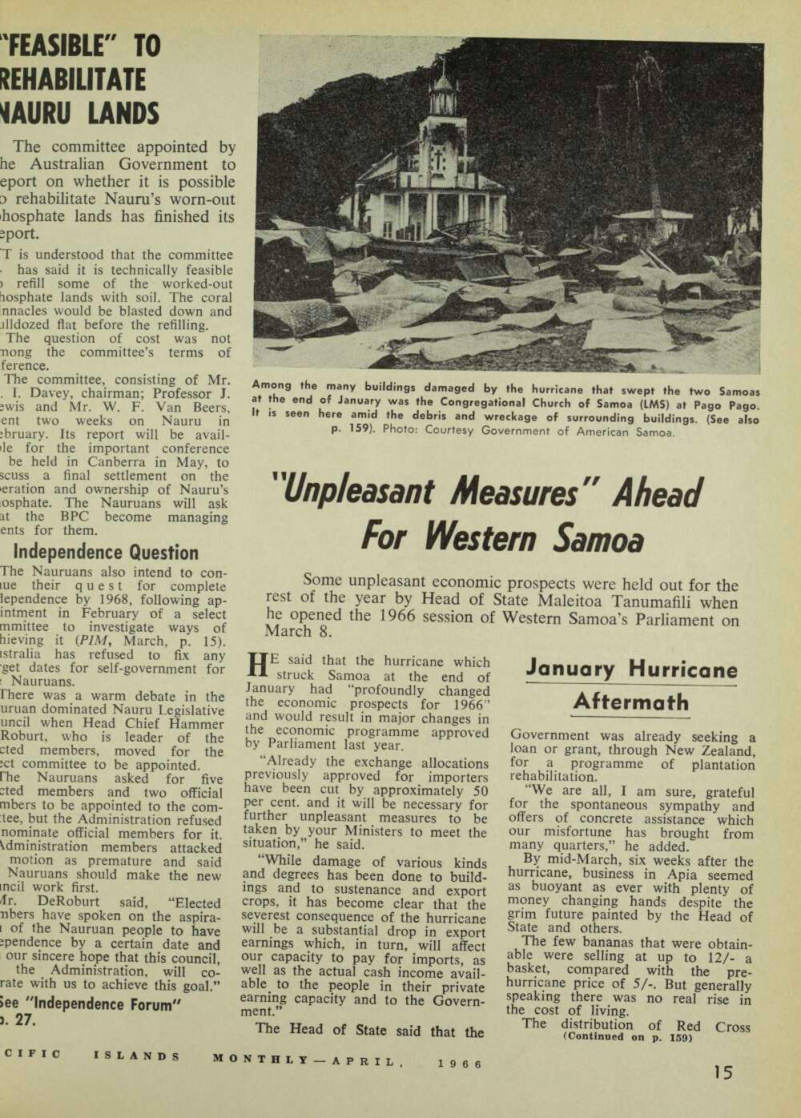
Among the many buildings damaged by the hurricane that swept the two Samoas at the end of January was the Congregational Church of Samoa (LMS) at Pago Pago.
It is seen here amid the debris and wreckage of surrounding buildings. (See also p. 159). Photo: Courtesy Government of American Samoa.
relief food to boarding schools and district hospitals began in mid month on both Savaii and Upolu.
A spokesman said at the time that no villages were then in immediate need of foodstuffs, but that he ex pected a need to arise by May-June.
However, some villages that did not have much plantation land and whose inhabitants had lost employ ment on plantations as a result of the hurricane were beginning to feel the shortage of cash with which to buy food.
American Samoa
On American Samoa early in March, Governor H, Rex Lee an nounced details of a major pro gramme to rebuild the territory fol lowing the damage and destruction caused by January’s hurricane.
Under the programme, an average grant of 5U52,400 may be made to provide shelter for families who lost their homes. This sum will be used to construct a house “shell”, con sisting of a foundation, roof sup ports and roof. Additionally, loans of up to $2,600 will be made avail able to finish the house with walls, windows and utilities. As many of the new houses as are needed may be built, the Governor said.
The Governor has obtained authority to divert $1 million of Government of American Samoa funds to the building programme immediately. He also obtained as surances that a $2.5 million supple mentary request will be made shortly to United States Congress.
In his announcement, Governor Lee stressed that the entire building project must be completed within the next year. This time limit, he said, made it mandatory that village chiefs avoid prolonged dispute over land use and land rights concerning housing sites.
“We have a wonderful opportunity to build a new Samoa because of the concern of the Administration and of the Congress for the disaster victims here,” the Governor said.
Following Governor Lee’s an nouncement, American Samoa’s homeless turned out by the score to register for new homes.
Registration also began early in the month to determine what families were in need of disaster relief food gifts.