Papua-New Guinea
p. 13 · Read in the full issue
"Disturbing Decline" In
Australian Trade With
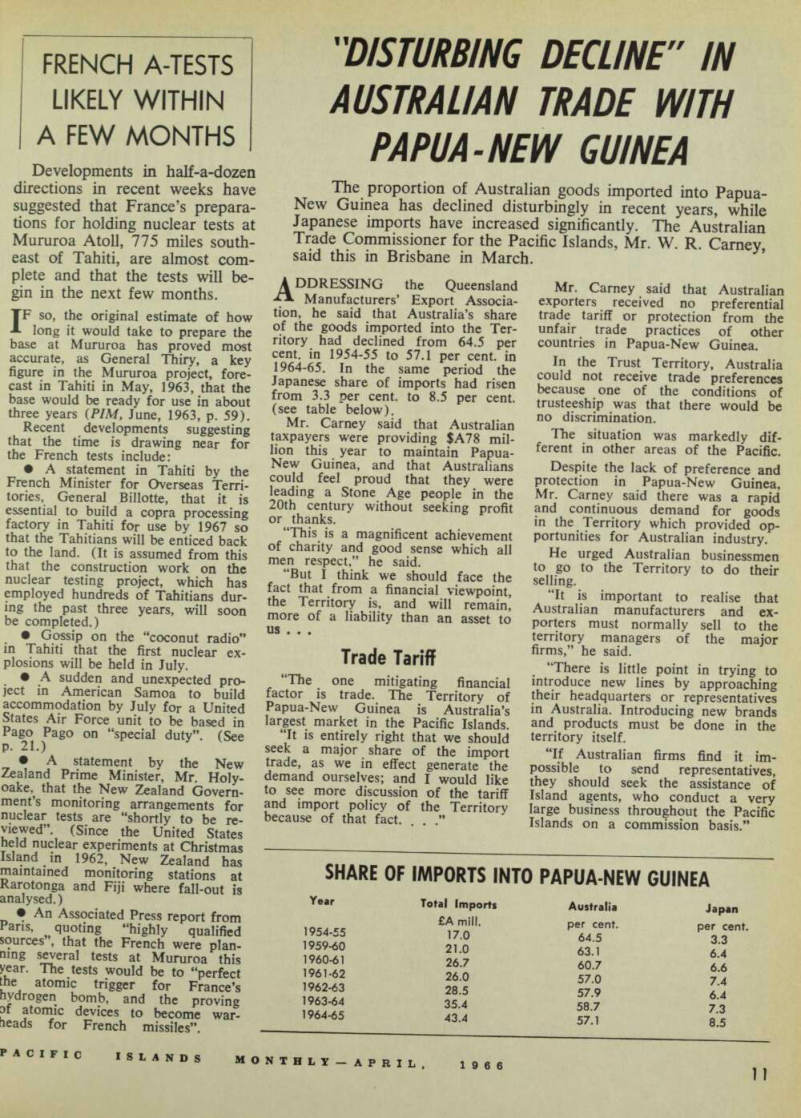
The proportion of Australian goods imported into Papua- New Guinea has declined disturbingly in recent years, while Japanese imports have increased significantly. The Australian Trade Commissioner for the Pacific Islands, Mr. W. R. Camey said this in Brisbane in March.
ADDRESSING the Queensland Manufacturers’ Export Associa tion, he said that Australia’s share of the goods imported into the Ter ritory had declined from 64.5 per cent, in 1954-55 to 57.1 per cent, in 1964-65. In the same period the Japanese share of imports had risen from 3.3 per cent, to 8.5 per cent, (see table below).
Mr. Carney said that Australian taxpayers were providing SA7B mil lion this year to maintain Papua- New Guinea, and that Australians could feel proud that they were leading a Stone Age people in the 20th century without seeking profit or thanks.
“This is a magnificent achievement of charity and good sense which all men respect,” he said.
“But I think we should face the fact that from a financial viewpoint, the Territory is, and will remain, more of a liability than an asset to us . . .
Trade Tariff
“The one mitigating financial factor is trade. The Territory of Papua-New Guinea is Australia’s largest market in the Pacific Islands.
“It is entirely right that we should seek a major share of the import trade, as we in effect generate the demand ourselves; and I would like to see more discussion of the tariff and import policy of the Territory because of that fact. ..”
Mr. Carney said that Australian exporters received no preferential trade tariff or protection from the unfair trade practices of other countries in Papua-New Guinea.
In the Trust Territory, Australia could not receive trade preferences because one of the conditions of trusteeship was that there would be no discrimination.
The situation was markedly dif ferent in other areas of the Pacific.
Despite the lack of preference and protection in Papua-New Guinea, Mr. Carney said there was a rapid and continuous demand for goods in the Territory which provided op portunities for Australian industry.
He urged Australian businessmen to go to the Territory to do their selling.
“It is important to realise that Australian manufacturers and ex porters must normally sell to the territory managers of the major firms,” he said.
“There is little point in trying to introduce new lines by approaching their headquarters or representatives in Australia. Introducing new brands and products must be done in the territory itself.
“If Australian firms find it im possible to send representatives, they should seek the assistance of Island agents, who conduct a very large business throughout the Pacific Islands on a commission basis.”