New Cash, New Owners-
pp. 127-129 · Read in the full issue

But The Same Old Policy For Honiara's Mendana
From Stuart Inder, in Honiara Honiara's celebrated Hotel Mendana has new money and new shareholders, but there is to be no change in its policy of dis crimination against Solomon Islanders.
SOLOMON Islanders may not book accommodation there, nor may they eat or drink in the main lounge or dining room.
“I’m still managing director,” says Ken Dalrymple-Hay, the man who established the hotel’s policy and who polices it. ‘There are no difficulties about it with the shareholders, and I can visualise none.”
This Australian who has spent 38 years in the British Solomons clearly means what he says, and he makes no apologies for his opinions. He is not concerned that his is the last hotel in the South Pacific which keeps a closed-door against some sections of the community.
“You run a hotel as a business, not to please people who might have ideas,” he says. “I keep out the Solomon Islanders because I don’t want to lower my standards.”
Established In 1948
The Hotel Mendana was established by Mr. Dalrymple-Hay in 1948, first as the Woodford Hotel. It was later rebuilt on the same site, and re named the Mendana after the Spaniard who discovered the Solomons in 1568.
Last year the hotel, together with a number of other interests, was sold for $480,000 to a newly-formed com pany with Australian backing called Guadalcanal Plains Ltd.
Other directors of the new company are: Messrs. W. F. B. Moses (vice chairman), a member of a well known grazing family in New South Wales; E. L. Sly, a grazier and farmer of Gunnedah, NSW, and adviser to the United Nations’ FAO, and David Thompson, a partner of the stockbrok ing firm of Ord, Minnett and Thomp son, of Sydney.
The Mendana is Honiara’s only residential hotel. There is one pub in Chinatown, not much more than a bar, and a small accommodation motel uptown, owned by Mr. A. C.
Blum, The Mendana is where everybody stays. It has 15 rooms, and 15 more are to be built soon. Tenders for the
additions, which will give every room a separate bath, closed in February.
Air transport through the Solomons has increased in recent years from one aircraft a fortnight to something like five a week, and there will be more increases when Fiji Airways takes delivery of Hawker Siddeley 748 aircraft to replace its Herons. This will speed up its Fiji-New Hebrides- Solomons service, which connects with New Guinea.
The Mendana has a high occupancy rate, and the planned extensions will hardly keep pace with the planned traffic increases.
A new hotel might do well in Honiara, and the many local people who object to the Mendana’s policy on Solomon Islanders say that one ought to be established just to take Mr. Dalrymple-Hay’s clients from him.
Mr. Dalrymple-Hay remains un moved. He says a new hotel would be a good idea, and that it wouldn’t worry him if somebody started one and allowed all the Solomon Islanders in. ‘They accuse me of discrimination but they are talking rubbish,” he says. (Over)
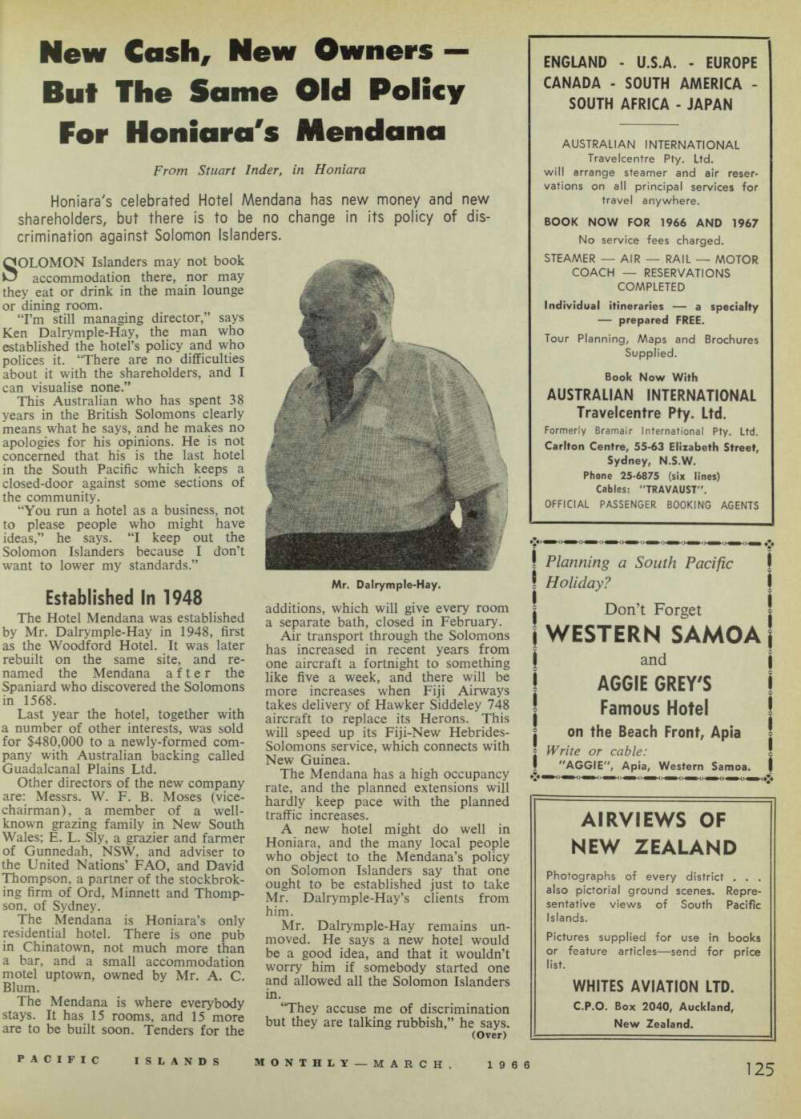
Mr. Dalrymple-Hay.
“Solomon Islanders can’t stay at my hotel because they are not all at the stage where they are fit to stay here.
“Certainly some of them are, but if I let some in and keep most of them out then that would be discrim ination. I don’t discriminate.
“You can’t ask Europeans to wait on some of these people. My Chinese cook wouldn’t cook for them, Euro peans wouldn’t be able to use the same bed linen.
“They have their own bar to drink at. I added a lounge a couple of years ago, but it has been a failure.
The Islanders smash the furniture.
You have to hose the place out. You give them glasses, and they smash them, or pinch them for spite. [The Islanders now drink beer out of paper cups].
“The liquor regulations say I have to supply food and drink to everybody, and I do. But there is nothing to say I have to serve them in the same places.
“New Guinea people passing through have congratulated me. They say, Thank God you have enough guts to keep out the rabble!’ ”
Mr. Dalrymple-Hay says any Solomon Islander drinking in the lounge, no matter with whom, would be asked to leave.
He makes his own decision on other Islanders. He has had Fijians stay there, and also, last year, a plane load of Nauruan students en route to Australia.
The Nauruans, he says, were not a success, and next time he will be “booked out” to them.
Against Policy
Mr. Dalrymple-Hay is well aware that there is a solid core of local Europeans against his policy, and that many Melanesians are especially hostile.
“I hear them talking in the bar about what they are going to do to me one day,” he says. But he says he cannot see that he will ever have to change his views. Europeans will want to keep their preserves.
Some local people have agitated for anti-discrimination legislation of the type introduced into Papua-New Guinea (where hotels are open to all), but the Government believes that such legislation is unwise because once on the books it may some day be used unfairly.
Ken Dalrymple-Hay, now 69, was born at Chatswood, Sydney, but spent much of his early years in the bush.
His father, who died in 1923, was
NSW Commissioner of Forestry for many years, and his name is perpetu ated in Dalrymple-Hay Forest, at St.
Ives, Sydney.
The Mendana’s boss fought in World War I and afterwards went on a property at Yass with his brother.
The property is still in the family, but Ken Dalrymple-Hay sold his share to go stockdealing in Queensland.
“I made a lot and lost a lot,” he says.
To get away from the debt col lectors, he went to the Russell Islands, BSIP, as junior plantation assistant for Lever’s, soon became a senior manager, and retired from Lever’s after World War II with the post of
general manager. There are still many stories told of his wartime exploits as a coastwatcher.
The Woodford, started in Honiara in 1948, was nothing but a couple of bars and a lounge—what was left of an American installation. Drinking was not a problem in those days for the Melanesians, for only in recent years have they been legally allowed to have liquor.
How long the Mendana’s descrim ination policy can continue is a mat ter for conjecture. It must, of course, collapse. It has survived so far be cause it is a personal thing—with one man against the crowd, and nobody game to take him on.