Four Books For Students
pp. 93-94 · Read in the full issue
The Month's New Reading
Of Pacific History
Until a few years ago, university dons and duennas seldom wrote books about the South Pacific —probably because the area was looked on as too insignificant to bother about.
NOWADAYS, all that has changed.
The academic world has dis covered the South Seas in a big way, and there is a constant stream of books from the world’s university presses embodying scholarly re searches into all manner of South Seas subjects.
Four such books, totalling 1,264 pages and covering historical aspects of the Pacific, arrived in PlM’s reviewing department recently. They are: • French Explorers in the Pacific (Vol. 1), by John Dunmore, of the Massey University of Manawatu, Palmerston North, New Zealand. (Oxford University Press. 82/6). • New England and the South Seas, by Ernest S. Dodge, director of the Peabody Museum, Salem, Massachusetts. (Harvard University Press. 67/-. Distributed in Australia by Oxford University Press). • New Zealand Aspirations in the Pacific in the Nineteenth Century, by Angus Ross, formerly of Cambridge but now with one of the NZ Univer sities, (Oxford University Press. 67/6). • Merchant Campbell, 1769-1846, by Margaret Steven, of the Australian National University, Canberra. (Oxford University Press. 75/-).
Dunmore’s book, which will be completed in two volumes, is the first attempt to tell the story of French exploration in the Pacific up to, but excluding, the period of colonisation. Much of it is based on unpublished manuscript material in the French Naval archives. When completed, it will be an essential reference work in every Pacific library.
Volume I deals with the explorers of the 18th century—Bougainville, de Surville, Marion du Fresne, Kerguelen, La Perouse, D’Entre casteaux and Marchand. There is also an introduction of nearly 60 pages reviewing the factors, extend ing over several hundred years, that led to the development of French interest in the Pacific. This is as interesting as anything in the book.
Dunmore describes how, in 1503, a 120-ton vessel, Espoir, under the command of a man named Gonne ville sailed from Normandy on a commercial venture to southern seas.
Six and a half months later, Gon neville reached an unknown land, where he was well treated by the natives, but where there were ap parently no commodities of com mercial importance.
On the way back to France, Gonneville was attacked in the English Channel by an English pirate, and his ship and all his papers were stolen. Thus, knowledge of the whereabouts of Gonneville’s unknown land became lost; but for the next 2i centuries, a legend grew up that it was a land of fabulous riches, and Frenchmen looked on the rediscovery of it as one of the most desirable feats they could perform.
It was one of the achievements of
the explorers from Bougainville to Marchand, Dunmore says, that the French “cleared their minds of the Gonneville pipe-dream”, while the southern continent was “erased from its tentative position on maps of the Pacific and Indian Oceans”.
Meanwhile, the mirage of the Antarctic continent —which several of the 18th century explorers sighted —was born.
A lesser achievement, but one of the most lasting, was the creation of the Tahiti legend. This occurred in 1768 when Bougainville’s men were lowering the anchor of their ship off Tahiti’s Hitiaa district, while more than 100 canoes, with a good proportion women aboard, were hovering round the ship.
Like Venus Herself
“In spite of all our precautions,”
Bougainville wrote, “one young woman came aboard on to the poop, and stood by one of the hatches above the capstan. This hatch was opened to give some air to those who were working below. The young girl negligently allowed her loin cloth to fall to the ground, and appeared to all eyes such as Venus showed herself to the Phrygian shepherd. She had the Goddess’s celestial form. Sailors and soldiers hurried to get to the hatchway, and never was capstan heaved with such speed.”
An interesting aspect of France’s 18th century explorers—but one that Dunmore has not especially stressed —is the high incidence of tragic ends among them. De Surville, who made a voyage from India to South America via the Solomons and New Zealand, was drowned while going ashore at Chilca, Peru. Marion du Fresne was murdered and eaten by
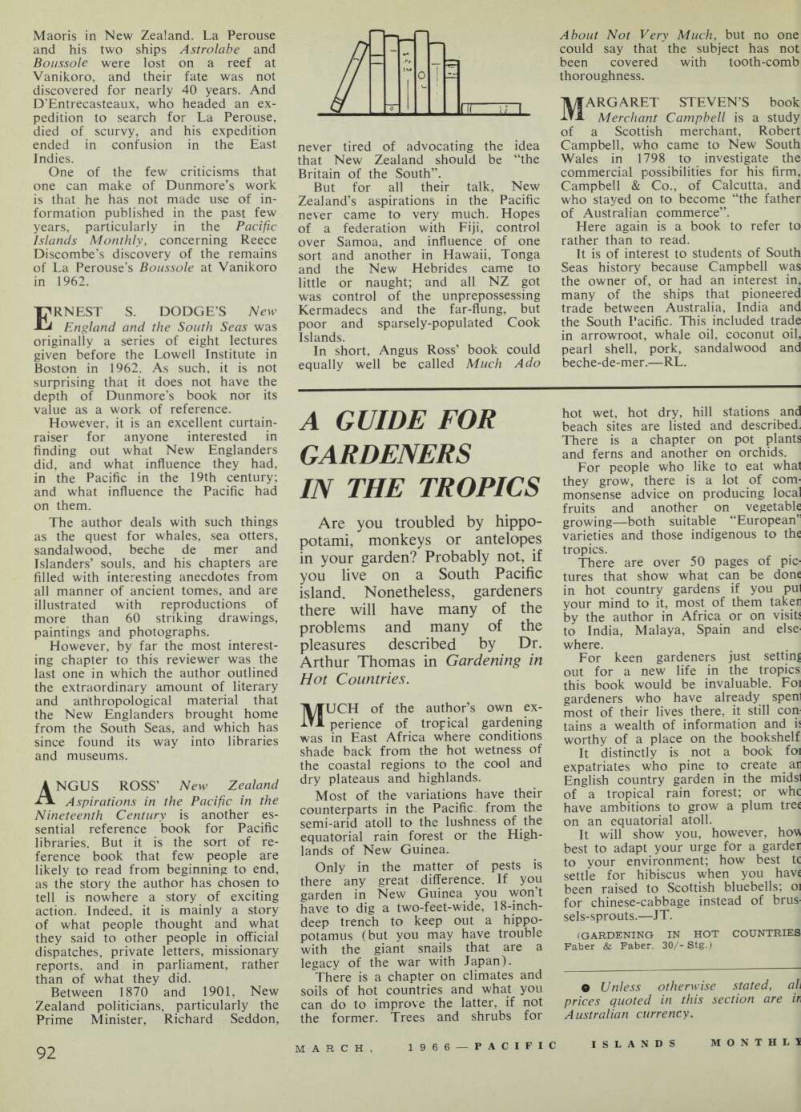
La Perouse, one of the seven French navigators dealt with in John Dunmore's new book.
Maoris in New Zealand. La Perouse and his two ships Astrolabe and Boussole were lost on a reef at Vanikoro, and their fate was not discovered for nearly 40 years. And D’Entrecasteaux, who headed an ex pedition to search for La Perouse, died of scurvy, and his expedition ended in confusion in the East Indies.
One of the few criticisms that one can make of Dunmore’s work is that he has not made use of in formation published in the past few years, particularly in the Pacific Islands Monthly, concerning Reece Discombe’s discovery of the remains of La Perouse’s Boussole at Vanikoro in 1962.
Ernest s. dodge’s New England and the South Seas was originally a series of eight lectures given before the Lowell Institute in Boston in 1962, As such, it is not surprising that it does not have the depth of Dunmore’s book nor its value as a work of reference.
However, it is an excellent curtain raiser for anyone interested in finding out what New Englanders did, and what influence they had, in the Pacific in the 19th century; and what influence the Pacific had on them.
The author deals with such things as the quest for whales, sea otters, sandalwood, beche de mer and Islanders’ souls, and his chapters are filled with interesting anecdotes from all manner of ancient tomes, and are illustrated with reproductions of more than 60 striking drawings, paintings and photographs.
However, by far the most interest ing chapter to this reviewer was the last one in which the author outlined the extraordinary amount of literary and anthropological material that the New Englanders brought home from the South Seas, and which has since found its way into libraries and museums.
ANGUS ROSS’ New Zealand Aspirations in the Pacific in the Nineteenth Century is another es sential reference book for Pacific libraries. But it is the sort of re ference book that few people are likely to read from beginning to end, as the story the author has chosen to tell is nowhere a story of exciting action. Indeed, it is mainly a story of what people thought and what they said to other people in official dispatches, private letters, missionary reports, and in parliament, rather than of what they did.
Between 1870 and 1901, New Zealand politicians, particularly the Prime Minister, Richard Seddon,
never tired of advocating the idea that New Zealand should be “the Britain of the South”.
But for all their talk, New Zealand’s aspirations in the Pacific never came to very much. Hopes of a federation with Fiji, control over Samoa, and influence of one sort and another in Hawaii, Tonga and the New Hebrides came to little or naught; and all NZ got was control of the unprepossessing Kermadecs and the far-flung, but poor and sparsely-populated Cook Islands.
In short, Angus Ross’ book could equally well be called Much Ado
About Not Very Much, but no one could say that the subject has not been covered with tooth-comb thoroughness.
Margaret steven’s book Merchant Campbell is a study of a Scottish merchant, Robert Campbell, who came to New South Wales in 1798 to investigate the commercial possibilities for his firm, Campbell & Co., of Calcutta, and who stayed on to become “the father of Australian commerce”.
Here again is a book to refer to rather than to read.
It is of interest to students of South Seas history because Campbell was the owner of, or had an interest in, many of the ships that pioneered trade between Australia, India and the South Pacific. This included trade in arrowroot, whale oil, coconut oil, pearl shell, pork, sandalwood and
beche-de-mer.-
RL.