Become Alive To Politics
pp. 31-35 · Read in the full issue

In Fiji, They've Suddenly
From John Carter, in Suva.
Now that independence, or some measure of it, is on Fiji’s horizon, the people of the Colony are displaying a political awareness which would have been unthinkable a few years ago.
THE explanation is simple and twofold.
Bearing in mind the maelstrom into which the peoples of newly independent countries were thrown when independence came, the people of Fiji are beginning to organise to protect their interests. This, hitherto, has been the burden of the Crown— and still will be, the majority hopes.
The new atmosphere in Fiji has resulted in the emergence in the past couple of years of several political parties—more, in fact, than exist in Great Britain or Australia.
The Indian community has, of course, been politically aware for years—it’s a racial trait—and the Europeans have several centuries of political background.
With the Fijians, however, politics are something entirely new, but they are beginning to catch on, mainly through those who have been educated overseas.
In the welter thrown up by con stitutional change, the Fijians now recognise that, as demonstrated in other countries, liberties can be lost and privileges disappear. Hence the growth of political consciousness among the Fijians, They are beginning to recognise that the old traditional system which is perpetuated in the Fijian Admini stration and behind which they shelter—or are kept in thrall, as some think—could be swept away overnight in a political upheaval or by a motion in a council chamber from an independent government not pledged to the Deed of Cession.
Hopes For Future
Another reason for the appearance of political parties, both Indian and Fijian, is that some people, with a little learning, fancy their chances as leaders. These people create nominal parties, hoping eventually to sell their ideas to those who will listen to them.
Among the Fijians, such people meet with a certain amount of success—at the outset.
Fijians feel more and more the old order must be modernised, that
the chiefly system is outmoded. The majority, however, are still firmly wedded to the old order, though the thinkers among them are wondering how long it can hold its own as the modern world encroaches.
But the man who offers them something new and something which will protect their rights and liberties will be listened to—at first.
The Fijians’ first political party was formed in 1956 with the name of the Fijian Association. Its moving spirit was the late Ravuama Vuni valu, but, politically, it did little until about two years ago.
Then, with more of the chiefs throwing their weight into it, it became more active; and at the crucial elections later this year under the new constitution the association no doubt will field several candidates.
Trade Union Leader
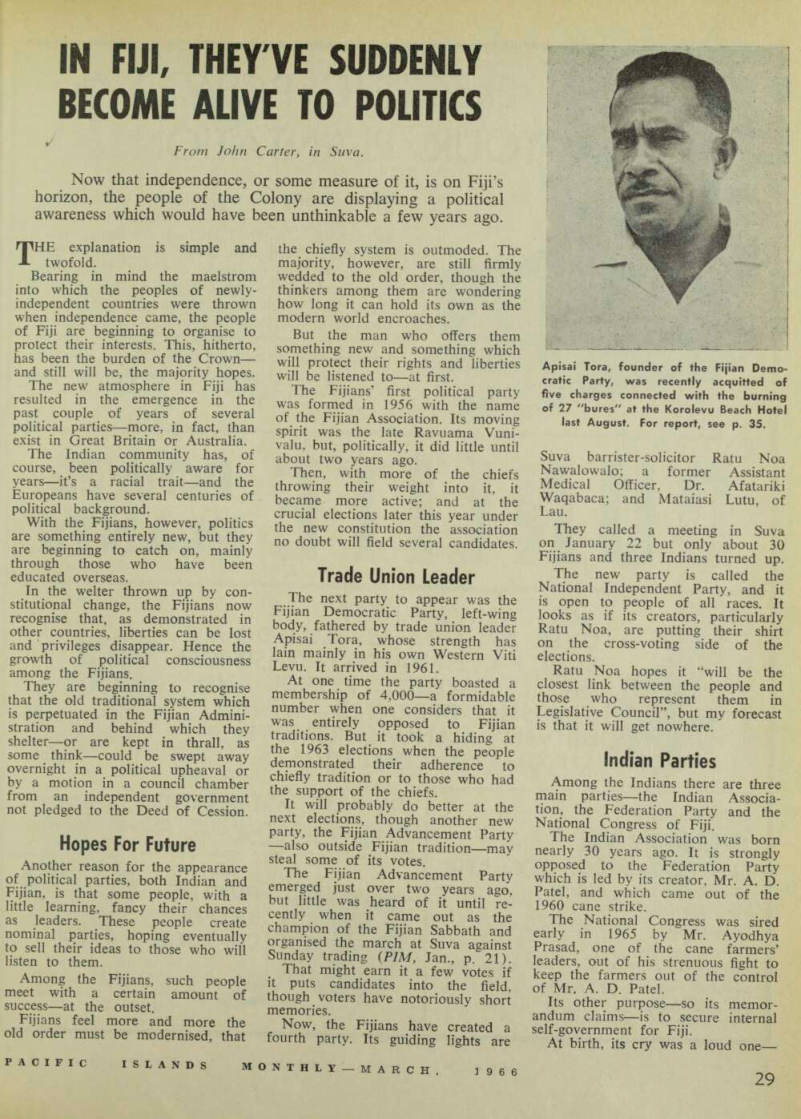
The next party to appear was the Fijian Democratic Party, left-wing body, fathered by trade union leader Apisai Tora, whose strength has lain mainly in his own Western Viti Levu. It arrived in 1961.
At one time the party boasted a membership of 4,000 —a formidable number when one considers that it was entirely opposed to Fijian traditions. But it took a hiding at the 1963 elections when the people demonstrated their adherence to chiefly tradition or to those who had the support of the chiefs.
It will probably do better at the next elections, though another new party, the Fijian Advancement Party —also outside Fijian tradition—may steal some of its votes.
The Fijian Advancement Party emerged just over two years ago, but little was heard of it until re cently when it came out as the champion of the Fijian Sabbath and organised the march at Suva against Sunday trading ( PIM , Jan., p. 21).
That might earn it a few votes if it puts candidates into the field, though voters have notoriously short memories.
Now, the Fijians have created a fourth party. Its guiding lights are
Suva barrister-solicitor Ratu Noa Nawalowalo; a former Assistant Medical Officer, Dr, Afatariki Waqabaca; and Mataiasi Lutu, of Lau.
They called a meeting in Suva on January 22 but only about 30 Fijians and three Indians turned up.
The new party is called the National Independent Party, and it is open to people of all races. It looks as if its creators, particularly Ratu Noa, are putting their shirt on the cross-voting side of the elections, Ratu Noa hopes it “will be the closest link between the people and those who represent them in Legislative Council”, but my forecast is that it will get nowhere.
Indian Parties
Among the Indians there are three main parties—the Indian Associa tion, the Federation Party and the National Congress of Fiji.
The Indian Association was born nearly 30 years ago. It is strongly opposed to the Federation Party which is led by its creator, Mr. A. D.
Patel, and which came out of the 1960 cane strike.
The National Congress was sired early in 1965 by Mr. Ayodhya Prasad, one of the cane farmers’ leaders, out of his strenuous fight to keep the farmers out of the control of Mr. A. D. Patel.
Its other purpose—so its memor andum claims—is to secure internal self-government for Fiji.
At birth, its cry was a loud one—
Apisai Tora, founder of the Fijian Demo cratic Party, was recently acquitted of five charges connected with the burning of 27 "bures" at the Korolevu Beach Hotel last August. For report, see p. 35.
a memorandum which was sent to the Parliament of Great Britain, the “Colonial Government of Fiji”, the United Nations, the Chiefs of Fiji and the general public, and which castigated the Fiji Government and the “colonialists”.
Now, probably for expediency, Mr.
Prasad has moved closer to the Fijians and Europeans and supports the loose alliance of Fijians, Euro peans and Indians who have one common platform—independence for Fiji, but not now; and are opposed to the Federation Party.
Not surprisingly, this alliance is called the Alliance (see below).
The Muslims, who do not regard themselves as Indians, have formed their own parties. They have two at the moment, the Fiji Minority Party and the Fiji Muslim Front.
The Muslim Front represents the political aspirations of the Fiji Muslim League, the members of which want to keep their politics separate from their religion.
As for the Europeans, they have had no need of political parties until now.
Legislative Council elections have been fought, where they have been fought, on personalities, and no one has had to fight for a European seat on the Suva City Council for years.
Now, however, even the Europeans are beginning to feel the need to organise for strength, to retain some thing in the forthcoming welter.
400 Present
On February 1, they brought a party into being. It has the somewhat unpretentious name of General Electors’ Association.
In this context, however, Euro pean means something different from the usual euphemism to describe a white man, which is a term heartily disliked by everyone in Fiji. Here it means a voter who does not qualify to register on the Indian or Fijian electoral rolls, but does qualify for the General roll.
This roll caters for Europeans (ethnological), part-E uropeans, Chinese and anyone else who has a vote and is not on the Fijian or Indian roll.
Thus, when more than 400 people turned up for the birth of the General Electors’ Association on February 1, there was a fair re presentation of the Colony’s 5,000odd Chinese as well as Europeans and part-Europeans.
Mr. John Falvey, a member of the Legislative Council, Member for Communications and Works, bar rister-solicitor, and the acknowledged leader of the European voters, acted as midwife for the new baby. He
was assisted by Suva businessman, Mr. Charles Cheng, who is one of the leaders of the Chinese community, a supporter of the Kuomingtang of Chiang Kai Shek, and a naturalised Australian.
Another barrister and member of Legislative Council, Mr. R, A.
Kearsley, had, for the most part, drawn up the constitution which was adopted with few changes.
There was little of the aura of history in the making about the occasion. Only a few people aired their views on the association’s constitution, and most of those who did bother to speak possibly had an eye to a future role, as a candidate
for the general elections about next October.
Mr. Falvey quietly explained the “compelling” reasons for creating an electoral association or political party, Under Fiji’s new constitution, he said, a majority of unofficial members would hold the balance of power in the Legislative Council and would be able to influence and even to dictate the policies of the Govern ment.
Those on the General roll wanted to be part of that Government and wanted to do all they could to ensure that the Members were fortified by the right policies deter mined by the association. (Over)
In that way, they could be sure that Government action would reflect the views of the electors who belonged to the association.
“Normally,” Mr. Falvey declared, “one community cannot, and must not, be allowed to dominate the Legislative Council.
“It follows, therefore, that the as sociation’s policies must be re conciled as far as possible with the policies adopted by representatives of other communities in the Legislative Council.
“For that reason, one of the as sociation’s objects is to affiliate with any other association or alliance of associations having objects com patible with the association’s objects and policies.”
When it came to appointing a council to run the association, every one wanted everyone else to be on the bandwagon.
There were 20 seats to be filled and nearly 40 nominations, including the Old Guard. It took the scrutineers till 2 a.m. to count the votes.
Hotelier David Ragg, son of the late Sir Hugh Ragg, was appointed president, with Messrs. Charles Cheng, Alec Muir and E. Ashley as vice-presidents, Mrs. K. R. Bain is the temporary secretary and Mr. Harry Kiss the treasurer. (Mrs. Bain is the wife of Mr. Ken Bain, Secretary for Social Services in the Fiji Government under the Member, Mr. A. D. Patel).
On the council are three Chinese.
Although the women were keen to play their part in running the as sociation, only Mrs. Bain obtained election.
More will be heard of her because, so far, she looks like being the first woman to stand as a candidate in the Legislative Council elections.
A formal meeting to bring the Alliance into being was held a few days after the inauguration of the General Electors’ Association. More than 60 men and women, represent
ing all the major races of Fiji, un animously approved action forming a political alliance “of organisations in the Colony concerned with the welfare of the people of Fiji”.
Ratu K. K. T. Mara, leader of the Fijians’ political organisation, the Fijian Association, called the meeting with the support of a multi-racial committee. Mr. Vijay Singh, of Nadi, was chairman.
A Rotuman leader, A. F. Varea, moved the formal resolution asking for the formation of an alliance between the various political organisa tions in Fiji.
One of the declared purposes of the Alliance is to “put up suitable candidates for election to the Legislative Council”.
This new body is thus likely to produce most of the candidates in the cross-voting.
One of the undeclared purposes of the Alliance, of course, is to fight A. D. Patel’s Federation Party But it is to be hoped the Alliance adopts a much more positive ap proach to Fiji’s politics than just opposition to this party, although if it can curb the extremists, it will save Fiji a lot of future grief.
Mr. Falvey.