Tropicalities
pp. 23-29 · Read in the full issue


The death by burning of pretty , 17-year-old Zinnia Edetang on Nauru in January—here reported for the first time—was a macabre incident with an even more macabre background.
ZINNIA was interested in a young Australian, employed on Nauru on contract work for the British Phosphate Commissioners by J. F.
Thomson Pty. Ltd., of Melbourne.
One night Zinnia poured kerosene over herself and her clothing, knocked on the door of the Aus tralian’s quarters, and, when he came out, lit a match. She burst into flames.
The Australian attempted to put out the flames, and in so doing burned his hands seriously.
Man and girl were taken to hos pital, where Zinnia died several days later. The man was sent to Australia for medical treatment and won’t be going back to Nauru.
It was a horrible death, and on Nauru there has been sympathy for all concerned in it.
But in some quarters there is also some serious head-shaking and puzzlement over the incident—be cause Zinnia’s death was the ninth suicide by burning on the island since 1948.
All who have died have been women, and all have been young.
Daisy Scotty was the first, in 1948.
She was 25.
Police Baffled By "Human Torch"
Deaths On Nauru
The next death was in 1954.
Others followed within a year or two.
In 1958 there were two such deaths in the one year.
“I don’t know why this sort of thing started, or why it should con tinue,” Nauru’s police chief, Jim McConnachie, said to us recently.
“It is extraordinary,”
Since then, Mr. McConnachie has retired to Sydney, so it’s unlikely that he will shed any more light on the problem of Nauru’s “human torches”.
She's Out To Break
More Records
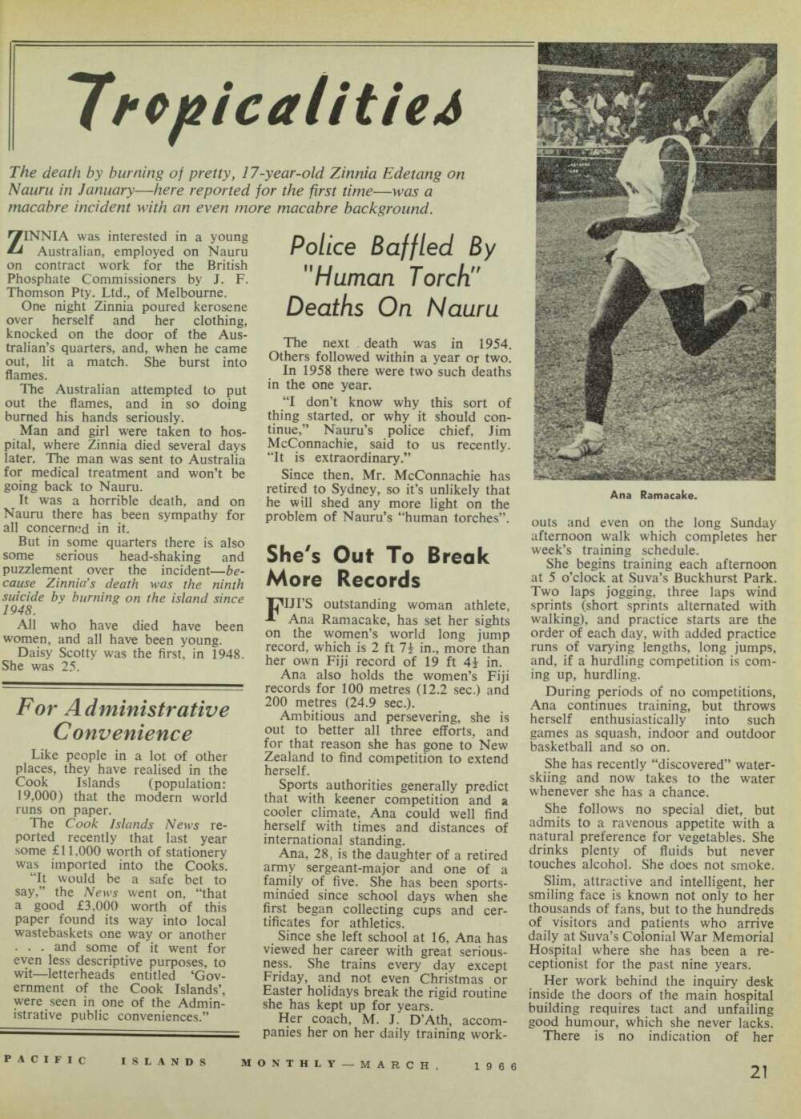
PUTS outstanding woman athlete, A Ana Ramacake, has set her sights on the women’s world long jump record, which is 2ft in., more than her own Fiji record of 19 ft 4i in.
Ana also holds the women’s Fiji records for 100 metres (12.2 sec.) and 200 metres (24.9 sec.).
Ambitious and persevering, she is out to better all three efforts, and for that reason she has gone to New Zealand to find competition to extend herself.
Sports authorities generally predict that with keener competition and a cooler climate, Ana could well find herself with times and distances of international standing.
Ana, 28, is the daughter of a retired army sergeant-major and one of a family of five. She has been sports minded since school days when she first began collecting cups and cer tificates for athletics.
Since she left school at 16, Ana has viewed her career with great serious ness. She trains every day except Friday, and not even Christmas or Easter holidays break the rigid routine she has kept up for years.
Her coach, M. J. D’Ath, accom panies her on her daily training work-
outs and even on the long Sunday afternoon walk which completes her week’s training schedule.
She begins training each afternoon at 5 o’clock at Suva’s Buckhurst Park.
Two laps jogging, three laps wind sprints (short sprints alternated with walking), and practice starts are the order of each day, with added practice runs of varying lengths, long jumps, and, if a hurdling competition is com ing up, hurdling.
During periods of no competitions, Ana continues training, but throws herself enthusiastically into such games as squash, indoor and outdoor basketball and so on.
She has recently “discovered” water skiing and now takes to the water whenever she has a chance.
She follows no special diet, but admits to a ravenous appetite with a natural preference for vegetables. She drinks plenty of fluids but never touches alcohol. She does not smoke.
Slim, attractive and intelligent, her smiling face is known not only to her thousands of fans, but to the hundreds of visitors and patients who arrive daily at Suva’s Colonial War Memorial Hospital where she has been a re ceptionist for the past nine years.
Her work behind the inquiry desk inside the doors of the main hospital building requires tact and unfailing good humour, which she never lacks.
There is no indication of her
Ana Ramacake.
muscular strength either in her white receptionist’s uniform or in the soft feminine clothes she prefers after work and after training hours.
Being well known all over Fiji, Ana constantly finds herself greeted by strangers as a friend and congratulated on her efforts.
After the South Pacific Games in Suva in 1964, when she romped home with five medals, a carload of people came from Nadi just to shake her by the hand.
Raf Lovers Of The
World, Unite!
THE world’s cat lovers will be relieved to learn that Bougain ville’s rat problem is being solved not with cats but with biscuits. What the world’s rat lovers have to say about it is probably another story.
Bougainville’s rat plague hit the headlines about 18 months ago following an announcement that Bougainville officials planned to press-gang about 2,000 stray alley cats from Sydney wharves, ship them to Bougainville and turn them loose on the thousands of rats which had been making hay with the local kaukau, tapioca and coconuts.
The rats, a cross between bush rats and ships’ rats, were so hungry that they were even pulling the cocoa pods from the trees and break ing them open. Native cocoa planters in the Kieta area were in a desperate state.
The cat proposal brought fierce de nunciations from all over the world.
Little old ladies wrote, wired and sent message sticks from distant places to protest about the fate of the cats after they had eaten the rats.
In Bougainville everybody pulled in their heads.
While we were there the other day, Kieta agricultural officer Robert Teylin told us that it had never seriously been planned to bring the cats to Bougainville. It had merely been mentioned as a possible solu tion.
“But we still had the rat plague,” he said, “although it has become less acute than it was. And now it might be beaten.”
Into the attack since Christmas have come three Australian agricul tural science students—George Reeves and Peter Lawrence, of Adelaide, and Douglas Small, of Melbourne.
They have been placing thousands of baits in the area, which, when taken, cause the rats to bleed to death if they start bleeding for any reason, such as if they receive a scratch.
The baits are “biscuits” of wheat meal, sugar, rice and paraffin wax, laced with poison.
The results so far look good, al though the students are still evalu ating their campaign.
What they are attempting to find out for the benefit of the P-NG Agricultural Department is whether it is economical to poison rats in the field on a large scale.
Even if it isn’t, cats are out.
A Handy Man
To Have Around
Mr. James F. Flannery,
Special Assistant to the Governor in American Samoa, is a handy man to have around the place.
While Mr. Flannery was a bachelor he was noted as a fine host and also outstanding for his culinary skill. Now
happily married, he is still in demand for work of all kinds.
Seven years ago he was American Samoa’s Auditor. Later, as Treasurer with the Finance Department, he was in time to receive the inrush of funds and attendant problems connected with educational expansion, road and building construction, and readying American Samoa quickly for the South Pacific Conference of 1962. He did all of this and left the Treasury much richer in funds than when he took over.
He was then assigned as Special Assistant to the Governor. This has involved him in handling executive problems, supervising the administra tion of Swains Island, and establish ing the American Samoan Develop ment Corporation.
A few months back he took over as American Samoa’s Director of Agriculture when Mr. Shiraishi was temporarily absent; and more recently
he became Acting Governor of Ameri can Samoa when Governor H. Rex Lee was in India for the annual con ference of the Pacific Area Travel Association.
Mr. Flannery was doing the guber natorial chores when American Samoa was hit by the hurricane in late January, and he had the unhappy task of having to declare a state of emergency.
GEIC Aviation As
It Might Have Been
OUR story last month (p. 50) about the plan to start an internal air service in the Gilbert and Ellice Islands Colony within four years was of more than ordinary interest to our old friend, Mr. Neville Chatfield, of Sydney.
Mr. Chatfield, who was supercargo in the Gilberts for Burns Philp from 1902 to 1914, suggested the idea of linking the Gilbert and Ellice Islands by air just after World War I! He has, moreover, some interesting correspon dence to prove it.
One letter, dated February 15, 1920, and addressed to the then GEIC Resident Commissioner, Mr. Carlyon Eliot (with whom he had often pre viously discussed the matter), sug gested that the ideal plane for Islands service was a 504 K-type Avro sea plane.
“This is a beautiful little machine,”
Mr. Chatfield said, “only 28 ft long, seating two passengers and capable of the run across from Ocean Island to Tarawa, Abemama or Butaritari in from 3i to four hours at a steady, comfortable flying speed of about 70 miles an hour against the easterly winds which prevail throughout the greater portion of the year in your parts. The return journey, wind abaft the beam, would be done in about two hours.
“The cost of a 504 K, fitted with floats, is about £l,BOO. The life of the engine is a sure 1,000 hours, and the cost of running about 1/3 to 1/6 a mile, which is no more expensive than running a Cadillac or a Rolls Royce motor car. . . .”
Mr. Chatfield’s letter contained many other interesting details. But as Resident Commissioner Eliot left the Colony early in 1920, it is pos sible that he never even read them.
However, the Chatfield letter was found in the files by Mr. Eliot’s successor, H. R. McClure, and he immediately wrote to Mr. Chatfield asking him to get further informa tion for him from the Australian Air craft Company.
“The purchase of a seaplane was one of the first things that struck me
on my arrival here,” Mr. McClure wrote. “The one drawback is the parlous condition to which pilot and passenger would be reduced in the event of engine trouble and forced landing. They would have little chance of survival in this part of the Pacific. It seems to me that to avoid the possibility of this, it would be necessary for two planes always to fly in company. That is one of the particular points on which I should like expert opinion. . .
Mr. Chatfield went to considerable trouble to obtain the information that Mr. McClure wanted. But the idea of a seaplane for the GEIC Resident Commissioner came to
naught; and it looks as though his idea of an internal air link for the GEIC will be at least 40 years old before it becomes a reality.
Nearly, But Not
Quite On Savaii
HAS anyone ever climbed Western Samoa’s highest mountain, the 6,094 ft peak Sili-Sili on Savaii?
Two people who are curious to know this just now are George A.
Wray, an American attorney from Washington, and Lee Graham, a 17year-old American yachtsman, who
had a go at climbing it late last year, but didn’t quite make the top.
Mr. Wray was in Samoa to set up a branch of his law firm in Pago Pago when he ran across Graham, who is sailing round the world in his 24 ft sloop Dove.
Mr. Wray, who has climbed many mountains in the South American Andes, plus Kilimanjaro in Africa, thought Sili-Sili would make an in teresting climb, even though aerial photographs of it taken in 1952 showed its top to be covered in forest; and he persuaded Graham to join him in the attempt.
“Lee and I set out on a Wednesday from Pago and finally got to the village of Aopo on the north-west side of Savaii,” Mr. Wray tells us in a note from Washington.
“Despite heavy rains we went up.
We scrambled up a barely visible trail to a height of about 3,500 ft; but from there on we had to break our own way through the brush.
“The forest cover was fantastic.
The trees rose to heights of from 70 to 90 ft and were often 10 ft in diameter.
“We got to about the 5,000 ft level, and then had to traverse a plateau to reach the promontory which is Sili-Sili.
“The going got to be incredibly slow. The bush was thick and the ground was broken into small hills.
“As I had a paternity suit to handle back in Pago for the following Wed nesday, we had to turn back when we were still at least three miles short of, and 600 ft below, the top of the mountain.
“Then it was a shocking surprise to discover that the trail we had care fully hewed out of the bush was barely discoverable 100 yards behind us because the white ends of the sticks we had cut had darkened quickly.
“With no hope of finding our way
back the way we had come, and not wishing to cut through the bush, which would have taken about three days, we did the next best thing.
“We found a stream gully cours ing off in the general direction we wished to go and followed that. We started down about five o’clock in the morning, and almost 12 hours later we made it to the sea.
“We came to waterfalls 200 and 300 ft in depth, and we had to cut back into the bush to the bottom of them.
“I’m certain that no one has ever
run down that stream bed before, and I’m certain that no one should ever try it again.
“Meanwhile, we haven’t seen the top of Sili-Sili; but if we had, I’m sure we would not have definitely known it. The foliage was so dense.”
Sili-Sili, incidentally, is by no means the highest mountain in the South Pacific, or even in Polynesia.
Tahiti’s 7,339 ft Mt. Orohena (first climbed by Europeans in 1953) easily takes the palm in Polynesia, while New Guinea has mountains that are twice as high as that.
George Wray.