sags
pp. 19-157 · Read in the full issue

Kieta Looks
Forward To
Bigger And
Better Things
From Stuart Inder in Kieta.
While it wouldn’t be true to say that Bougainville’s east coast town of Kieta has reached the stage of being a metropolis, it certainly is happily conscious that it is destined for larger things in life.
TJISTORY is at last catching up with Kieta. Within the next two years it will recover the glory it had before the war, and in the German days, as it becomes again the administrative headquarters for Bougainville.
The tiny island of Sohano, headquarters since World War 11, is reluctantly counting its days.
Six years ago when I was last on Bougainville, Kieta was nothing but a pretty, sleepy little South Seas backwater with a few native-type houses among the giant old raintrees; a wobbly copra store of pitpit where the local planters stored their produce between the six-weekly visits of the Tulagi; Wong You’s branch store (headquarters at Buka Passage); and the Kieta Club, which stirred to beery life on boat days and at Christmas.
Onp RiillrlnTPr
une Bulldozer The only “road” was a wheel track which took you a desperate 14 miles to the airstrip down by Robin Me- Kays Aropa Plantation, and there Kieta was so much out in the sticks, and Bougainville so far out of the ken of the rest of the Territory, that when I wrote a piece for PIM
suggesting that some of suburban Port Moresby’s kerbing and guttering be shipped down Kieta way, I was set upon as a shocking bore, disloyal to what was once my home town i was reminded that many thousands of honest, hard-working citizens lived in Port Moresby, and weren’t they, too, entitled to the use of real roads and not dirt tracks for !jj eir Pe f u B eots and Mercedes Benz? f as *? * 11 a case B reatest good for the B reatest number?
Development A/loneV
r ' The World Bank has now come in °n Bougainville’s side. The rule is that development money should go to the areas with the greatest poten tial for economic development, That rule, coupled with the fact that as new district headquarters it can be guaranteed a larger share of money from the inevitable empire builders, means that Kieta is not sleepy now—and may never be again, The first month of this year brought some electrifying changes to Kieta
sags
vat, near Rabaul, who has 15 police men under him (although not so much as a bicycle to move around on).
Young lan Duncan has just arrived from Sydney to take charge of the 17 European children at Kieta’s brand-new A school. (Last year the European children took corres pondence courses.) The hospital has just been given electricity (so that Dr. Jim Watson doesn’t have to operate with the aid of seven-cell torches, and the X-ray people don’t have to borrow the power plant from somebody else’s welding outfit).
A bulldozer is whining away on the foreshores among great piles of steel bars in readiness for a pile driver which will sink the piles for Kieta’s new overseas wharf. This wharf will enable big Bank Line vessels in, as well as the Malekula, which has taken the place of the Tulagi.
New Houses
New houses are going up on the moist green hills around Kieta.
Another 30 are on the works pro gramme for this year.
Already district headquarters for Public Health and Public Works have moved from Sohano. Helmut Kroen ing’s friendly 10-room Hotel Kieta frequently bursts at the seams, and it looks like having to expand again.
Helmut, with his stevedoring, haulage and plantation interests is a busy man.
There is an active native ex
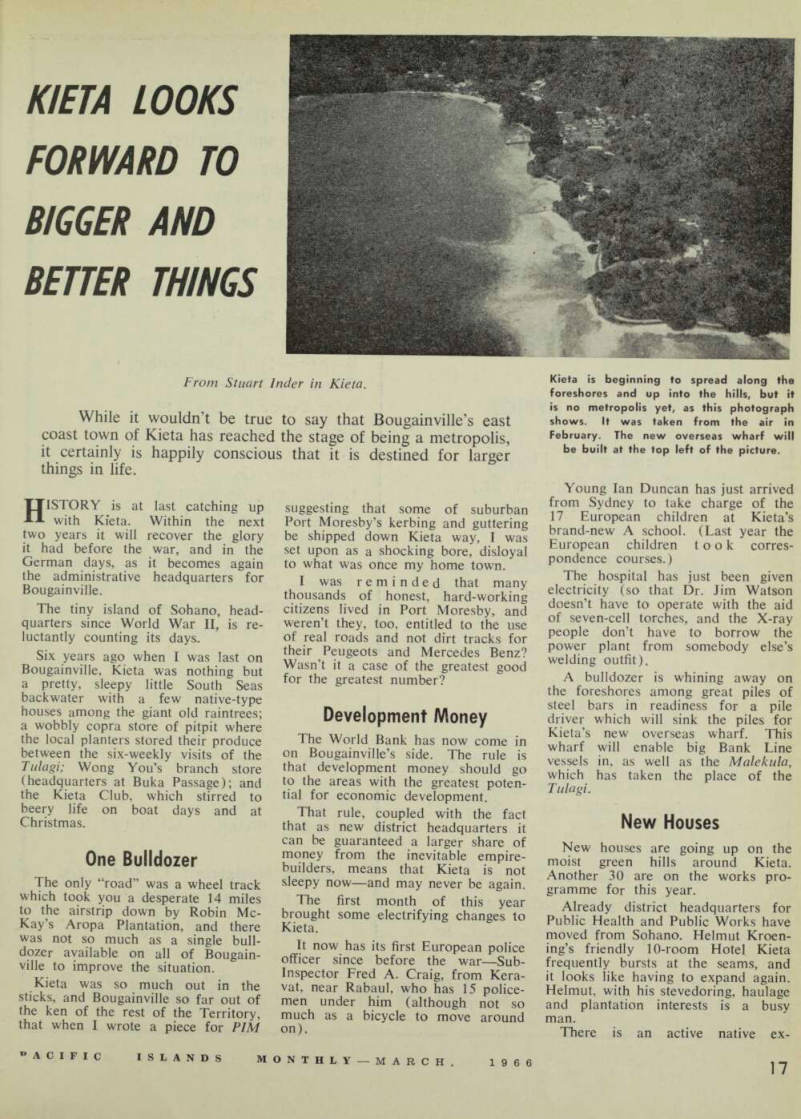
Kieta is beginning to spread along the foreshores and up into the hills, but it is no metropolis yet, as this photograph shows. It was taken from the air in February. The new overseas wharf will be built at the top left of the picture.
servicemen’s club in addition to the Kieta Club.
The new wharf will mean Customs officials and copra inspectors, and perhaps even tourists in what now is one of the most off-the-beaten track beauty spots in all of the South Seas.
At Sohano they are wondering what life will be like down on the east coast, and in Kieta they are wondering how the town will with stand the invasion to come.
But the biggest changes have been in the roads, and in the presence of a get-up-and-go organisation called CRA, which is never out of the local conversation.
The road to the airstrip is now somewhat broader than the wheel tracks of old, and it carries far more traffic.
Robin McKay’s large figure is not now to be seen behind the wheel of a flying Land-Rover, for Aropa has been sold, for about $360,000, to the P.NG Biological Foundation and Robin and Laurie live in a two-storey house with swimming pool in Killara, Sydney. The Foundation is interested in experimenting with tropical crops.
In the other direction, past “Kip”
McKillop’s Arawa plantation, there is now a fine eight-mile stretch of PWD road skirting the coral fore shores, and bulldozers are tearing hunks out of the 4,000 ft ranges be hind Kieta as a further 18-mile stretch is driven into the clouds.
Present Works boss Henry Traczyk and former roadmaster Denzil (“Hairy Mac”) McLellan are men who enjoy the challenge of road making.
The cloud-piercing stretch is a CRA road. Some of it is an improve ment on a native-made road, put in under the direction of the Kieta kiap.
Assistant District Commissioner M.
J. Denehy, but for the most difficult part of its length it is new.
CRA stands for Conzinc Riotinto Australia, and the local organisation, CRA Exploration Pty, Ltd., is a tightly-knit group of about 60 drillers, geologists, pilots, support men and labourers under chief geologist Ken Phillips.
For two years now they have been digging into the mountains behind
(Continued on p. 156)
Kieta, attempting to prove the value of low-grade copper deposits.
On their work will depend whether there will be established a valuable industry for Bougainville—an in dustry which could mean, at its best, an initial treatment works for the copper, and wharves and shipping with which to export it—presumably to Japan.
It appears to me that the CRA work here is at a transition stage, with the administrators and more per manent developers beginning to take over from the initial geological parties.
This, presumably, is promising for Bougainville, and for Kieta in par ticular.
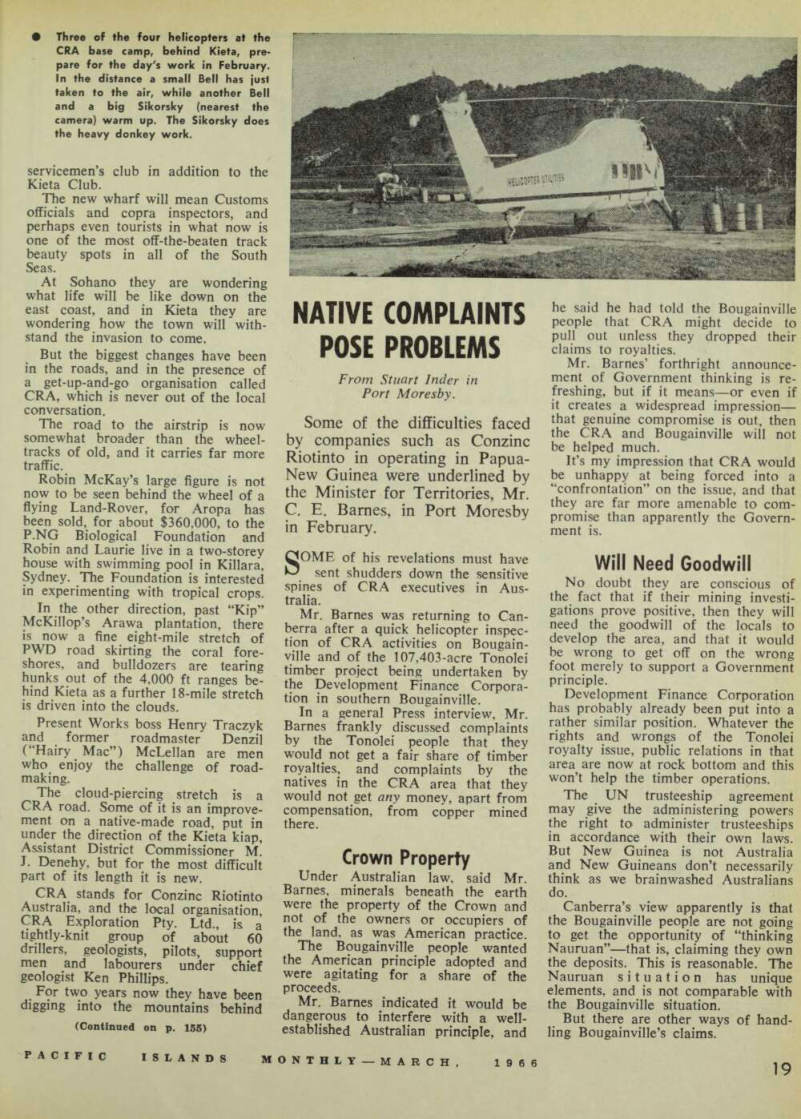
Base headquarters for CRA are at Kobuan Bay, within a few miles of Kieta, where some excellent per manent buildings have been erected, including a hangar for a big Sikorsky helicopter.
CRA helicopters have brought the “big time” to Kieta. The Sikorsky whirls and roars regularly into the ranges, doing the heavy chores of delivering fuel and equipment. Three smaller Bell’s chop around the area, taking men and materials to all kinds of places.
Each morning of my stay they have been putting down practically on the front porch of the Hotel Kieta to pick up aerial survey teams billeted there. The locals hardly turn a hair, so familiar is the sight and sound of the whirleybirds.
The new road being pushed up into the ranges will be a supply route, to enable trucks to take over the job of the expensive Sikorsky.
The fact that the road will also open up native plantations is a bonus for the Administration, for which it is duly grateful.
Six years ago this area was in the grip of a cargo cult. Crosses had been cleared from the cemeteries, and gardens had been destroyed in readiness for the cargo that was to come.
The reputation of the Government men was low, for they were humbugs who had no materials or machinery, who could offer the Bougainville people nothing.
TTie new activity, the growing signs of prosperity in Kieta, have created a bright new image which has con fined the cargo cult to the south.
For Kieta, the future looks good.