Pacific Commerce and Produce
pp. 135-139 · Read in the full issue


£1M. Development
Plan For
Western Samoa
Details of a £1 million, five
year development plan for
Western Samoa were announced in the territory’s Parliament in December by the Minister of Finance, Mr. G. F. D. Betham.
THE plan provides for the expendi ture of £260,000 in 1966. Of this agriculture has been given top priority with 46 per cent.; visitor and secondary industry projects have been allocated 22.2 per cent., and Public Works will get 22.5 per cent.
Just how far available finance falls short of needs was illustrated by Mr.
Betham when he revealed that the £1 million programme was pruned from detailed priority projects totalling £7J million put forward by the various economic development committees.
Increased Production
“An acceleration in the develop ment of roads, water supplies, ex tension and upgrading of our health, education and social services, tele communications, electric power supply, transportation and visitor support facilities, public buildings and 3ther structures, as well as other development necessarily calls for very heavy investment far in excess 3f what our slender purse can pur chase,” he said.
Agricultural development schemes approved include subsidies, incentives, ;he supply of planting materials, re search. and increased extension activities aimed at achieving a fairly •apid increase of production of copra, cocoa, bananas and other small crops.
Also included are two land settle ment schemes, which, if successful, could set the pattern for more effective use of the land and lead to nuch higher production figures than s generally the case throughout the country at present.
Tourism, or as the Economic Development Department prefers to call it, the visitor industry, is
featured prominently in the 5-year plan.
Consultants from Hawaii reported in November that the first resort hotel should be built at Cape Lefatu, about nine miles beyond the airport at Faleolo and about 30 miles from Apia. They recommended a 100-room hotel costing £600,000.
Mr. Betham told Parliament that the Government did not have enough money to finance this project by itself, so it was important to induce private capital to invest in it.
The Government, however, was in vesting in the hotel to assure hotel investors that the Government fully supported the development of the hotel and would do everything to ensure its success, and so that the Government could be represented in the directorate and in that way “exert its influence on hotel policy”.
Mr. Betham said that the Govern ment also recommended that the Samoan people should have an opportunity to invest in the hotel.
He said the Government proposed to invest £40,000 in the hotel in 1966, and £60,000 in 1967, and that it was hoped to open the hotel in 1968.
Savaii Timber Plan
Meanwhile, the giant US firm of Potlatch Forests Inc. has made a proposition to the Samoan Govern ment, involving the expenditure of up to £3 million over the next five years, in developing the timber in dustry on Savaii, Western Samoa’s largest island.
Besides exploiting the timber potential of that island, the invest ment would include the development of power and water supplies for the proposed new town of Asau, and the upgrading of Savaii reading to facilitate transport of timber and other export products to the Asau wharf.
The investment proposal follows exhaustive tests made last year in the US by Potlatch on about 26 species of Samoan hardwoods.
The firm now wants to build a modern mill in Savaii capable of handling 50 million super feet of timber annually on a sustained yield basis, with a comprehensive re planting scheme.
Vice-president K. L. Floan, of Potlatch, was expected in Apia in
late January for discussions with Government officials.
Prime Minister Mataafa, who visited Potlatch installations in the States several months ago after recuperating from medical treatment in Hawaii, is enthusiastic about the proposals.
“I believe this is a wonderful opportunity to make a major step forward in economic development aimed at improving the lot of our people,” he says.
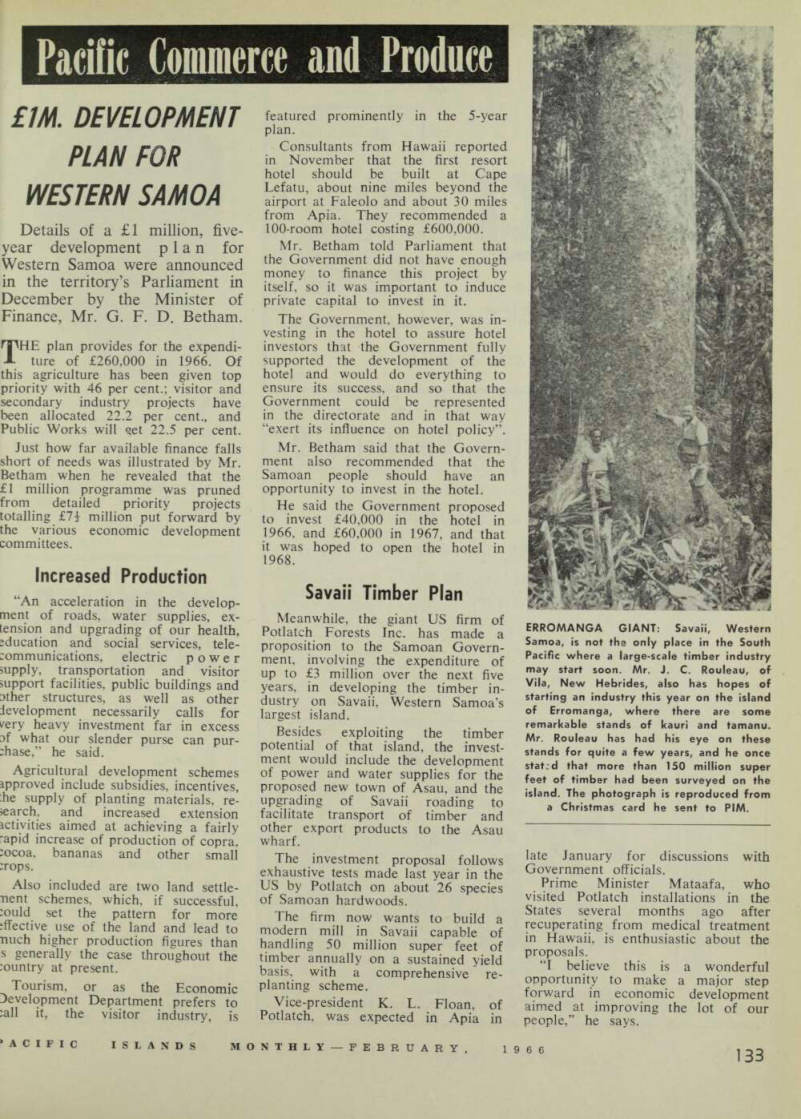
ERROMANGA GIANT: Savaii, Western Samoa, is not the only place in the South Pacific where a large-scale timber industry may start soon. Mr. J. C. Rouleau, of Vila, New Hebrides, also has hopes of starting an industry this year on the island of Erromanga, where there are some remarkable stands of kauri and tamanu.
Mr. Rouleau has had his eye on these stands for quite a few years, and he once stated that more than 150 million super feet of timber had been surveyed on the island. The photograph is reproduced from a Christmas card he sent to PIM.
New Store for BP
In Vila
BURNS PHIL? (New Hebrides) Ltd. is planning to build a new store in Vila at an estimated cost of more than £A 100,000.
The firm’s Vila manager, Mr. John Stegler, said recently that building might begin at the end of 1966.
Consulting architects are Messrs.
Warren and Mahoney, of Christ church, New Zealand, who have designed the new British Secondary School in Vila and the new hospital to be built at a cost of some £A95,000 at Lenakel, Tanna.
Rarotonga Looks
At Copra Again
AFTER producing virtually no copra for many years, several Rarotonga planters have recently shown interest in taking advantage of the high prices now being paid to producers in other parts of the Cook Islands.
Most Cook Islands copra comes from the Northern Group—mainly Manihiki, Aitutaki and Penrhyn— and is shipped to Abels Limited, Auckland, who operate the only copra-crushing mill in New Zealand.
Abels pay Islands producers on the basis of the average London price for the previous three months, less hand ling charges. The prices for the first quarter of 1966 are £NZ67/0/4 for first grade, and £NZ6S/15/4 for standard grade. Both prices are f.o.b.
Rarotonga.
The most important products grown in Rarotonga in recent years have been oranges and other citrus fruits, :omatoes and bananas.
Two prominent planters have stated hat they intend planting out extensive ireas in coconuts for copra produc ;ion, and that they are interested in i new compact copra dryer designed ?y Mr. Dick Thomson, which is :heap to operate.
Other planters have expressed in erest in 5,000 uto (young coconut) ;eedlings which the Department of Agriculture plans to make available.
Fiji's Ready-Mixed
Concrete Factory
PHI will have a ready-mixed con i’ crete factory about the end of March. The factory, costing about :50,000, is being built for Certified Concrete Products (Fiji) Ltd.
The company’s managing director, Mr. R. T. McCahill, expects that the actory will offer employment for ibout 100 men.
In future, instead of mixing concrete on the site, builders will be able to order it from the factory and have it delivered ready to pour.
The company also plans to manu facture vibrated concrete blocks, pre stressed concrete beams, concrete piles and decorative concrete panels.
Vibrated blocks are made on a machine which vibrates the block to give it better texture and strength.
The company’s factory is at Lami, a few miles west of Suva.
Bright Outlook For
P.l. Mines
Shareholders in Pacific island Mines Ltd. can feel happy with the latest annual report and also that the company is linked with Cultus Explorations Ltd., of Canada.
The report, which covers the 12
months to October 31, 1965, says that Cultus have received advice from their consulting engineer that proven ore reserves in the Umuna lode, Misima Island, had a gross value of $9,300,000 Canadian (£A3,877,100 or $A7,754,200), and that ore could be mined and milled to recover a profit of more than SCS million (£A2,084,462 or $A4,168,924).
Cultus intends to proceed with the development of the Umuna lode by deep adit early this year.
The report says that recent evaluations of the prospect have warranted Cultus considering a more extensive development programme, the planning of which required a minor postponement of the target date to start development.
Pacific Island Mines shares have been steady round the 4/3 (42c) to 4/6 (45c) for some weeks.
Banana Production
Recovers
FOR the first time since Fiji was struck by a hurricane and floods in February, 1965, a near-normal shipment of bananas has been sent to New Zealand. The Union Steam Ship Company’s vessel Tofua loaded nearly 8,000 cases for Auckland in late December.
During that month, nearly 10,500 cases were exported from Lomaivuna, Fiji’s first large-scale land settlement scheme.
Mr. S. Hunter, general manager of the Fiji Development Company which manages the scheme, said that December shipments indicated a complete recovery from the hurricane and floods.
In Western Samoa, banana exports for 1965—481,541 cases—were the lowest for 10 years, and more than 200,000 cases fewer than in 1964.
The 1964 figure was 645,776 cases.
Samoa Eyes Asian
Bank Loan
Western Samoa's Prime
Minister Mataafa announced in December that the New Zealand representative, Mr. D. W. Barker, had signed the charter of the new Asian Development Bank on Samoa’s behalf. Samoa’s joining the bank is
subject to parliamentary approval, but officials in Apia are confident it will be forthcoming.
Western Samoa’s share capital has been set at .01 per cent, or $60,000 — a very small outlay for what the country is likely to get in develop ment loans in return, according to Mataafa.
“This is an important step forward for Western Samoa especially bearing in mind the need for overseas finance for the implementation of develop ment projects over the next few years,” he said.
Copra Expected
To Stay Firm
MARKET prices for copra are expected to remain firm for the time being, according to a report in late January from the chairman of the P-NG Copra Marketing Board, Mr. lan McDonald.
“Philippine FM copra has remain ed fairly steady during the month— around £79 sterling per ton c.i.f. delivered UK/Continent,” he said.
“This is better than the December, 1965, average by almost £3 sterling per ton.
“Imports into Europe have recently shown a slight decline, although this decline has been taken up to some extent by increased imports of coconut oil. No particular reason has been advanced for this trend, hence it can probably be put down to ir regular shipping schedules.
“Copra production in P-NG rose to 122,340 tons during 1965, an in crease of 7 per cent, on 1964, or almost 33 per cent, more than the highest recorded pre-war figure.
“World consumption of oils and fats is expected to increase by at least one million tons this year compared with last year’s consump tion. However, production is not expected to catch up with this con sumption figure, consequently, stock piles will have to be drawn on to make up the difference, “As a result, market prices may be expected to continue firm.”
NG Cocoa Growers
May Federate
THE president of the New Guinea Cocoa Growers’ Association, Mr.
A. G. Price, is trying to form a federation of growers so that they may speak with one voice. At present there are many small groups, each of which puts its own point of view.
Mr. Price said in January that his association was writing to all interested groups, and hoped, in February or March, to have a meeting to discuss the possibility of a federation.
Meanwhile, many small cocoa growers in the Gazelle Peninsula, New Britain, are struggling after a con tinued drop in production.
Many of them have been receiving very little income from cocoa.
Hot high winds and scorched trees in recent months have resulted in no setting of cocoa.
£Bm. Adverse Trade
FIJI’S adverse trade balance in 1965 was £8,049,000, according to pro visional figures. The total trade, im ports and exports, at £50,065,000, was £3,644,000 below the record estab lished in 1964.
The 1965 exports were down by £5,075,000, when compared with 1964, chiefly because of lower values for the two main exports of sugar and coconut oil.