travel
pp. 125-127 · Read in the full issue

Cook Islands
May Lose Air
Service Soon
Unless light, four-engined air
craft can be obtained as a tem porary measure it seems certain that the Cook Islands will again be without air services with the outside world after the end of June.
AT present Polynesian Airlines maintains a weekly service from Apia, Western Samoa, to Rarotonga via Aitutaki. It uses a DC3 aircraft which, after June 30, will become sub ject to the “90-minute rule” that will limit it to being no further than 90 minutes from an airstrip at any time. (It is calculated that 90 minutes is the maximum time a DC3 can be maintained in the air with safety after the failure of one of its two engines).
The present hop from Apia’s air port of Faleolo to Aitutaki takes five hours with no land in sight except for Palmerston Atoll near the end of the jour n e y. It is the longest scheduled DC3 service left in the South Pacific that is all over sea and has no alternative airports for use in an emergency.
Possible Solutions
Reports that the 90-minute rule would be applied on the Faleolo- Aitutaki service began circulating in Rarotonga last June, and various ways of solving the Cook Islands air trans
travel
port problem have been discussed since then.
One solution is to widen, tar-seal and lengthen the present Rarotonga strip by 500 feet at the seaward end by filling in a lagoon.
This work, which would have to be financed and undertaken by New Zea land, would take 18 months and would cost about £NZSOO,OOO. The strip would then be capable of taking prop jet Electras.
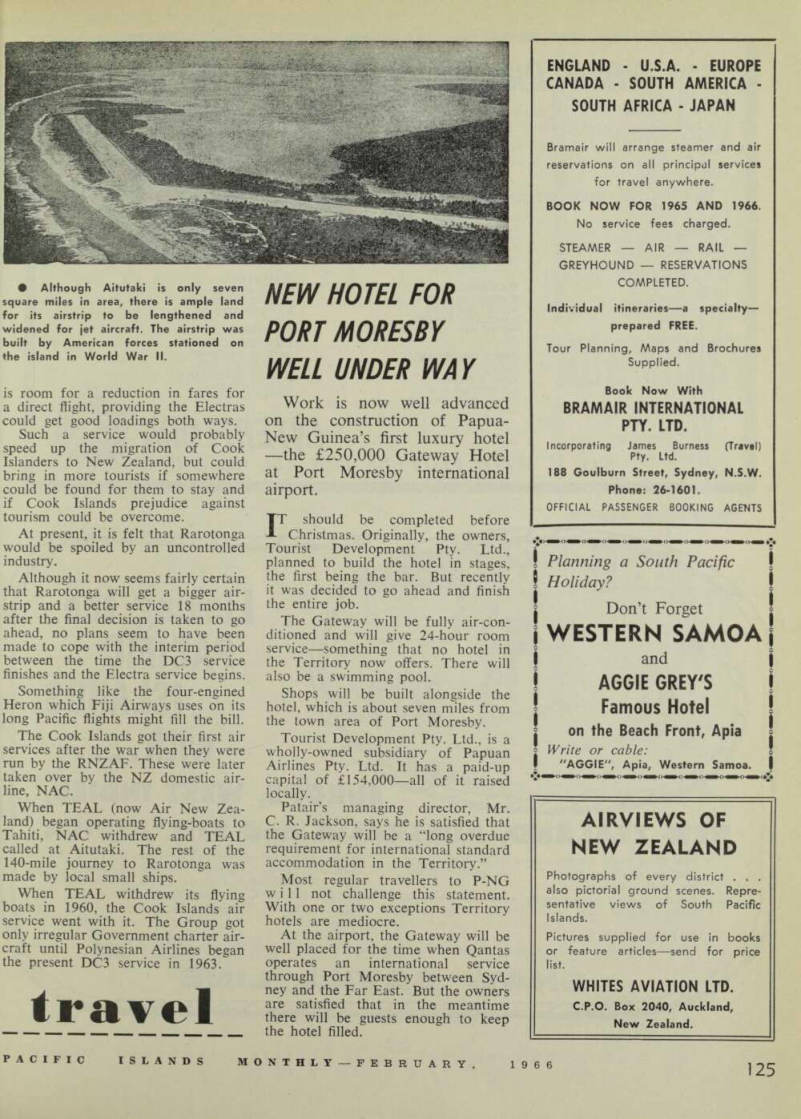
Another solution is to bring the Aitutaki strip up to jet standards—at an estimated cost of £NZ2i million— and use a smaller aircraft for the 140 miles between there and Raro tonga.
If a jet strip were built at Raro tonga, it would take up a large slice of land now used for dwellings and gardens. This idea is unpopular and the Government is adamant that it should not be put into effect.
Even widening the strip for Electras would require the removal of some coconut trees and dwellings.
It was promised in December that the people concerned would be con sulted about this as soon as possible.
If an Electra strip were built, it would bring Auckland within 4\ hours of Rarotonga and fares also could be reduced.
At present, the airstrip to Auck land is spread over three days—DC 3 to Apia where passengers stay two nights, and a flight to Pago Pago next morning to join Air New Zealand.
The fare is about £NZ72.
As the distance from Rarotonga to Auckland is about 1,600 miles, there
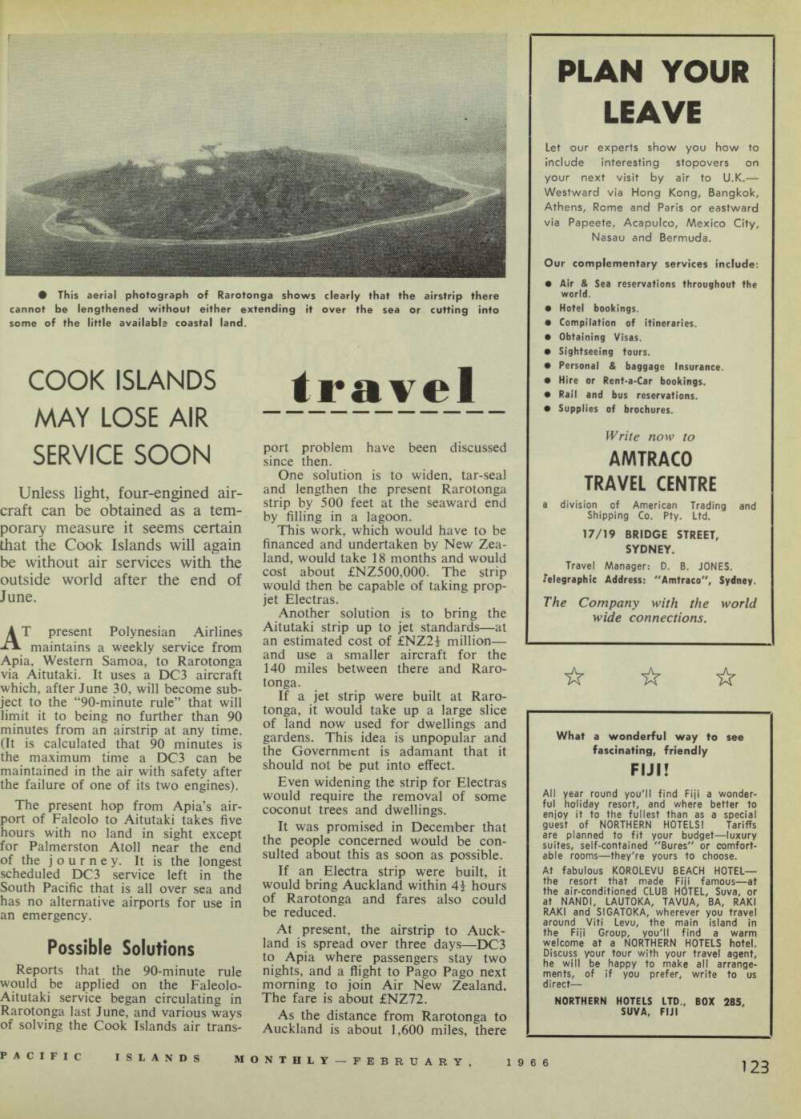
This aerial photograph of Rarotonga shows clearly that the airstrip there cannot be lengthened without either extending it over the sea or cutting into some of the little available coastal land.
is room for a reduction in fares for a direct flight, providing the Electras could get good loadings both ways.
Such a service would probably speed up the migration of Cook Islanders to New Zealand, but could bring in more tourists if somewhere could be found for them to stay and if Cook Islands prejudice against tourism could be overcome.
At present, it is felt that Rarotonga would be spoiled by an uncontrolled industry.
Although it now seems fairly certain that Rarotonga will get a bigger air strip and a better service 18 months after the final decision is taken to go ahead, no plans seem to have been made to cope with the interim period between the time the DC3 service finishes and the Electra service begins.
Something like the four-engined Heron which Fiji Airways uses on its long Pacific flights might fill the bill.
The Cook Islands got their first air services after the war when they were run by the RNZAF. These were later taken over by the NZ domestic air line, NAC.
When TEAL (now Air New Zea land) began operating flying-boats to Tahiti, NAC withdrew and TEAL called at Aitutaki. The rest of the 140-mile journey to Rarotonga was made by local small ships.
When TEAL withdrew its flying boats in 1960, the Cook Islands air service went with it. The Group got only irregular Government charter air craft until Polynesian Airlines began the present DC3 service in 1963.