True Life South Seas
pp. 83-85 · Read in the full issue
Tale Had A Somerset
Maugham Ending
By a Staff Writer
The death in December of the English novelist W.
Somerset Maugham has recalled to Mr. John Eamshaw, of Sydney, how, in 1928, he figured in the grim ending of one of Maugham’s short stories—several years after the story was written.
THE story, “German Harry”, was one of Maugham’s briefer efforts. It first appeared in the American Cosmopolitan for January, 1924, and was republished in a book called Cosmopolitans.
Maugham gathered the material for the story in 1922 when he was making a leisurely journey from Indonesia to Torres Strait and back.
He heard about German Harry— he was really a Dane called Henry Evolt—when he visited Thursday Island, off the northern tip of Aus tralia. He was so intrigued by what he learned that he resolved to pay Harry a visit.
German Harry was a hermit and the last of the New Guinea beach combers. For 28 years, he had lived on Deliverance Island, a small cay, some 30 miles from the mouth of the Bensbach River, which divides West New Guinea from the Aus tralian territory of Papua.
Born at Helsingfors, Denmark, in October, 1849, he shipped before the
mast as a lad of 16 and for many years sailed the oceans of the world.
Coming to Newcastle, New South Wales, in the eighties, he joined the Austrian ship Gibraud bound for Batavia.
The ship was wrecked on Woppa Reef, Torres Strait, and German Harry finished up in Thursday Island.
There he met an old shipmate, Louis the Greek; bought a half share in his beche-de-mer boat, and fished and traded off the New Guinea coast for the next six years.
The partnership prospered. By 1890 they had established their head quarters on Deliverance Island, to where they could retire from the pest and fever-ridden coast, and also be safe from the fierce Tugeri head hunters who made periodic forays along the coast from West New Guinea.
For another nine years all went well until another adventurer came to the island to work for them. This
was “Joe Austen”, or Joseph Augustin de Paoli.
He was a Corsican soldier of fortune who had fought in the Crimean and Franco-Prussian Wars; had joined the Communist uprising in Paris in 1871; and had been arrested and exiled to New Cale donia. However, on the voyage to New Caledonia, he escaped from the transport at Melbourne, and from there began a wandering life in the Pacific which eventually took him to Deliverance Island.
Partnership Broken
His advent at Deliverance broke up the partnership between German Harry and Louis the Greek, for one night he decamped with their boat loaded with turtle shell and other trade, and sold the lot in Thursday Island.
After this bitter blow Louis the
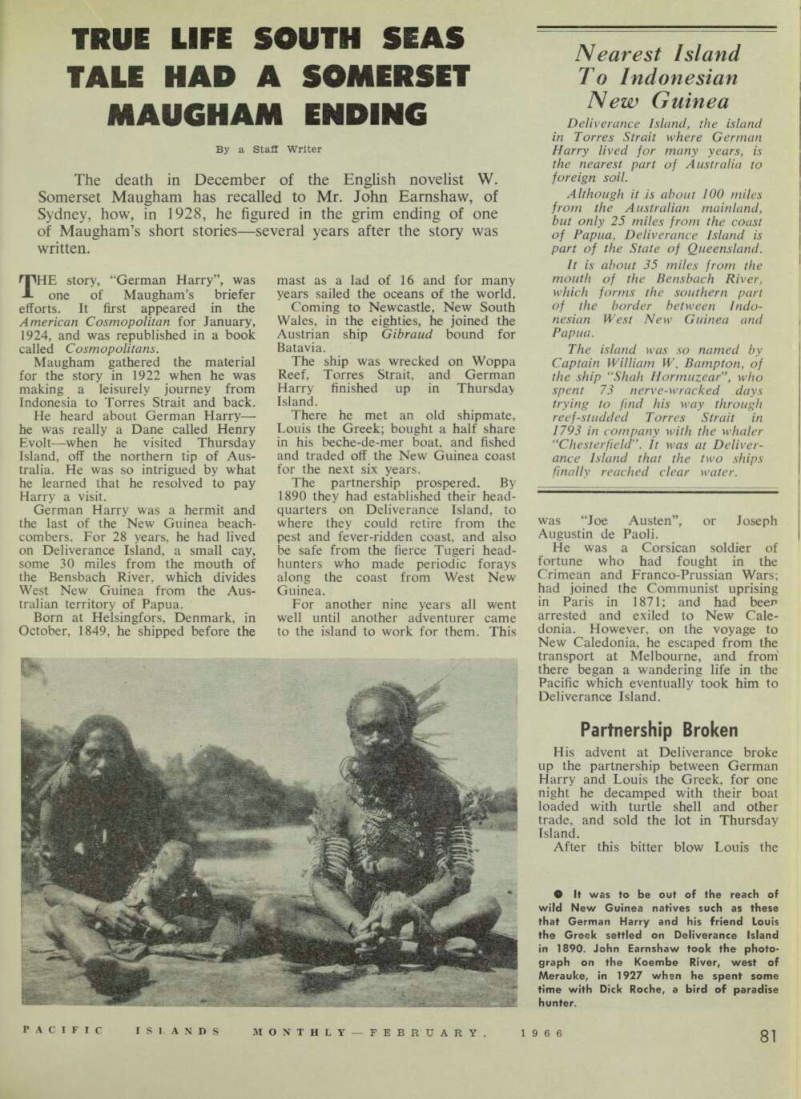
It was to be out of the reach of wild New Guinea natives such as these that German Harry and his friend Louis the Greek settled on Deliverance Island in 1890. John Earnshaw took the photo graph on the Koembe River, west of Merauke, in 1927 when he spent some time with Dick Roche, a bird of paradise hunter.
Greek drifted away, and German Harry was left alone on the island.
Except for a few months spent in Thursday Island in 1912, his solitude was almost unbroken for the next 28 years. In later years his greatest fear was that authority might wrest him from his little island and send him to the frightening care of a home for the aged near Bris bane.
He was therefore always sour and suspicious when strangers arrived at Deliverance, and it was thus that Maugham found him when he reached the island in 1922 in a lugger that he had chartered in Thursday Island to carry him across the island studded waters of Torres Strait to the Dutch settlement of Merauke.
In writing of his encounter with the old hermit, Maugham also prophesied his end.
“ . . . And then I foresaw the end,” he wrote. “One day a pearl fisher would land on the island and German Harry would not be waiting for him, silent and suspicious on the water’s edge.
“He would go up to the hut and there, lying on the bed, unrecognis able, he would see all that remained of what had been a man.
“Perhaps he would hunt high and low for the great mass of pearls which had haunted the fancy of so many an adventurer. But I do not believe he would find it; German Harry would have seen to it that none would discover his treasure and the pearls would rot in their hiding place.
“Then the pearl fisher would go
back to his dinghy and the island would once more be deserted by man.”
In March, 1928, some four years after Maugham’s story was published, Mr. Earnshaw called at Deliverance Island in company with the late Dick Roche, a well-known bird of paradise hunter, of Merauke.
The time of their arrival was just right for them to play a role in the German Harry story a la Maugham.
Mr. Earnshaw still vividly recalls the occasion: He says: “Dick Roche and I had spent some weeks in the swamps of the Bensbach River where ducks and geese wheeled in their countless thousands and a single shot would always bring two or three tumbling down.
“Deliverance Island, some 30 miles from the desolate mangroves of the
New Guinea coast, was to be our first stop. I looked forward to meet ing German Harry, for he was then a legend to everyone from Cooktown to Samarai.
“Roche, on his twice-yearly trips to the civilisation of Thursday Island, had regularly called at the island and for long periods was its only visitor.
“With little kindnesses he had gradually won the confidence and friendship of old Harry and in this way learnt of his early wanderings and long years of solitude.
“It was only after a hard day’s plug against the bustling South-East trade wind that we reached the welcome shelter of Deliverance Island.
“The island, half a mile or so in circumference, is ringed with a beach of white coral sand, crowned with coconut palms, and surrounded by a wide fringing reef.
“It looked the veritable coral island from a boyhood adventure book.
No Sign Of Harry
“But on the beach we could see no sign of German Harry—only a white mongrel dog running back and forth in an ecstasy of welcome.
“It was with deep foreboding that we rowed ashore to where a huge solitary fig tree spread its sheltering branches over the several little huts that made up Harry’s home.
“With the pink-eyed dog still tumbling at our feet, we walked into the deep shade beneath the tree.
“There, in the open close of a smoke-blackened kitchen, was a rude
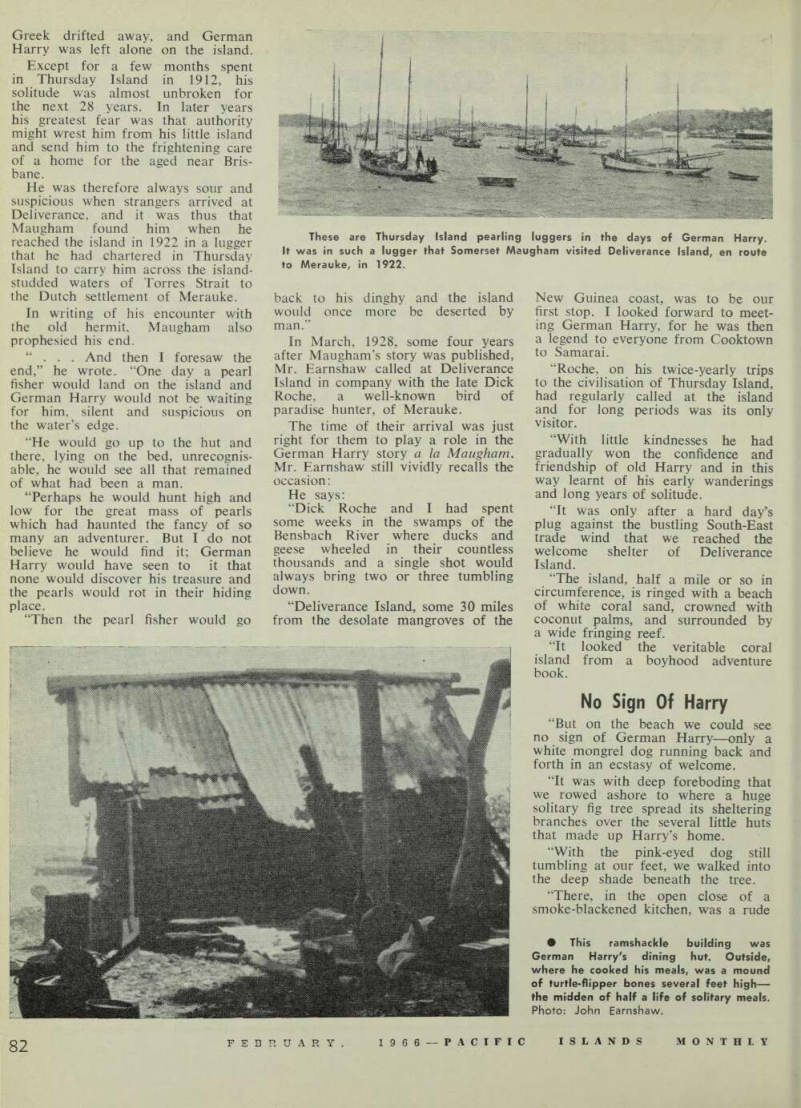
These are Thursday Island pearling luggers in the days of German Harry.
It was in such a lugger that Somerset Maugham visited Deliverance Island, en route to Merauke, in 1922.
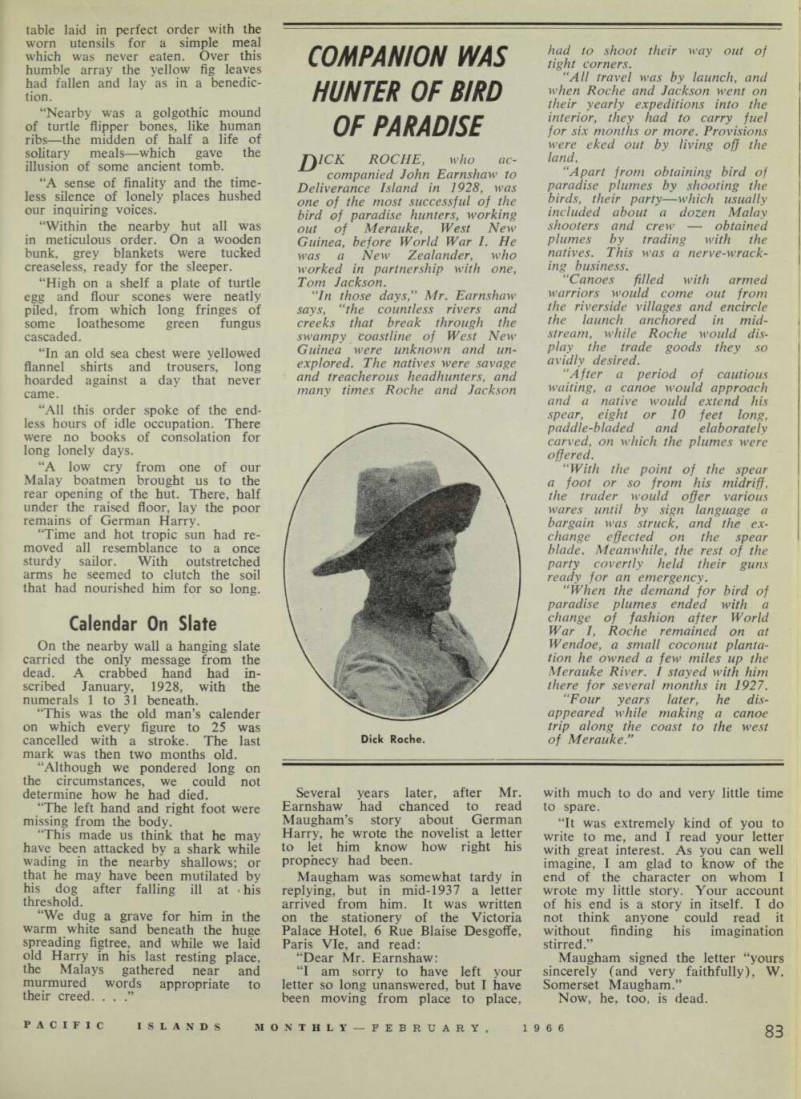
This ramshackle building was German Harry's dining hut. Outside, where he cooked his meals, was a mound of turtle-flipper bones several feet high— the midden of half a life of solitary meals.
Photo: John Earnshaw.
table laid in perfect order with the worn utensils for a simple meal which was never eaten. Over this humble array the yellow fig leaves had fallen and lay as in a benedic tion.
“Nearby was a golgothic mound of turtle flipper bones, like human ribs—the midden of half a life of solitary meals—which gave the illusion of some ancient tomb.
“A sense of finality and the time less silence of lonely places hushed our inquiring voices.
“Within the nearby hut all was in meticulous order. On a wooden bunk, grey blankets were tucked creaseless, ready for the sleeper.
“High on a shelf a plate of turtle egg and flour scones were neatly piled, from which long fringes of some loathesome green fungus cascaded.
“In an old sea chest were yellowed flannel shirts and trousers, long hoarded against a day that never came.
“All this order spoke of the end less hours of idle occupation. There were no books of consolation for long lonely days.
“A low cry from one of our Malay boatmen brought us to the rear opening of the hut. There, half under the raised floor, lay the poor remains of German Harry.
“Time and hot tropic sun had re moved all resemblance to a once sturdy sailor. With outstretched arms he seemed to clutch the soil that had nourished him for so long.
Calendar On Slate
On the nearby wall a hanging slate carried the only message from the dead. A crabbed hand had in scribed January, 1928, with the numerals 1 to 31 beneath.
“This was the old man’s calender on which every figure to 25 was cancelled with a stroke. The last mark was then two months old.
“Although we pondered long on the circumstances, we could not determine how he had died.
“The left hand and right foot were missing from the body.
“This made us think that he may have been attacked by a shark while wading in the nearby shallows; or that he may have been mutilated by his dog after falling ill at -his threshold.
“We dug a grave for him in the warm white sand beneath the huge spreading figtree, and while we laid old Harry in his last resting place, the Malays gathered near and murmured words appropriate to their creed, . . .”
Several years later, after Mr.
Earnshaw had chanced to read Maugham’s story about German Harry, he wrote the novelist a letter to let him know how right his prophecy had been.
Maugham was somewhat tardy in replying, but in mid-1937 a letter arrived from him. It was written on the stationery of the Victoria Palace Hotel, 6 Rue Blaise Desgoffe, Paris Vie, and read: “Dear Mr. Earnshaw; “I am sorry to have left your letter so long unanswered, but I have been moving from place to place,
with much to do and very little time to spare.
“It was extremely kind of you to wr i te to me, and I read your letter with great interest. As you can well imagine, I am glad to know of the end of the character on whom I wrote my little story. Your account of his end is a story in itself. I do not think anyone could read it without finding his imagination stirred.”
Maugham signed the letter “yours sincerely (and very faithfully), W.
Somerset Maugham.”
Now, he, too, is dead.