Bright Future
pp. 63-65 · Read in the full issue


For The Man From Pari?
In 1962, Dr. John Gunther, then the only Assistant Administrator of Papua and New Guinea (now there are two) selected a young (aged 27) Papuan named Gala Gala Rarua as his administrative assistant.
THIS appointment of a Papuan to what could well be a key posi tion in the Public Service aroused little interest, except among a few close observers of the Papuan scene.
Their impression that the young man selected must have been one of con siderable talents has been borne out by his career over the past three or four years.
Since his appointment he has chalked up the following achieve ments: • Two attendances at 1.L.0. Con ferences—one at Melbourne in 1962 and the other at Geneva in June, 1965, • Served for over a year as an executive assistant to the Com mittee on Higher Education in Papua and New Guinea. • Served on the committee organis ing the Territory team for the Empire Games at Perth a couple of years ago, • President of the Papua and New Guinea Workers’ Association since its inception, earning a high reputation with employers and employees as a negotiator and a conciliator. • An unsuccessful (and unlucky) candidate for the House of Assembly elections in 1964. • Formed, last August, the New Guinea United National Party, of which he is the president.
These are unusual achievements for a New Guinea man who only turned 31 last June; and it is no wonder that in the past few months or so he has become the most dis cussed man in the Territory.
Schooling Interrupted
What manner of man is he? Who are the people who have influenced him and moulded his thoughts and opinions? What does the future hold for him?
He was born in mid-1934 at Pari, a fishing village some 10 miles east of Port Moresby. Many people in correctly think he was born in Hanuabada, He has many links with Hanuabada through his parents.
He was a bright young boy of seven, when Japanese bombs first fell on Port Moresby, and like all his contemporaries his schooling was in terrupted during the war. But by 1946, when he was only 12 years of age, he had already impressed his teachers at the LMS primary school
he attended, and he went on to finish at the Sogeri Secondary School, the only place of its kind then in the Territory and where only the brightest pupils were accepted.
He qualified as a school teacher and in all spent six and a half years with the Education Department, in cluding a spell as an instructor at the Posts and Telegraphs Training Centre and a year abroad under the auspices of the Moral Rearmament Movement, which was particularly strong among Protestant Papuans a few years ago.
Now at 31 he is a tall (5 feet 10 inches) sturdily built, open faced man who gives an instant impression of toughness, both mental and physical.
Australian Accent
He is a fluent speaker of English with a pleasant Australian accent, but he is not a word spinner like John Guise or a platform orator like Matthias Tollman.
His manner is quiet and restrained yet there is a distinct impression of hidden fire and energy in his speech and his movements. He is a polite and receptive listener, but there is nothing of the obsequiousness, or “oibe taubada” or “Yes Sir Masta” attitude which characterises many so called P-NG political and economic “leaders”.
He shows definite signs of being able to sort the wheat from the chaff, as witness his realistic assessment of many of the white people who sought to jump on to his band wagon as soon as the new party’s formation was announced.
“Opportunists, who have no real interest, save their own, in the development of our country,” he
Personality Parade
recently confided to a senior officer in the Administration, He is a man of dignity of spirit and courage as was illustrated when he gave up his very promising career in the Public Service, because he wanted to devote all his energy and talent to the new party.
Mentors
It is obvious that he owes much to that redoubtable and remarkable man, Dr. Gunther. From him he has learnt the power of command and decision. Like him, he is impatient of red tape and restrictive Public Service procedures. But unlike his mentor, he is patient and he can allow a situation to mature.
He shows signs also, of being a better politician than the doctor (who, incidentally, is very good) and he is determined never again to suffer the humiliation he experienced when, through a split in the Motuan vote, he was defeated by an unknown Goilala for the Moresby open elec torate. He is content to wait for the inevitable re-drawing of electoral boundaries before he essays another attempt at membership of the House.
But Dr. Gunther has not been his sole mentor. Several highly placed Australian academics, including, so it is rumoured. Professor Henry Mayer, the political scientist from Sydney University and Peter Hastings, the Sydney journalist and writer, have assisted him. In Port Moresby, he
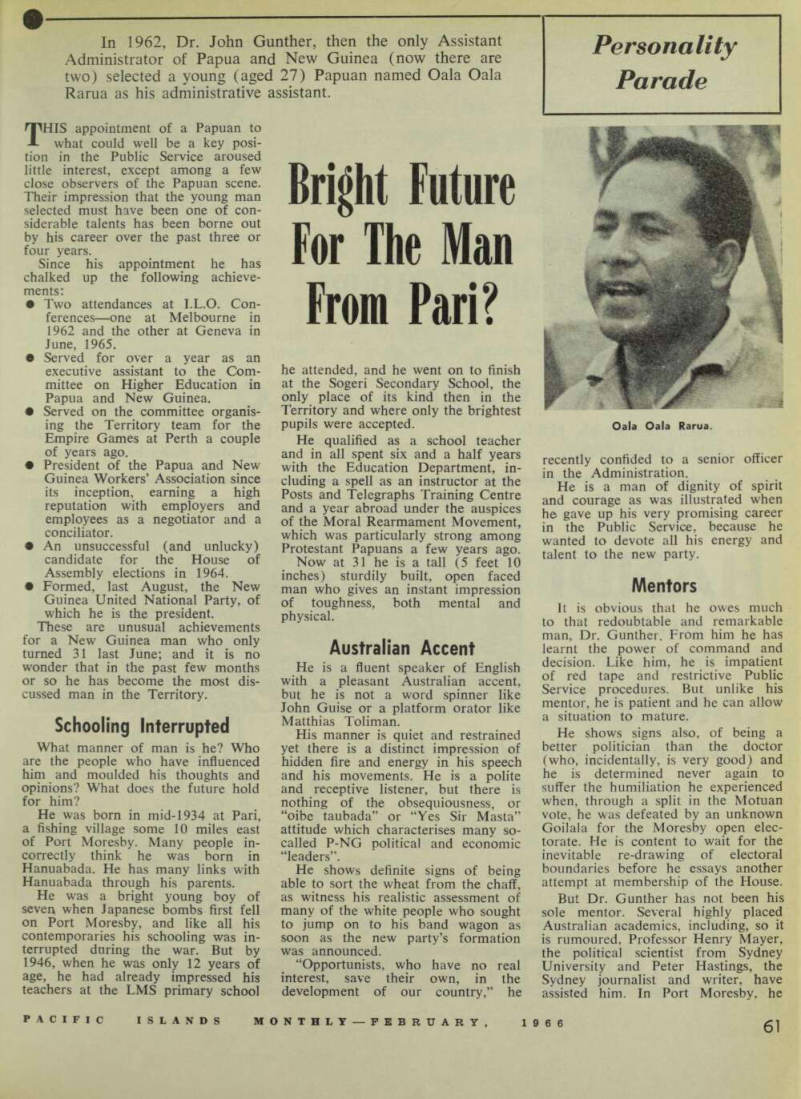
Oala Oala Rarua.
has been friendly with Australians in the Law Department and the Public Solicitor’s Office. The formidable David Fenbury, Secretary to the Administrator’s Department, has always been well disposed towards him.
His prospects for the future are bright. He appeals to two very significant groups in the Territory; the young educated elite—the doctors, teachers, public servants and so on; and the workers whose cause he has espoused and for whom he has suc cessfully negotiated substantial wage increases.
His main drawbacks at the moment are threefold; (1) a certain diffidence (which he will overcome) to travel to the other side of the Territory and make himself known to New Guineans, (2) the presence, on the fringes of his party of a few “ratbag” types (both white and brown) which he has not yet got round to getting rid of, and (3) the party’s lack of money.
Here an interesting development has been noticed. A number of large and wealthy Territory business organisations have made their own assessment of Gala and they have been encouraged by his good sense and restraint. Following the principle of their Australian counterparts, these firms are seeking to make con tributions to the new party, partly as a sort of insurance policy, but largely because they can appreciate, as hard-headed realists, the worth and value of a party such as the one Gala is sponsoring. When these con tributions come in, his financial difficulties might be over.
Gorohauve