Territories TALK-TALK
pp. 55-59 · Read in the full issue
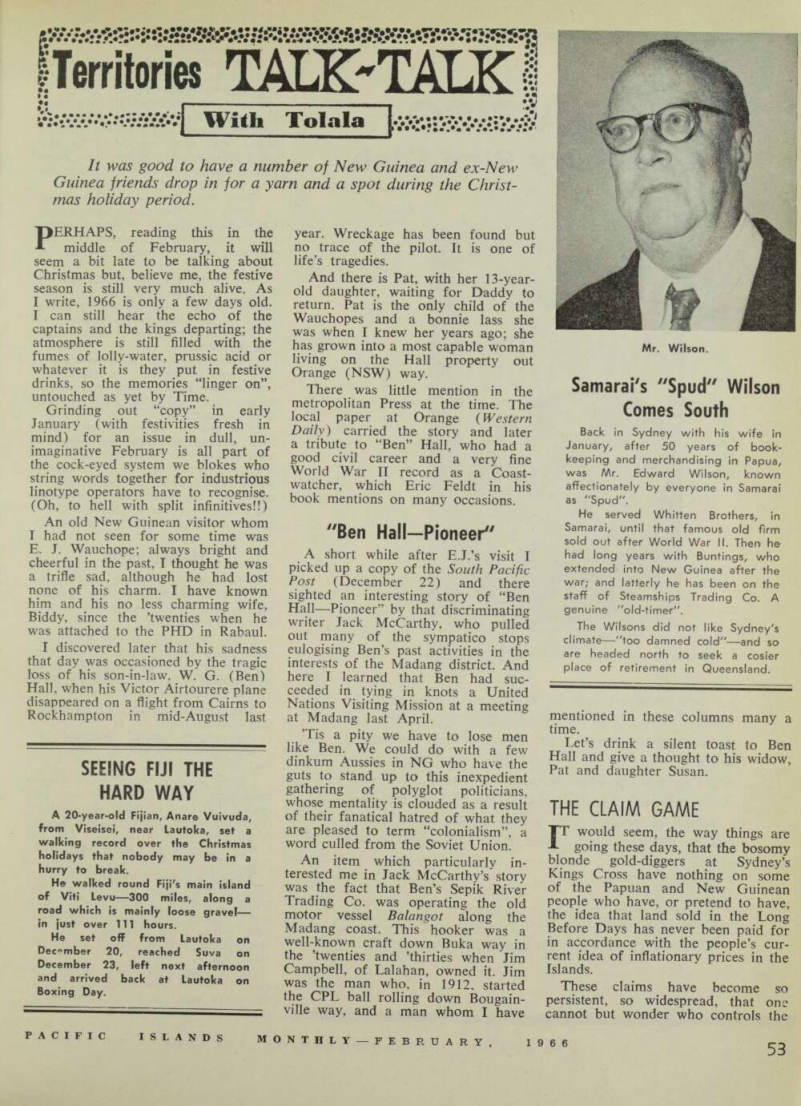

With Tola la
It was good to have a number of New Guinea and ex-New Guinea friends drop in for a yarn and a spot during the Christ mas holiday period.
PERHAPS, reading this in the middle of February, it will seem a bit late to be talking about Christmas but, believe me, the festive season is still very much alive. As I write, 1966 is only a few days old.
I can still hear the echo of the captains and the kings departing; the atmosphere is still filled with the fumes of lolly-water, prussic acid or whatever it is they put in festive drinks, so the memories “linger on”, untouched as yet by Time.
Grinding out “copy” in early January (with festivities fresh in mind) for an issue in dull, un imaginative February is all part of the cock-eyed system we blokes who string words together for industrious linotype operators have to recognise. (Oh, to hell with split infinitives!!) An old New Guinean visitor whom I had not seen for some time was E. J. Wauchope; always bright and cheerful in the past, I thought he was a trifle sad, although he had lost none of his charm. I have known him and his no less charming wife, Biddy, since the ’twenties when he was attached to the PHD in Rabaul.
I discovered later that his sadness that day was occasioned by the tragic loss of his son-in-law. W. G. (Ben) Hall, when his Victor Airtourere plane disappeared on a flight from Cairns to Rockhampton in mid-August last
year. Wreckage has been found but no trace of the pilot. It is one of life’s tragedies.
And there is Pat, with her 13-year old daughter, waiting for Daddy to return. Pat is the only child of the Wauchopes and a bonnie lass she was when I knew her years ago; she has grown into a most capable woman living on the Hall property out Orange (NSW) way.
There was little mention in the metropolitan Press at the time. The local paper at Orange {Western Daily ) carried the story and later a tribute to “Ben” Hall, who had a good civil career and a very fine World War II record as a Coast watcher, which Eric Feldt in his book mentions on many occasions.
"Ben Hall—Pioneer"
A short while after E.J.’s visit I picked up a copy of the South Pacific Post (December 22) and there sighted an interesting story of “Ben Hall—Pioneer” by that discriminating writer Jack McCarthy, who pulled out many of the sympatico stops eulogising Ben’s past activities in the interests of the Madang district. And here I learned that Ben had suc ceeded in tying in knots a United Nations Visiting Mission at a meeting at Madang last April. ’Tis a pity we have to lose men like Ben. We could do with a few dinkum Aussies in NG who have the guts to stand up to this inexpedient gathering of polyglot politicians, whose mentality is clouded as a result of their fanatical hatred of what they are pleased to term “colonialism”, a word culled from the Soviet Union.
An item which particularly in terested me in Jack McCarthy’s story was the fact that Ben’s Sepik River Trading Cos. was operating the old motor vessel Balangot along the Madang coast. This hooker was a well-known craft down Buka way in the ’twenties and ’thirties when Jim Campbell, of Lalahan, owned it. Jim was the man who, in 1912, started the CPL ball rolling down Bougain ville way, and a man whom I have
mentioned in these columns many a time.
Let’s drink a silent toast to Ben Hall and give a thought to his widow, Pat and daughter Susan.
The Claim Game
TT would seem, the way things are A going these days, that the bosomy blonde gold-diggers at Sydney’s Kings Cross have nothing on some of the Papuan and New Guinean people who have, or pretend to have, the idea that land sold in the Long Before Days has never been paid for in accordance with the people’s cur rent idea of inflationary prices in the Islands.
These claims have become so persistent, so widespread, that one cannot but wonder who controls the
master mind behind the scheme. Who is Big Brother?
Why don’t they organise a whole sale claim of all alienated native land and be done with it?
The claim game started with private properties; lately it has shifted to both Methodist and Catholic mission lands; and now, according to the latest Press reports, claims have been lodged against the Administration for land in Port Moresby and Lae.
There must be a weak link along the chain of justice somewhere, which has been discovered by some super eager legal eagle (probably an ex patriate) and it is being worked flat out.
And what are the Land Board Inquiry Commissioners to do, poor things? What with all the yapping pack of anti-colonialist Asians and Africans in the United Nations, what can they do?
Would it be too much to suggest the appointment of a Research Council to unearth old-time docu ments connected with New Guinea land transactions?
It would be far more profitable than putting a couple of sputniks, satellites or whatever they are into space to prove all sorts of things which won’t alter the price of fish one iota. Asa starting point for inquiries I would suggest the New Guinea Club in Hamburg (Germany).
Unbelievable
It seems unbelievable that some record of a purchase or sale of land under government supervision is not available somewhere.
Public servants in all countries have an irritating habit of denying the existence of any recorded transac tion unless they can actually turn up the documents in their own files.
And what about racial discrimina tion at these inquiries? Is there none?
Is the uncorroborated statement of a non-native accepted as readily as that of a native?
I often wonder, too, if Land Com missioners and people of that ilk realise that land disputes, and claims for fishing and hunting rights are a dominating part in the very life of a New Guinean, and have been since long, long ago.
When life became monotonous and uninteresting: the tuna were not biting, the gardens were planted, all leaky canoes had been mended and most wives were pregnant, then an enterprising villager would start the claim game.
Next thing you knew it was a case of spears and stone clubs and the party was on. . . . Then came captives, tortures, feasts. . . .
And now, as ever, history repeats itself; the captives are the unsuc cessful litigants; the torture; extract ing the costs of those litigants from the Australian taxpayer, and the feasts: feeding those costs to the super-eager legal eagles.
The claim game will not cease even when the inquitous Pale Face has folded his wigwam and departed hence.
First Planes
OF late I have received a number of inquiries from readers as to the date of the first mail-carrying aeroplane in New Guinea. Most of the inquirers are philatelists.
The authority on this particular subject, of course, is Basil Challis, philatelist, photographer and NG pioneer.
Incidentally, Basil and his charming wife have deserted the serene atmosphere of Adelaide for the garish lights of Surfers Paradise, on Queensland’s Gold Coast.
The first commercial planes were flying in 1927; but, to my knowledge, the first planes ever to take to the New Guinea air were in 1923, about April or May, I think it was, when the US warships (one, Milwaukee) made a goodwill visit to Rabaul.
They anchored snugly in its glorious harbour and during the second day sent three or four small planes aloft for experimental purposes, so I was told.
The talk went round that, owing to atmospheric conditions, flying would be OUT in this area—“quite im possible,” as the fuel mixture didn’t function properly!
Fortunately, someone later on must have blown down the “phuphu” valve and made the mixture right, for a few years later NG planes
established world records for carrying aer . ial , freight.
And this reminds me of another dogmatic verdict given in Rabaul in the early thirties and which has since been exploded. Automatic telephones, said the Oracle, could never be installed in Rabaul on account of the atmospheric conditions, which would gum up the works in some way.
Rabaul certainly was a bit leisurely in its march along the road of progress. One reason I suspect now (though at the time it did not occur to me) was the tight budget on which the Territory was working during the late ’twenties and early ’thirties.
It was much the same as Britain’s when Churchill told his Ministers in Cabinet, who were clamouring for more finance: “Same old story, too many little pigs and not enough teats onold s ? w / , , That was before the days of lavish grants from the Australian taxpayer.
There were certainly not enough teats on the old sow in those days when Treasurers Daily or Townsend worked out a balanced budget each year— even showing a surplus sometimes.
For instance, in Rabaul, until 1932, there was no electricity system. Those establishments able to afford electric light had installed their own individual lighting plants for club, store or private residence. For the majority it was a case of the old-time pressure lamp: the good old Tilley, the humble kerosene lamp and the übiquitous “lamp walkabout”—usually the old Dietz brand.
This particular brand was placed in the somewhat elaborate street light posts at the corner of the streets in the German time. I remember a German officials telling me once the hurricane lamps were not locked to the standards, and yet were seldom stolen.
Times change: No native could
afford to be so prosperous as to afford a Dietz lantern in German days. And now the lanterns would be just as safe with the present people.
Who would be seen with an old “lamp walkabout” when there are torches, fluorescent lighting and electricity to be had, thank you very much? (“You-me all one-time ’long Masta Jones, laka?”)
A Line Of Willow
Wielders
CRICKET fans in the Kokopo area will know that Tom Garrett 111 is a capable wielder of the willow.
Little wonder for it is an hereditary accomplishment.
His father, Tom II hit many a sixer on the pre-war Kokopo sports ground—or for that matter wherever he played.
Tom II was lost in Montevideo Maru, worse luck. He was a good cove. He came up for the Expro board as a plantation man in 1921 and later on acquired Varzin planta tion.
But Tom IPs father was the daddy of the lot. He played in the first England-Australia match at Mel bourne in March, 1877. He was 18 years old at the time. Later in life he became well-known as Public Trustee for NSW.
Saviours Of The
Pacific
Sorting out a pile of pamphlets, Government hand-outs and the like the other day I came upon an old issue of the Territories Department’s Australian Territories of March, 1965 (I received it on December 20, but that is beside the point).
It contained an informative story about the Coastwatchers in New Guinea during World War 11, the wonderful work they performed, and “Bull” Halsey’s tribute that they “had saved Guadalcanal and Guadalcanal saved the Pacific”. The story was written by C. J. Coady, of the Aus tralian War Museum.
Here are some interesting figures he gave: Coastwatchers were credited with causing 5,414 enemy deaths, wounding 1,492, and capturing 74.
Thirty seven European Coastwatchers were killed, two were captured and survived; and 20 native helpers were killed and 40 were captured. Coast watchers rescued 321 shot-down air men, 280 naval personnel from sunken ships, and 190 civilians. They received 58 decorations, and each one was well deserved, as you well know.