Perry Mason Plans
pp. 35-37 · Read in the full issue
With The Case Of Naitauba Island Settled . . .
Perry Mason Plans To Quit Law For Life In Lau
Prom a Suva Correspondent Most Kai Vitis are flattered that Mr. Raymond Burr (better known to millions of fans all over the world as the TV lawyer
Perry Mason) thinks enough of
the Fiji Group to buy Naitauba,
one of the islands of northern Lau.
BUT there is regret, too, that this will inevitably mean the end of the Hennings family’s association with Lau. They have been associated with that archipelago back through the generations for over 100 years.
Naitauba is of composite forma tion, three square miles in area and 610 feet in elevation at the centre. It is about 20 miles from Vanua Balavu and 180 from Suva. It is run as a coconut plantation and in a good year can produce upwards of 300 tons.
The plantation was run by a family company. Since the death of Mr. Gus Hennings in 1955, his widow, Mrs.
Elizabeth Hennings, and their three daughters have been the main share holders.
The family’s link with Fiji goes back to William Hennings, born in Bremen, Germany, in 1837. He
arrived in Fiji in 1860 via the gold fields of Victoria.
On a visit to Sydney, he met Mr.
Caesar Godeffroy, of the famous Hamburg firm that was primarily re sponsible for coconut planting in the South Seas and for the German in terest in colonisation that followed.
Godeffroy encouraged Hennings to go to Levuka, Fiji, where he repre sented the big firm for a while; but soon William and his three brothers who followed him were interested in trading on their own account and in cotton-growing on a number of the islands of the Lau Archipelago.
Cotton Slump
Cotton boomed until 1870, by which time the American Southern States were recovering from the Civil War. William Hennings and his brothers lost heavily in the cotton slump that followed and for the next 18 years, William became a copra merchant in Levuka.
The financial troubles in 1889 of Baring Brothers, of London, and Godeffroy, of Hamburg, came close to ruining him again, and for the remainder of his life he lived as a planter, mostly on the Lau island of Katafaga.
To William Hennings is given the credit for getting together Maafu, the Tongan who was all-powerful in eastern Fiji, and Cakobau, self-styled King of Fiji.
They had, with reason, been mutually antagonistic, but due to Hennings’ good offices, Maafu became a minister in Cakobau’s short-lived government. This led, in 1874, to the
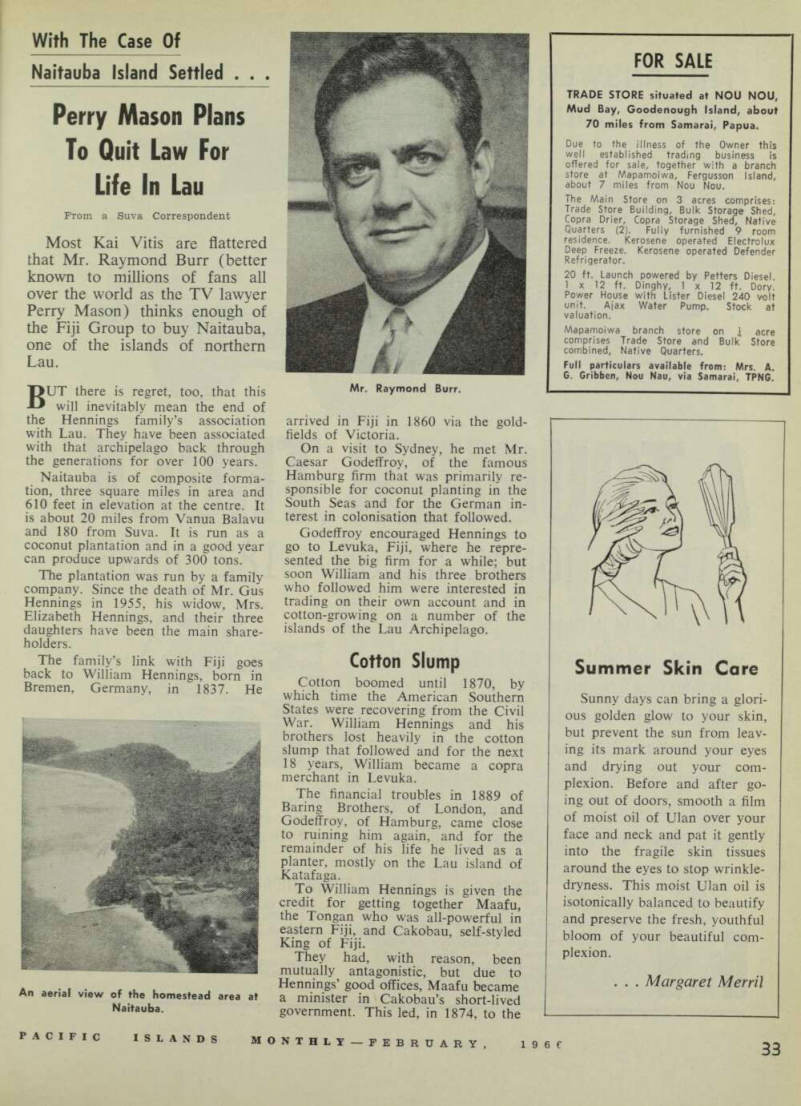
An aerial view of the homestead area at Naitauba.
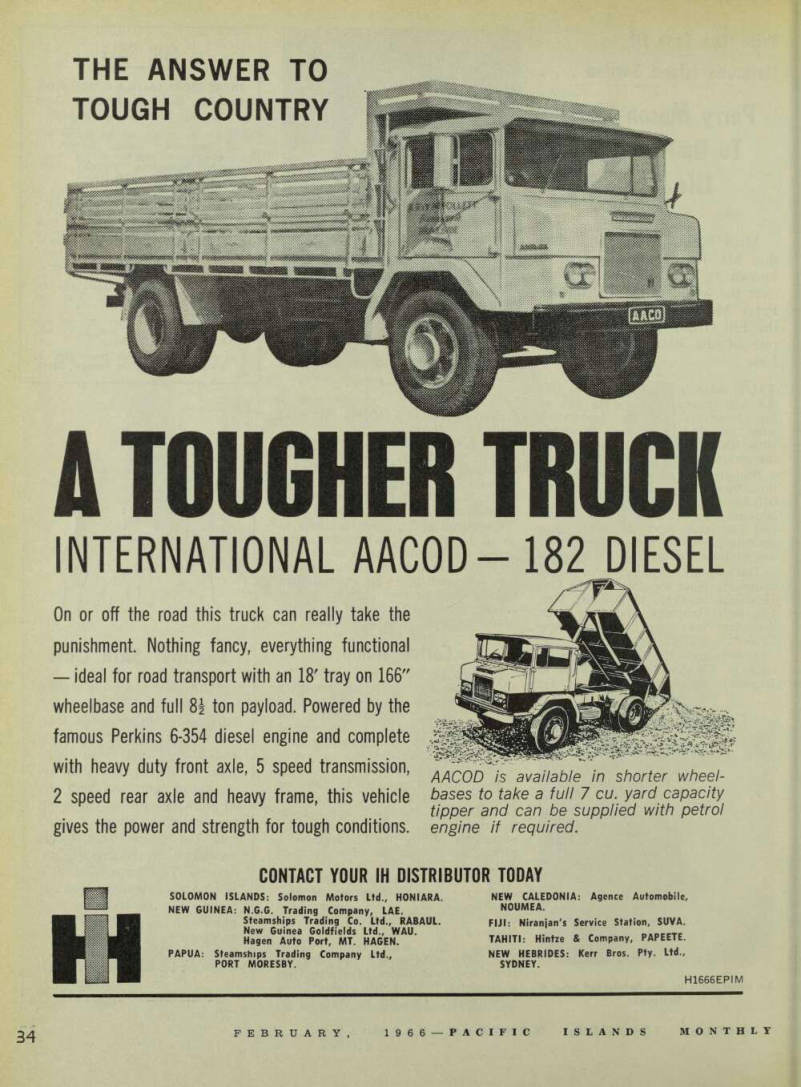
Mr. Raymond Burr.
cession of Fiji to Great Britain by the Cakobau and the chiefs.
William Hennings married a Lauan girl, Adi Meri, daughter of Ratu Mara, a famous chief in his day.
Mr. Gus Hennings, who died at Naitauba in 1955, was their son.
Gus brought a bride back from Germany just before World War I.
She is the present Mrs. Elizabeth Hennings who, since the death of her husband, has supervised the planta tion work on Naitauba almost single handed.
Naitauba has, in fact, been her whole life for over 40 years. She knows every inch of it, its debits and credits, its isolation, its loneliness and its compensating joys.
It is hard, indeed, to imagine Naitauba without Elizabeth Hennings.
Or Elizabeth Hennings without Naitauba. The social round of Suva, or wherever she chooses to settle, will seem pretty tame in comparison. Of all the remarkable women the Pacific has bred or shaped, she must come pretty near the top of the list.
Naitauba was put up for sale in early 1963 through London brokers who were then asking £Stg.7o,ooo for the property. The actual buying price has not been disclosed.
Mr. Burr is apparently working in partnership with other Californian friends in his purchase. One of these is Miss Peggy Slater who was in Fiji in January and later went on to Syd ney to try to buy a power boat for communication between Naitauba and other islands.
She is a famous yachtswoman in California and also is a yacht broker.
She will be a director of the new Naitauba Ltd. So will Mrs. Elizabeth Hennings and her daughter, Mrs. M.
Miller, of Suva.
As a copra plantation Naitauba has three disadvantages: The distance from Suva and dependence on small local ships for irregular communica
tions; lack of a suitable harbour; and an occasional hurricane.
But on the credit side it must be one of the last freehold island pro perties in the world. Had it not been so valuable it no doubt would have been bought back by the Native Land Trust Board —as many other freehold properties have been —in the three years since the Hennings family de cided 10 sell it.
Naitauba was once inhabited by some Fijian families, but these were cleared out before Cession by local chiefs who were then sold on the idea of having Europeans settle among them. The freehold title was con firmed early in the British adminis tration.
Mr. Burr was in Fiji during the Pacific War. He went back for a holiday visit in the middle of last year and was back again just before Christmas.
He said in Suva, before he flew north again on January 6, that he would return in April.
He plans to quit his role of Perry Mason at this time but not his interest in film-making.
Mr. Burr controls a large film com pany, Harbour Productions Ltd., which deals in anything in the enter tainment line, and he plans to make pictures, some of them with him in the lead. In Naitauba, he has a ready made film set.