Helpful In The BSIP
pp. 31-33 · Read in the full issue

More For This And Less For That Might Be Helpful In The BSIP
From Gabrielle Lawson in Honiara
With £6,201,375 available to the British Solomon Islands Protectorate for development over the next 3i years, it was suggested by the Financial Secretary at the December meeting of Legislative Council that the “Isles of Unwisdom” be now renamed the “Isles of Endeavour”.
ryTEARLY £2 million a year is not ■-Li a bad sum for this outpost of the Pacific. But whether the funds are distributed where they will do the most good is another matter.
The Government says its aim is to develop the natural and human resources of the Protectorate and strengthen its economy to enable standards to rise.
At the same time, it wants to raise the standard of education and medical services, without imposing revenue measures which would dis courage enterprise and further in vestment.
It looks pretty good on paper, but some members of the community get a little browned off when they look around at the efforts of the Public Works Department.
Four Lanes
The PWD has its moments and has done a lot of good work. But it is hard to understand why a back street should be wide enough to take four lanes of cars.
Twenty-eight miles of road were built in 1965, but one member of Legco asked in a lighter moment, whether this figure came from measuring the width and not the length!
Another four-lane drive goes past the golf course and the new King George VI School, but then it quickly peters out.
On the other hand, the Educa tion Department is doing all it can to raise the standard of education although the Missions are not satis fied.
The new King George VI School,
not yet completed, was referred to in Legco as a Honiara Hilton and the idea of four boys in a dormitory was said to be morally wrong. There are varying opinions about the change ta Honiara from Malaita for the site of the school. But obviously this is the only place for such a school. Malaita is too isolated and distant from the centre of the Pro tectorate.
To the onlooker, it would seem that the Agricultural Department should concentrate more than it does on the growing of local foods. These would be more beneficial to the local people than great rice-growing projects and the growing of soya beans.
To experiment with the growing of soya beans seems a waste of money when everyone who grew them in their gardens 10 years ago knows they grow like weeds. Moreover, the export market does not seem to justify the expense, time and labour.
As for rice, this will only put money into the pockets of big overseas com panies and will not benefit the Solomon Islands people one iota.
The small Agricultural Training College at Kukum under the direction of Mr. A. Sweeney is a step in the right direction.
One would like to see the money
spent on rice and soya beans used in making the college bigger.
At the college, Solomon Islands trainees are taught how to grow local foodstuffs, how to care for pigs, poultry and even cattle and goats.
Nothing is produced for profit.
The training school is at present only a shop window. The grounds cover some 80 acres, of which only 12 acres can be considered arable land.
The rest is mainly pasture and build ing sites.
The pastures are largely kunai and improved grassland. Unfortunately, they have reached the limits of the boundaries.
The kunai grasslands are a chal lenge to pasture improvement.
Very little is known about tropical pasture plants and under the Kukum
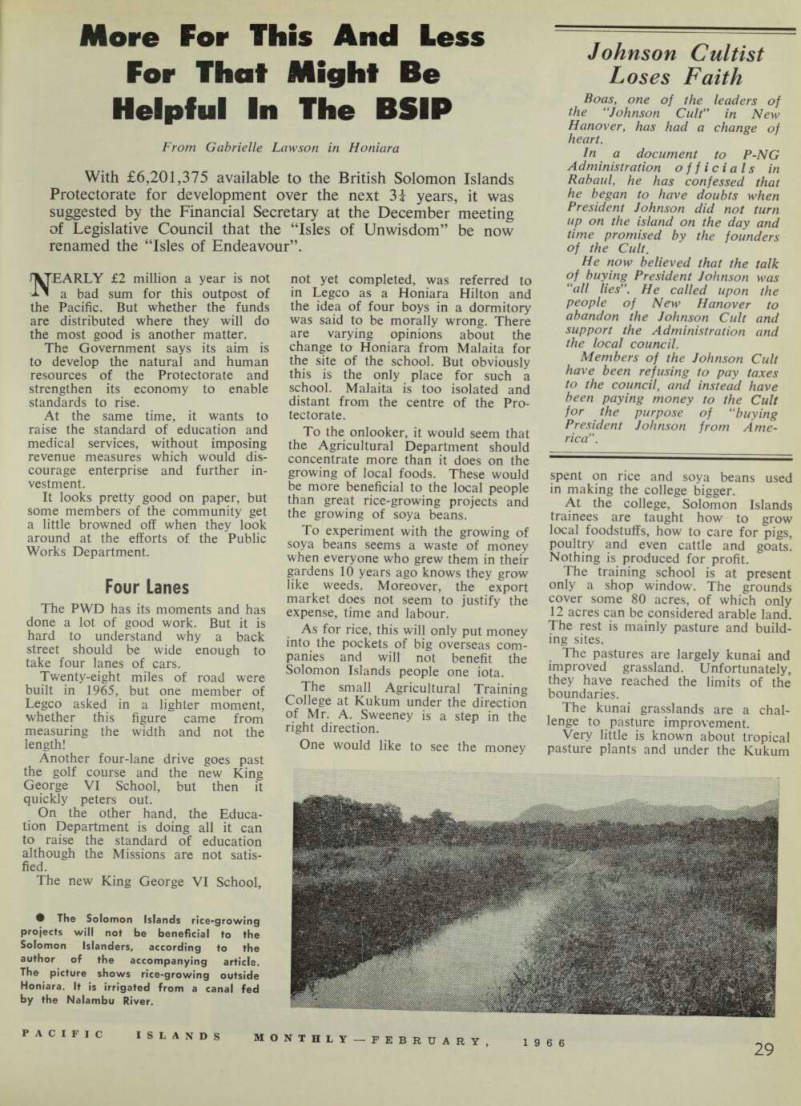
• The Solomon Islands rice-growing projects will not be beneficial to the Solomon Islanders, according to the author of the accompanying article.
The picture shows rice-growing outside Honiara. It is irrigated from a canal fed by the Nalambu River.
conditions not much more can be done.
But if this training school could go further afield, a lot more good could be done for the good of the Solomon Islanders.
Mr. Sweeney says that at present the school does not produce enough “graduates” considering the time and effort put into teaching the three year course.
Six or eight field assistants are all they have been able to offer to agri culture each year.
Only four trainees were recruited in 1965, and only two field assistants are expected to be available in 1967.
It is a depressing picture.
The Solomon Islanders should be taught and encouraged to get on with growing and producing, and get away from the idea of rice.
The Solomons could be a land of plenty, but all the average Solomon Islander wants at the moment is a bag of rice and a tin of meat.
Income Tax Bill
Meanwhile, people are still talking about the new Income Tax Bill, which came as a shock to many.
The intention of the bill was to re peal and replace the Income Tax Ordinance enacted in 1948.
When the first reading of the bill came up in Legco in December, it was explained that it provided that taxation machinery should be more in keeping with higher standards of business now prevailing and increase the spending of community activities.
However, the most controversial point of the bill concerned the tax ation of undistributed profits. The Financial Secretary said there was nothing new in that. Once profits were distributed they were liable to tax.
But the business community pointed out that undistributed profits were frequently tied up in assets and that the bill restricted business develop ment or the sale of assets. The result was an amendment to reduce the percentage of profits.
People feel that the bill went a bit too far and favours large companies with capital outside the Protectorate.
Representatives warned Legco
against the Government’s policy of victimising the small man. It was asked that the almost unrestricted powers given to the Commissioner of Tax should be administered with sympathy and understanding.
In many cases, small companies would be forced to dispose of assets to meet the tax bill which would deprive them of money to carry on, members said, and shareholders would be taxed on money they did not re ceive.
On the whole the development plan is a good one, but to the observer it would seem that a little more taken from this and put into that would perhaps do a lot more for the Pro tectorate.
The understaffed Medical Depart ment, for example, could do with more.
The housing problem has got into a state of chaos.
Government officials are being sent off on leave months before their time to make housing available.
The new Government House build ing ( PIM, Jan., p. 16) has been scrapped for the time being and the High Commissioner will continue to live in a ramshackle out-of-date build ing.
Maybe this is a good thing from the point of view of the experts, but it is not good for the morale of the Solomon Islanders who hope one day to occupy the unbuilt building.