Tropicalities
pp. 23-29 · Read in the full issue


One of the “plum” jobs in the Fiji Civil Service these days is that of the Colony's representative in Sydney.
We hear that several top officers have been angling for the post.
BUT the “hottest” beach tip is that Ratu Edward Cakobau, currently Commissioner for Fiji’s Eastern Division, will soon come to Sydney to take over.
Such an appointment would be popular in Fiji and Australia, and Ratu Edward could probably do much good for the Colony.
Ratu Edward, who is 57, is a descendant of “King” Cakobau who ceded Fiji to Great Britain in 1874.
He was educated at Oxford; he has held many prominent Govern ment posts; he has a fine record as a soldier and sportsman; and he
Hot Tip For
Fiji's Sydney
Post
is no stranger to the world outside Fiji.
He has soldiered in the Solomons and Malaya; has toured the US on a leadership grant; and has managed various Fijian sports teams overseas, including Australia.
His sparkling sense of humour has endeared him to Australians in the past.
They still tell the story of how Ratu Edward was once seated at the captain’s table of one of the P and O-Orient ships en route to England, and was being annoyed by a large woman, high in the social scale, who repeatedly insisted that Fiji must surely be uncivilised, for that “was where the cannibals came from.”
Ratu Edward could take it no longer. Turning to the steward, who had just handed him the menu, he ordered, “Take this away! Bring me the passenger list!”
The man at present keeping the seat warm in Fiji’s Sydney office is the Colony’s Deputy Accountant- General, Mr. Barney Smith.
The first man to fill the Sydney job, and fill it admirably, was Mr.
Basil Rogers. He left early in December to take up work of an entirely different nature with the South-East Arabian Federation, with headquarters in Aden.
The Fiji Government then offered the job to Mr. Howard Davidson, the Colony’s Financial Secretary from 1954 to 1958, who is living in retirement in England. He declined.
Since then the Government has discontinued recruiting officers for the Civil Service overseas, so the appointment is bound to come from within the ranks of the existing service.
Her Lesson Was
Well Learned
AT least one family on Tarawa has good cause to be grateful for the visit to the Gilbert and Ellice Islands Colony last September by Miss A.
Sopper, of the Fiji Branch of the British Red Cross. On Tarawa, Miss Sopper gave demonstrations of mouth to-mouth resuscitation and showed a film on the subject, Pulse of Life.
That her demonstrations were fol lowed with interest and intelligence was shown in January, when the method was used for the first time in the Colony and saved the life of a five-year-old girl.
The girl, Retita Takirua, fell from a reef latrine at about eight o’clock at night when the tide was high and there was no one near except her six-year-old sister, who screamed for help in the darkness.
A woman came from a nearby house and, on being told what had happened, also called for help. Some of her relatives rushed from the house and began to search for the child with torches. After about 15 minutes Kanoua Roaia, a secretariat clerk, found her as she was being washed away by the ebbing tide. She had stopped breathing and her stomach was swollen.
Luckily Kanoua’s 21-year-old sister, Neeti Roaia, a teacher who had seen
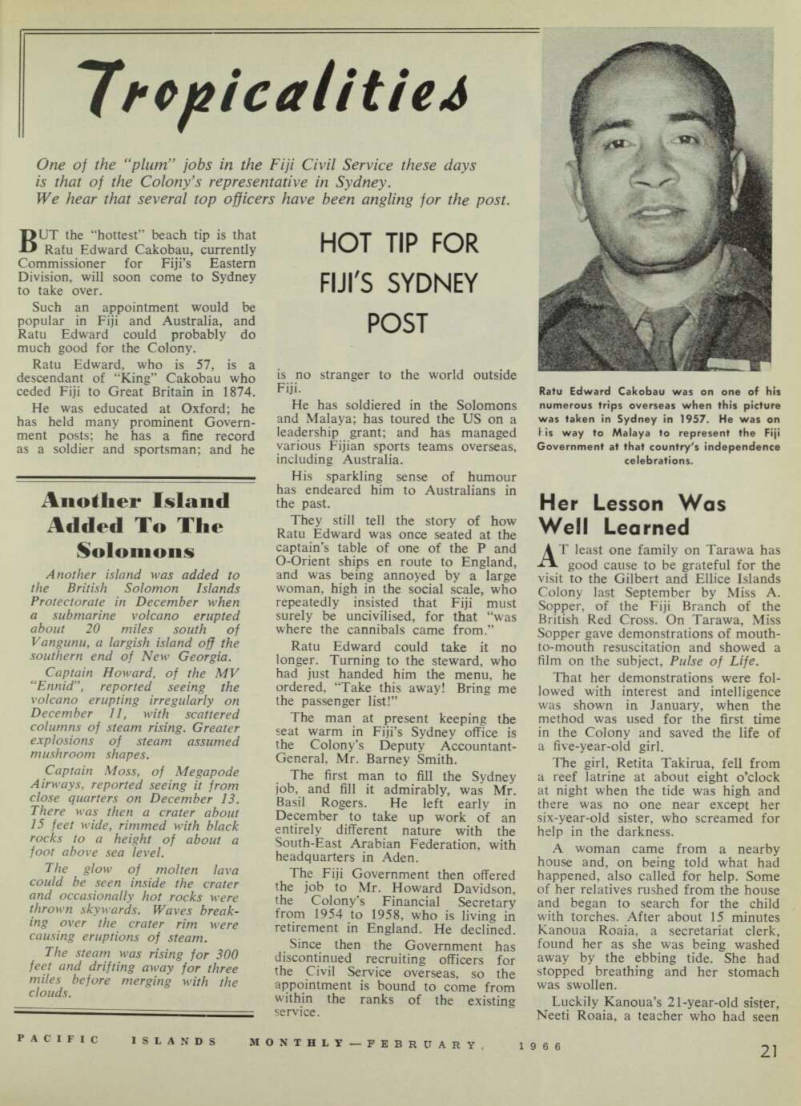
Ratu Edward Cakobau was on one of his numerous trips overseas when this picture was taken in Sydney in 1957. He was on Ms way to Malaya to represent the Fiji Government at that country's independence celebrations.
Miss Sopper’s demonstrations, was there and was able to apply mouth to-mouth resuscitation. After about five minutes, Retita began to breathe and started crying.
When the dresser, who had been called to help, arrived he said nothing remained for him to do.
Retita has now recovered from her misadventure.
Without Honour In
Their Own Country
A RECENT visitor to Fiji’s Legis lative Council, who listened with interest to the speeches about the Colony’s new constitution, tells us that he was particularly impressed by the portraits of royalty and vice royalty on the walls of the Chamber.
“Behind the Speaker’s chair there are paintings of Queen Victoria, Edward VII, Queen Alexandria, and Edward VIII, when he was a young and handsome Prince,” he reminds us. “And ranged around the walls of the Chamber are no less than 20 large photographs of the British Governors whom Fiji has known during the past 90 years.
“But to my surprise there was not one photograph of a prominent Fijian or Indian, or, indeed, any photograph of the rather notable Europeans who, as private citizens, did so much to shape Fiji during the period of ‘colonialism’.
“Photographs of men like Sir Maynard Hedstrom, Sir Henry Milne Scott, Sir Alport Barker, and especially Sir Lala Sukuna surely have a better claim to a place on the walls of the distinguished Chamber than some of the rather inconspicuous gentlemen who were sent by the British Colonial Office to Fiji as Governors in the past half century.”
Big Men Of The
German Times
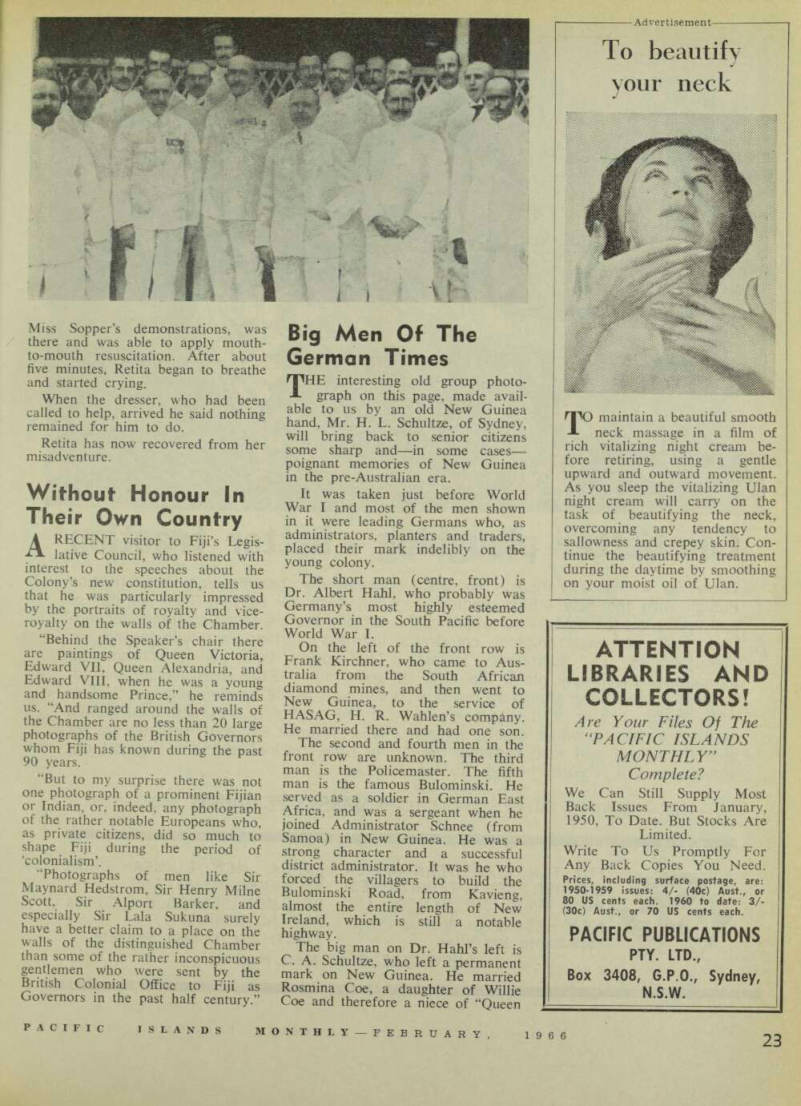
THE interesting old group photo graph on this page, made avail able to us by an old New Guinea hand, Mr. H. L. Schultze, of Sydney, will bring back to senior citizens some sharp and—in some cases— poignant memories of New Guinea in the pre-Australian era.
It was taken just before World War I and most of the men shown in it were leading Germans who, as administrators, planters and traders, placed their mark indelibly on the young colony.
The short man (centre, front) is Dr. Albert Hahl, who probably was Germany’s most highly esteemed Governor in the South Pacific before World War I.
On the left of the front row is Frank Kirchner, who came to Aus tralia from the South African diamond mines, and then went to New Guinea, to the service of HASAG, H. R. Wahlen’s company.
He married there and had one son.
The second and fourth men in the front row are unknown. The third man is the Policemaster. The fifth man is the famous Bulominski. He served as a soldier in German East Africa, and was a sergeant when he joined Administrator Schnee (from Samoa) in New Guinea. He was a strong character and a successful district administrator. It was he who forced the villagers to build the Bulominski Road, from Kavieng, almost the entire length of New Ireland, which is still a notable highway.
The big man on Dr. Hahl’s left is C. A. Schultze, who left a permanent mark on New Guinea. He married Rosmina Coe, a daughter of Willie Coe and therefore a niece of “Queen
Emma”. Their descendants now live in New Guinea, Australia and Germany.
Schultze went originally to Aus tralia to buy remounts for the Indian Army. He became a jackeroo in Queensland, and, with his brother, a Doctor of Philology, established the Bundaberg Grammar School.
He then joined the German NG Administration as Government Sec retary, and he died there.
Captain Macco, on Schultze’s left, married a Miss Hoergren, niece of “Queen Emma”, and settled in NG.
On his left (end of front row) is Ernest Beck.
The only identified man in the back row has an unusual history. He is second from the right—Father Constantini, who was a missionary priest at Vunapope when he in herited a large family estate in Northern Italy. He abandoned mis sionary work and settled on a large plantation, Logogan, in New Ireland.
Even in that age of hospitality his house parties were famous—for he took pride in the fact that when he entertained guests there was a New Ireland beauty at every pillow!
One day he cut his hand when opening a bottle of beer and died of tetanus. He left his fortune to the Vunapope Mission.
Call For Beryl
Brings Results
WHEN we published a collection of Pacific Islands Monthly stories last year in book form as PlM’s Pacific, we had no success in contacting one contributor, Beryl Sawyer, a former PIM correspondent in Tahiti.
We said as much in a biographical note, and the mystery of Beryl’s current whereabouts seemed to in trigue Mr, Ross Campbell, the Syd ney Daily Telegraph’s ace book re viewer. His review of PlM’s Pacific began: “Beryl, where art thou?”
Had Beryl sunk without trace into suburbia? he asked in his review. Or had she, perhaps, found a mate on some remote island where they dance on the edge of the sand by the light of the moon?
Where we failed, Ross Campbell’s review did the trick. Beryl has now revealed herself. She is in Honolulu, which, if not a coral strand any longer, is not suburbia, either.
She tells us that the Daily Tele graph review was shown to her at a Christmas party given by a former MGM secretary who met her in Tahiti during the filming of Mutiny on the Bounty.
When her third visa to French
Polynesia expired in 1962 and she was threatened with expulsion, a 19year-old Tahitian presented himself at the Hotel Aimeo on Moorea, where she was working, and asked her to marry him so that she might “stay in Tahiti forever”.
She was sorely tempted, she says, but she knew that if she did not reenter United States territory by June, 1962, she would lose her immigration status and the right to live and work in the United States that she had had Sln £ e 1953.
Before she returned to Honolulu she decided to have one last look around the South Pacific to see if she could line up some future jobs there, “I could see myself another Bloody Mary, with a small hotel on some remote atoll,” she says.
But it was not to be. In Tonga all she got was a “big, brown noncommittal smile”. In Western Samoa she was given, with some reluctance, a visa for one week. She wasn’t greatly attracted to American Samoa.
Back in Honolulu she worked for a year as publicity director for the Honolulu Symphony Orchestra. At present she is executive secretary for the Hawaii League of Nursing, handling public relations, publications, recruitment and so forth.
At weekends, as a member of the 1 rail and Mountain Club, she explores and climbs the mountains and valleys of Oahu and neighbouring islands, with the 13,000 ft summit of Mauna Loa on the 1966 agenda. i, a , soun<^s ver y vigorous and healthy, but a long, long way from beautiful Moorea.
... g
Aaiss Nxoty S Dock
p ti
■Ot Ing Z.Dto I Ittic
VTOTHING makes Fiji artist Mary -kl Edwell-Burke more annoyed than the suggestion that she is eccentric.
“i am an individualist,” she de dares,” but an eccentric, never!”
Evidence of the world famous artist’s individuality—if that’s what it is—is her present mode of living, In a home-made tent, cut from canvas with nail scissors, and sewn together on a tiny hand machine that is 112 years old, she has taken up residence along the Queen’s Road, half-way between Suva and Deuba on Viti Levu.
Miss Edwell-Burke has definite reasons for settling in such an out of-the-way spot, The views—among the most pano ramie in Fiji—have appealed to her, and she hopes that her site will one day became a South Seas art and cultural centre where artists and students will meet, and where Islands arts will be fostered, exhibited and taught.
“I envisage the centre set in five acres of beautiful tropical gardens,” says Miss Edwell-Burke, who had experience as a professional gardener for a large Sydney retail store during the war.
“Bures will be set around the
• Artist Mary Edwell Burke in her prize winning costume during Suva's 1965 Hibiscus Festival. The artist was dressed to represent Adi Ni Cakau, (Lady of the Reef).
gardens, and in these artists will work on various South Seas crafts.”
Planned in the site also are a big bure for display purposes and an open air meke theatre.
Previously known as Mary Edwards in her native Australia, Miss Edwell- Burke’s work has won wide acclaim, and is exhibited in many Australian art galleries, private collections and private homes.
Seven of her paintings have been bought by the Trustees of the National Art Gallery, NSW. She was awarded the Coronation Medal for her contribution to art.
Miss Edwell-Burke began studying painting and sculpture after being taken from school at the age of 13i years on the advice of a noted art teacher.
After four years she went to France to continue studies, and at 19 became one of the youngest artists to exhibit at the Paris Salon.
From France she went to Tahiti, and, at the request of the French Governor, held an exhibition of her work there. This was the first art exhibition ever held in Tahiti, and was shown by request in the British Consulate.
An inveterate wanderer who dis likes travelling but enjoys seeing new places and new faces, she has sketched and painted throughout her wanderings around the world, and her works have been snapped up by art lovers everywhere.
Shoehorn Needed
Now, her paintings are to be found all over the world, in national galleries, and large and small private collections. She regrets she has not kept records of her works for she has no idea how many she has done and where most of them could be found.
Her main fame has been gained for her paintings of South Seas people and portraits of celebrities.
Recently “Miss Mary”, as she is known by Islanders throughout the Pacific, spent some months in Canada.
Though she found the climate stark, and she yearned for the warmth of the tropics, her work was given an excellent reception and her undeniable ability widely acknowledged.
“This is my 23rd return to Fiji,” she said on her return. “I have been going to and from the country for 33 years.”
In the tent she has made for her self, the artist has crammed a cane lounge with a home-made mattress of voivoi, her clothes, personal belong ings and all her artist’s impedimenta.
Outside the tent is her water catch
ment—a large, plastic strip suspended between trees.
That the living quarters may be rough could be some people’s opinion, but not Miss Mary’s. She scoffs at the idea, yet she smiles quietly and admits: “I practically need a shoe horn to get inside.”
Memorial Neglected
Judge Ralph T. Gore, Now
retired from the P-NG Supreme Court, was telling us recently that he had been most concerned to learn that the memorial in Port Moresby to the late Sir Hubert Murray, Lieutenant-Governor of Papua for many years, was in a neglected con dition, and that the surrounding garden had been much damaged by vandals.
The memorial was erected between old Port Moresby and Konedobu some 20 years after Sir Hubert’s death with money raised by public subscription.
Judge Gore, who now lives at Southport, Queensland, told us that when he left Port Moresby on retire ment a couple of years ago, there was £1,200 in a trust account, which he understood was to be used for the maintenance of the memorial and the garden it stands in.
Pros And Cons Of
Pidgin AGAIN
T'HE apparently slight difference of A opinion over Pidgin English in January between Mr. H. L. Niall, Speaker of the P-NG House of Assembly, and Dr. John Gunther, Acting Administrator, got more publicity in Australia than the two men probably expected.
The newspaper, The Australian, even editorialised to the extent of telling Mr. Niall that he would be serving the Territory and its people better if he devoted all his energies to fostering an effective and fully understood Parliament, Mr. Niall supported the use of Pidgin at the opening of a seminar on English that is being held for members of the House of Assembly, He is reported to have said that, when the Territory is independent, Pidgin could become the national language.
This, of course, is not official policy and Dr. Gunther hopped in to say that it was just a useful bridge to the use of straight English; and to warn that mission schools which did not teach the latter would not be subsidised.
There probably was no need for either the warning or the publicity.
The pros and cons of Pidgin versus English have been raked over so
frequently that they now become tedious.
It would be politically inept for Australia to sponsor the official use of Pidgin; nor, in the higher echelons of emerging P-NG, is it likely to endure in its present form longer than the next decade.
But to eradicate it from the village level will be next to impossible. It is too easy for native people to learn and, as Mr. Niall no doubt meant to suggest, it could become the basis of a local patois.
It is coincidental that Speaker Niall is a fluent speaker of Pidgin while Dr. Gunther does not speak it—at least, not in public.
But it is true that Pidgin has had a boost since the new House of Assembly came into being. A large section of the native members can speak nothing else, and non-native members who can address the House in it more often than not. Such is the use of Pidgin now in the House that anyone who cannot understand it misses about 50 per cent, of what is going on.
Despite this use. Pidgin is not a good parliamentary language not because it is Pidgin, but because it is based on the syntax of a Melanesian language in which cir cumlocutions abound.